
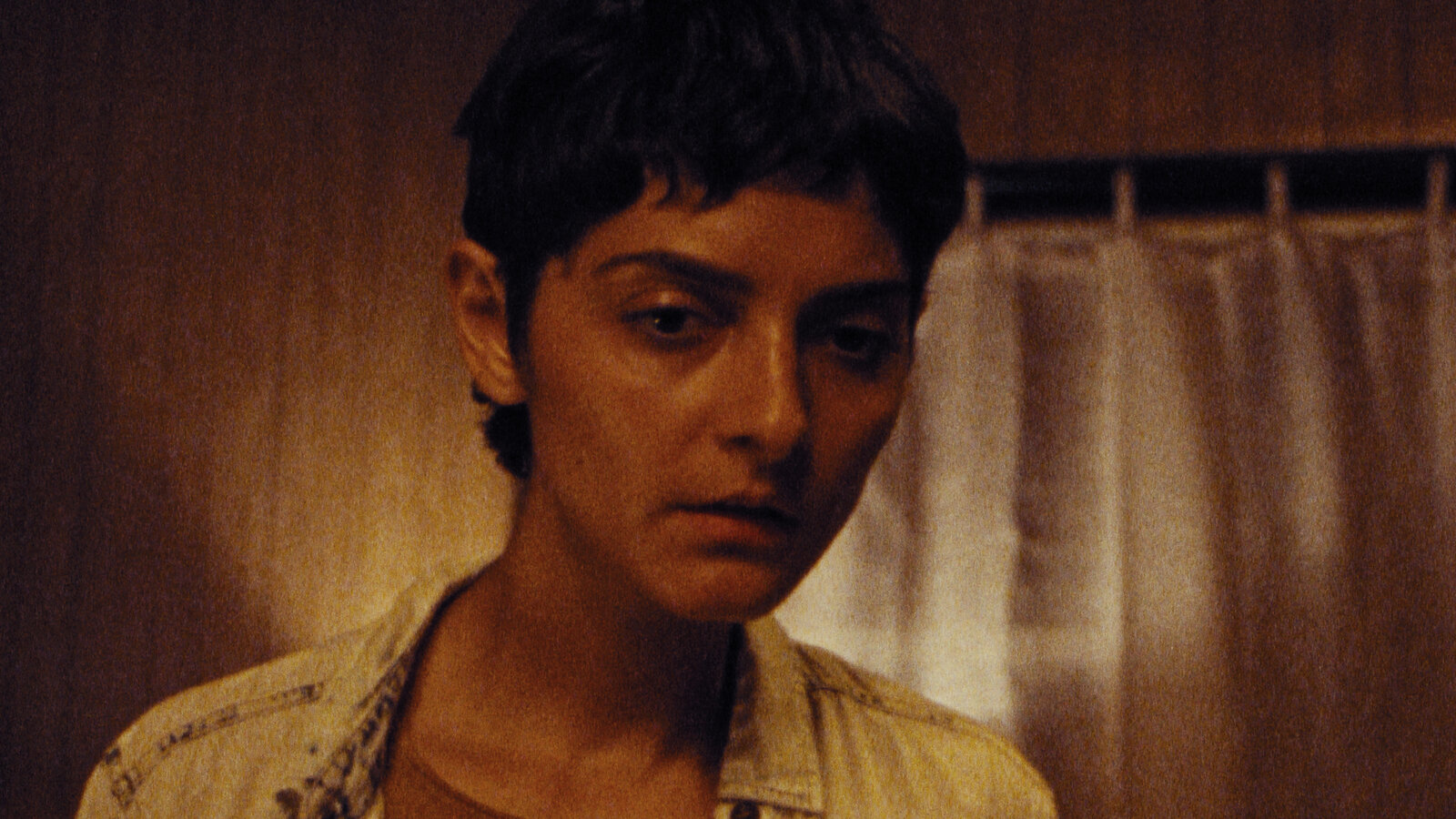
If you’ve just stumbled out of Gazer and your brain feels like it’s been chopped into fragments and scattered across a dreamscape of grief, memory lapses, and ominous cassette tapes—you are not alone. This film is deliberately slippery, a noir-tinged psychological horror that thrives on disorientation. And while that makes for a tense, unnerving watch, it also means you’re probably here because you want answers—or at least some sort of a roadmap through the fog.

Fair warning: from here on out we’re diving straight into spoiler territory. We’ll be unpacking the major beats, questioning what’s real versus imagined, and trying to piece together what director Ryan Guiterman might be saying with all the ambiguity. So, if you haven’t seen the film yet, bookmark this page and come back later. For everyone else: let’s wade into the mystery of Gazer and see if we can make some sense of it.
The Ambiguously Confusing Movie Gazer Walkthrough
Frankie Rhodes (Ariella Mastroianni) is a single mother suffering from dyschronometria, a rare neurological disorder that makes it hard for her to perceive time reliably; she experiences blackouts and gaps in her memory. To complicate an already complicated situation, she is also dealing with grief from her husband’s suicide. And worse, she’s fighting for custody of her daughter, who is being cared for by her mother-in-law. Right? So, Frankie is in a bit of a bad way… she’s down chips, and she’s got a pair of twos. Check that, she has a 2 and 3. She’s got nothing.
Interestingly, Frankie attempts to master her dyschronometria in the cleverest of ways… she uses cassette tapes (wait, remind me what cassette tapes are again?) as tools to help anchor herself to reality — recordings of herself that instruct her to stay focused, to notice what she’s seeing, etc. And it’s this setup that really wants to see this as a Christopher Nolan remake. No, no, not Inception Nolan… Following Nolan, or even Memento Nolan. This would be a banger of an indie film if Nolan got his hands on this screenplay. (Never mind that 90% of it would be in Black and White, and going backwards.)
Unfortunately, the tapes aren’t enough and Frankie loses her job as a gas station attendant. And it was 100% due to her inability to stay in the here and now… she’s constantly zoning out, and losing herself. Eventually she runs into Claire (played by Renee Gagner), a mysterious woman that she recognizes from a window across the street. She would regularly zone out and watch her and was concerned for what she was seeing there. But at a grief support group for people that have lost loved ones to suicide, the two meet.
Claire claims her brother Henry (a police officer) is abusive, and has taken her car keys, and she wants to escape from his control. Shockingly, Claire offers Frankie $3,000 to sneak into the apartment, retrieve the car keys, and drop off the car at a remote location. See the part above about how Frankie is desperate for money – she’s losing her daughter in a court struggle – and all her bills are back due. So yeah, Frankie, desperate for money, takes the job.
Here’s the problem though… Frankie – the one with dyschronometria – is the WORST possible person you could ask to do a job like this. You want me to break into this bank vault, steal all the cash, haul it all to a van in the parking garage, and make a hasty getaway? Wait, why am I standing in this parking garage with all this money again? How long have I been staring at this street lamp? Right, because of Frankie’s inability to stay present in time, she has a horrible time knowing or tracking the passage of time. She blacks out, she loses passages of time, she is terribly unreliable for the simplest of tasks, let alone stealing back this woman’s car.
So, as a viewer, it is very difficult to track the comings and goings of this film. (Which is why I enjoyed it so much, honestly.) Regardless, as she attempts to get the car back something alarming happens. She uncovers evidence (or she is completely tripping, or being played!) that something awful might have happened… probably a significant crime. Suddenly we the viewer begin to wonder if we really know what is actually going on here. Or, maybe, things really do have some sort of sinister dark roots here. We don’t know.
Claire disappears without paying the $3,000. Frankie is unable to find her again. And now the police are involved and standing at her front door. When the authorities check out the car, there was a dead body in the trunk. And Frankie? Her fingerprints are all over the steering wheel. Which, makes her a prime suspect in a murder case that she knows absolutely nothing about.
How is Frankie involved in all of this and Claire’s disappearance? Did she have a role, or was she a hapless victim to someone else’s crime? We are left wondering what Frankie’s complete role was in everything that happened. We see that as the movie ties up, we have no idea what is actually happening… we have been given the world’s worst and most unreliable narrator, and it’s difficult to know what to think about all of this. Not only is Frankie dealing with external threats from the police, the brother, and Claire herself, but also the threats are internal – Frankie’s deteriorating certainty about reality, time, and her own ability to hold it all together.
Gazer Unpacked and Explained
What makes Gazer so unnerving isn’t just the strange job Frankie takes on, or the shadowy figures that may, or may not, be manipulating her. It’s the fact that the audience is forced to share her fractured perspective. Frankie’s dyschronometria keeps her from experiencing time in a consistent way—she slips in and out of moments, finds herself lost in blackouts, and struggles to piece together what has really happened. The film never gives us a stable anchor, which means we’re just as unmoored as she is. In that way, the uncertainty isn’t just a plot device—it’s an empathy machine, pulling us into Frankie’s disorientation until we’re living inside her experience of confusion and fear.
And at the heart of that disorientation is grief. Frankie isn’t only grappling with the loss of her husband to suicide; she’s also losing her grip on the ordinary flow of life. Time itself is slipping away from her, leaving gaps that can’t be recovered, much like the moments she’s lost with her daughter, her husband, and her former stability. The film blurs these layers of loss—the personal, the relational, and the temporal—until they become indistinguishable. In the end, Gazer isn’t just a story about a sinister plot or an unreliable narrator. It’s about the way grief dismantles your sense of reality, how mourning can stretch and distort time, and how the fear of forgetting can be just as haunting as the fear of what actually happened.
It wouldn’t have shocked me if Guiterman had included one more scene of Frankie, hand on a fuel pump, staring off into the distance as the film ends. This entire film could have been one of Frankie’s attempts to cope… to latch on to something in order to make sense of the passage of time. When Claire and Frankie first start talking, Frankie tells Claire that she stares in order to “come up with scenarios and imagining what their lives are like, it helps me keep from zoning out.” The entire movie could have been one long zone out for all we know. But more importantly than the details of what actually happened, and what didn’t, is that we have experienced the chaos of what it means to be Frankie. We have been immersed in that world for just a little bit. A world of grief, loss, and regret.
Edited by: CY