The Long Walk Movie recommendation discussion – and why this totally overlooked movie is worth your time. If you’re into tense, stripped-down survival dramas that fuse psychological pressure with biting social commentary, The Long Walk is a must-watch. Think of films like Circle, The Hunger Games, The Platform, The Cube, The Exam or Battle Royale – movies that take a high-concept premise and then zoom in on human choices, endurance, and morality under extreme duress. That’s the terrain here, and while it’s based on one of Stephen King’s earliest novels (written as Richard Bachman), the movie updates and streamlines the story for a contemporary audience without losing its bleak, haunting heart. It’s grippingly brutal, and oddly beautiful—definitely worth a watch before you dive into the spoilers below.

Spoiler Warning
From here on out, this post will contain full spoilers for the movie The Long Walk which is currently in theaters. If you haven’t seen it yet, I highly recommend stopping here, buying a ticket at the theater… watching said film, and then coming back to read the walk-through and discussion. You’ve been sufficiently warned. Or, I guess if you’ve read the book – that will do as well. The two are basically the same entity. I may even do a write-up talking about the differences between the movie and the book – but trust me, they are almost identical.
The Long Walk – Movie Full Walkthrough
The movie opens with a stark and unsettling setup. Should remind you of that short story we all read in Middle School/High School called The Lottery. You know… the one where the winner of the lottery is executed? Yeah, that’s the sort of terrain we are dealing with here. Basically, we are in a dystopian America that is ruled by an authoritarian regime. And this regime puts on an annual event called The Long Walk.
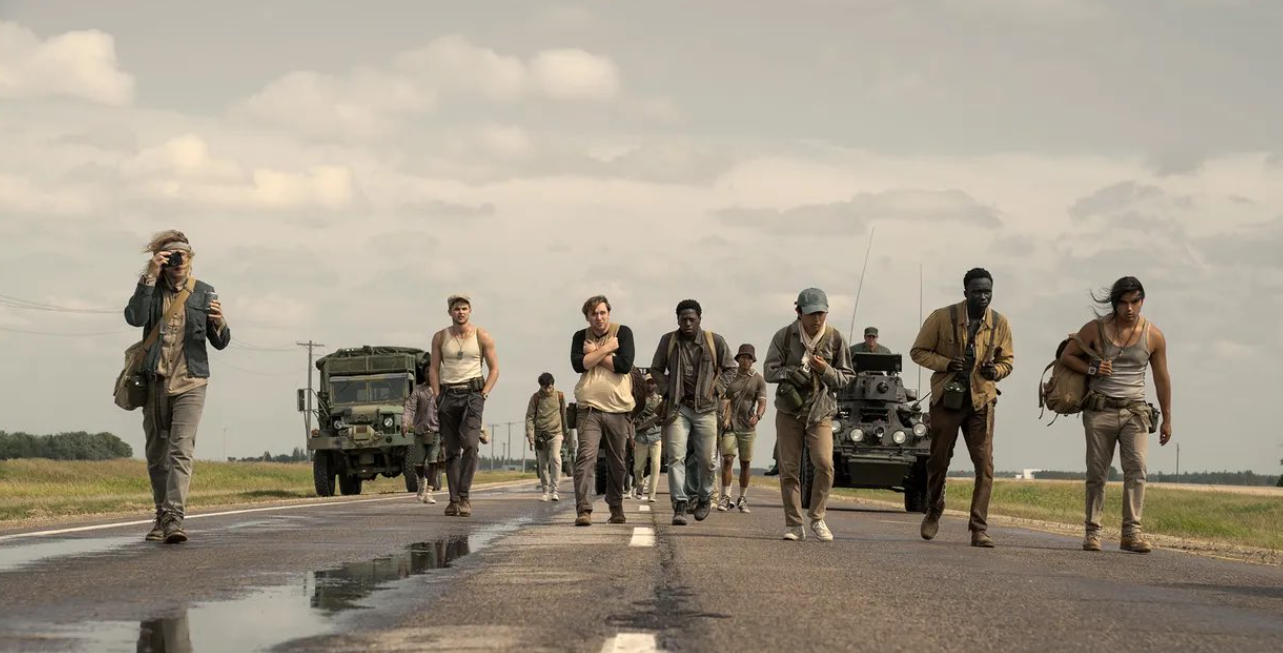
What is the Long Walk? Well, fifty teenage boys (a reduced number from the novel’s hundred) are chosen—some volunteering, some coerced—to compete in a walking contest with life-or-death stakes. The rules are simple, but savage: they must walk continuously at a minimum pace of three miles per hour. Fall below that speed, stop too long, or break the rules three times, and you’re shot on the spot by armed soldiers accompanying the march. Only the final walker survives, winning untold riches and “The Prize”—essentially whatever he wishes for.
Our central character is Ray Garraty (played with raw intensity by Cooper Hoffman who we fell in love with in Licorice Pizza). He is a young man carrying the shadow of his father’s death, who was killed at the hands of the Major (played by Mark Hamill – whom you’ve never seen in absolutely anything before… definitely), the ruthless overseer of The Walk. Garraty isn’t just walking to win—he’s walking with a simmering desire for vengeance and some sense of meaning in a world that feels hopelessly broken. Early on, he befriends Peter McVries (DYNAMICALLY and brilliantly played by David Jonsson – I will be watching whatever movie he stars in next), one of the few walkers with both charisma and compassion. Their relationship quickly becomes the emotional spine of the story.
As the guys begin the march, what could feel repetitive instead becomes hypnotic. The story is a group of guys walking. I could envision this as a brilliant Broadway play – I see a turntable on the stage like Les Mis? Are you seeing this with me? It would work. Anyway, this is a dialogue rich experience where each character reveals layers of themselves in fragments—small conversations about life, regrets, and fears, interspersed with sudden, shocking deaths when one of them falters. Some walkers break down mentally, others physically; each collapse reinforces the brutal machinery of the event.
But almost all of the camera’s focus remains on Garraty and McVries. Their conversations veer between gallows humor, despair, and genuine warmth, making the audience root for them even as we know only one can win. (Or will they find a loophole like Katniss did in the Hunger Games?) As The Walk grinds on, the physical toll becomes more surreal. The boys suffer blistered feet, sunstroke, dehydration, and hallucinations. The outside world cheers and jeers as they pass through towns, turning their suffering into a grotesque spectacle. It’s impossible not to see the echoes of modern reality TV culture, or the broader critique of how society feeds off the exploitation of youth.
Eventually, the group dwindles until only Garraty, McVries, and Stebbins remain. Stebbins, we learn, is the illegitimate son of The Major. This is why he knows so much about The Long Walk and the inner details of how it all works. But ultimately, he collapses, and isn’t even acknowledged by The Major and we see this as a cruel, despotic kind of reminder of how horrible this Authoritarian Regime really is. With Stebbins gone, Garraty, utterly broken, makes the decision to step aside and allow McVries to win. It’s an act of sacrifice, born out of their bond.
McVries is declared the winner, but rather than bask in victory, he immediately uses his Prize to exact revenge. He asks as his wish, for a carbine. And with the carbine he shoots the Major dead. He demands revenge for his good friend, Garraty. He demands revenge for all the countless other young men that had been walked to their deaths in years previous. Getting his wish, and striking the Major down in brutal fashion, it leaves McVries to walk away alone, hollow yet oddly free. The closing image lingers—a single survivor on an empty road, his future uncertain, but carrying with him both the cost and meaning of the journey.
Explain the Ending of The Long Walk Again Please??
So, I went through that kind of quickly. In the film version of The Long Walk, Garraty and McVries become friends. Better than that, they become something of soul mates – David and Jonathan if you will. And Garraty confides that the only reason he chose to come on the long walk was so that he could avenge his murdered father who stood by his principles. McVries, a beautiful soul, tries to convince Garraty that you need to live for each moment, savor every second that you have, and not live a life for revenge.
As the duo are walking among the cheering throng, and McVries saves Garraty one last time, it’s Garraty that sort of tricks McVries, and pushes him on without him. It’s Garraty that sacrifices his life for his friend. It’s an act of selflessness that crosses all bounds. Which, in turn, is why McVries takes on the debt of revenge on his friend’s behalf. He chooses to kill The Major for Garraty’s father. It’s a selfless act created out of their bond of friendship.
My Thoughts on The Long Walk
What struck me most about this film was how the film transformed a bleak survival contest into something profoundly human. Yes, the premise is horrifying – a death march as entertainment ala Dark Mirror – but what emerges isn’t just brutality for shock’s sake. It’s a story about connection, and the desperate search to find meaning when life seems reduced to its barest and inane mechanics.
For me, The Long Walk was a heartfelt deep dive into wringing the marrow out of life. Every conversation, every stumble forward, every shared joke in the shadow of death emphasized the urgency of savoring each moment we have. Garraty’s sacrifice, and McVries’s final hollow victory, drove home the truth that life is fleeting, and what matters is not simply surviving, but choosing how we carry ourselves through suffering and uncertainty.
The acting across the board was superb, but the bond between the two leads was the film’s emotional anchor. Their dialogue was alive—by turns biting, warm, and reflective. It’s rare to see a script this sharp; the words felt lived-in, not like exposition. Without gorgeous acting like this the film would have wrung hollow – like a cheap off Broadway play. The cinematography reinforced the monotony of the road, the relentless pace of the Walk, but always with small shifts in light and setting that mirrored the walkers’ deterioration.
Some viewers may prefer the book’s ambiguous ending, where Garraty is left hallucinating a dark figure beckoning him onward. But I appreciated the film’s bolder, more direct close. By allowing McVries to win and then immediately forcing him to confront the hollowness of victory, the movie gave us both catharsis and tragedy. It’s not a happy ending, but it’s one that lingers, echoing the themes of endurance, sacrifice, and the fragility of human connection.
In short: The Long Walk isn’t just a dystopian survival tale. It’s a reminder of the finite road we’re all walking, and the importance of how we spend that time. If you’re ready for a film that will both unsettle you, and make you reflect on your own life, this one’s a journey worth taking.
Edited by: CY