
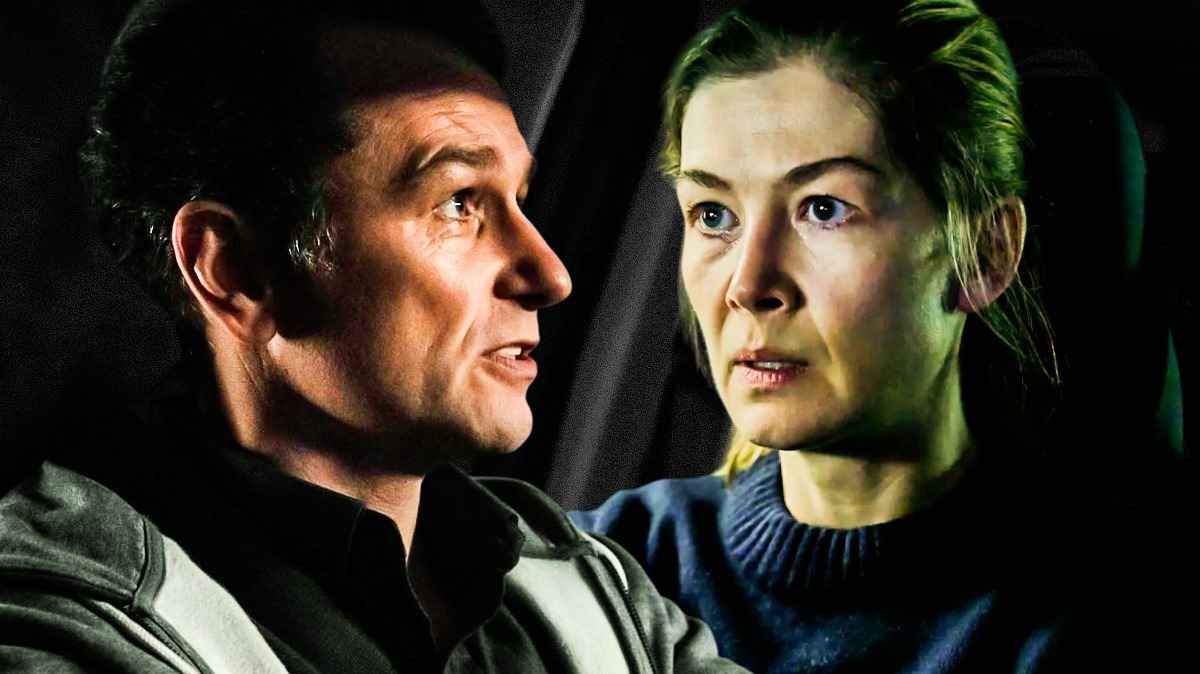
Have you seen the movie The Guilty or maybe the movie Calibre? Hallow Road’s similarly to those two films (and many other I could mention now, but I will control myself) starts off with a simple premise. And then, as the moral ambiguity piles up, things do go further and further afield. And there seems to be no exit ramp all along the way. Sort of a blender on low, ultimately going to eleven and you know that there is absolutely no way you are going to be able to stop it. Yes. That is what Hallow Road is like. But that ending… it was so confusing?!?? Maybe we can manage to try and make sense of it… shall we?
Hallow Road, directed by Babak Anvari and penned by debut writer William Gillies, delivers a perfectly tuned, extraordinarily well crafted, nerve-shredding, emotional drive into chaos and fear. But I must warn you – if you haven’t seen it yet, please watch the trailer, then find a way to watch it post haste, for the rest of this post will be an in-depth, deep dive into the inner workings of this fantastic little film.

Alright – from here on, expect plot revelations and thematic insights. Stop reading now if you haven’t watched the film and want to experience firsthand its full impact .
A Hallow Road Deep Dive
Late one night, home scenes whisper of unrest: broken glass on the table, food left untouched. Maddie (Rosamund Pike), a paramedic, and her husband Frank (Matthew Rhys) are awakened by their daughter Alice’s frantic voice. After a heated discussion and drive-off following a family conflict, 18-year-old Alice has apparently struck a pedestrian deep in the woods along the eerie Hallow Road.
As the situation begins to unfold, we start to learn more about Alice, Maddie – her mother, and Frank, the father. In a similar format to the brilliant movie Locke, almost all of the action of this movie is told within the claustrophobic confines of their car. Maddie and Frank rush into the gloom, careening forward in a desperate attempt to help their daughter who is 40 minutes away. But every second counts and the stress of the situation just continues spiraling upwards as the darkness from the night just gets thicker and thicker. Maddie begins channeling her medical instincts to guide Alice through emergency first-aid over the phone.
Inside the vehicle, the couple wrestles with their marriage and parenting styles. Maddie’s clinical composure meets Frank’s frantic shock. Their interplay examines guilt, fear, and extremes parents will cross to protect their child, who, they have just learned is pregnant??!? Just one more stressors in a long pile of incoming chaos. As they drive, subtle shifts twist the film’s grounded setup into surprising territory. Supernatural undertones seep in, rendering the journey increasingly disorienting and suspenseful.
As the film stretches into its second act, what started as a tense family drama takes a turn for the surreal and terrifying. We slowly peel back the layers of Alice’s panic: she wasn’t just rattled from the accident. She’s been high on MDMA for hours, and she admits she never even called an ambulance like she first claimed. The weight of her lies begins suffocating Maddie and Frank in the car, where the argument that triggered this whole nightmare—Alice’s unexpected pregnancy—spills back into focus. This isn’t just about a hit-and-run anymore; it’s about fractured trust, guilt, and three people running out of time to fix what’s broken.
But then the script slides into something much darker. Alice notices headlights approaching. A stranger—a woman whose voice drips with false kindness—steps into the story. What starts as a hopeful interlude, it quickly twists into a dark and predatory encounter. This woman’s interrogation grows sharper as Alice begins to beg her to leave. The tension here is unbearable. Maddie tries to intervene through the phone, but the mysterious woman doesn’t budge. And then, in a chilling escalation, Alice reports that the dead girl’s face is changing. Reality itself begins to fray.
From here, Hallow Road leans hard into horror. Alice is trapped in a nightmarish encounter as the woman smashes into her car, alternately threatening and gaslighting her. Soon, she and her husband claim the girl Alice hit is alive and in their care. But the way they speak—their insistence that they’ve “taken in girls before” and that Alice will now become theirs—pushes the film into folklore nightmare territory. It’s as though Maddie and Frank are on the phone with cultist predators operating just beyond the veil of the ordinary world.
The Ending of Hallow Road Investigated
The climax of the Hallow Road is devastating. Maddie and Frank finally arrive at Alice’s location – the Hallow Road… only to find Alice’s car abandoned, a corpse in the undergrowth that looks like their daughter. Frank identifies the body as Alice, while Maddie refuses to believe it—until Alice herself picks up the phone again. Except now she’s in the hands of the mysterious woman and her husband, who calmly tell her parents she’s theirs now. The final gut punch? Detectives in the morning brush it all away, chalking Alice’s death up to a mundane accident and dismissing Maddie and Frank’s calls with their daughter as nothing more than grief-fueled hallucinations.
It’s this ambiguity that makes Hallow Road so disturbing. Did Maddie and Frank really lose their daughter in a banal accident, inventing the supernatural to cope with guilt? Or did Alice truly fall into the clutches of something malevolent lurking off the road? The movie never answers, and that’s exactly why it lingers like a nightmare.
Two Ways of Viewing the Ending of Hallow Road
It seems that there’s two possible ways of interpreting the movie Hallow Road. Either you take everything at face-value and the other couple killed Alice. Or, the more likely ending I think is that Alice was dead all along and the parents hallucinated the calls as a manifestation of their guilt and grief.
Option 1 – Alice was Killed Via the Initial Impact
The ending strongly supports the detectives’ explanation that Alice was simply killed in the initial accident and that everything Maddie and Frank experienced afterward was a manifestation of grief, guilt, and trauma. The “corpse” discovered at the roadside looks like Alice, and the police treat the scene as a straightforward fatal hit-and-run with no trace of a second vehicle or suspicious couple. Maddie and Frank’s frantic calls could be read as psychological coping mechanisms, their desperate minds conjuring Alice’s voice and the sinister woman as projections of their deepest fears — Maddie’s guilt over leaving her paramedic career in disgrace, Frank’s frantic desire to take responsibility, and their shared conflict over Alice’s pregnancy. In this light, the supernatural or cultist couple is never real at all, but rather an eerie, symbolic device representing the parents’ inability to face the truth: that Alice’s death was random, meaningless, and tragically ordinary.
Option 2 – Alice was Killed by the Other Couple
The film seems to lean heavily toward the interpretation that Alice was abducted and killed by the mysterious couple rather than simply being struck by another car. The most compelling evidence is that both Maddie and Frank hear the woman directly over the phone—her interrogations, her taunts, and even her declaration that she and her husband have “corrected many girls before.” This shared auditory experience rules out the idea of a purely grief-induced hallucination. The woman also demonstrates knowledge of Alice’s pregnancy, something no passing motorist could have guessed, which reinforces the sense that she was deliberately targeting Alice rather than just stumbling onto the scene. Finally, Alice herself continues to respond to her parents after the supposed discovery of her “corpse,” which makes the detectives’ dismissal feel more like a cold rationalization than truth. Taken together, these details suggest the supernatural or cult-like couple is real, and that Alice fell victim to them on Hallow Road.
Option 3 – The Callers Were Fae or Shapeshifters
Thanks to Matt and Lisa in the comments for our Option #3! Another way of reading this ending is through a folkloric or supernatural lens: that the people on the phone weren’t ordinary humans at all, but beings like fae or shapeshifters who prey on travelers. Hallow Road, with its name alone, suggests an older, liminal place where the veil between worlds is thin. The eerie woman and her partner may not be kidnappers in the traditional sense, but otherworldly entities who lure and torment the living. Their cryptic statements about having “corrected many girls before” echo myths of fae who abduct the young, replace them with changelings, or punish them for hidden transgressions. The fact that Alice’s voice persists after her supposed death fits this reading as well: perhaps what Maddie and Frank were hearing wasn’t their daughter at all, but an imitation spun to deepen their despair. In this interpretation, the couple—and the road itself—represent a supernatural trap, a predatory trick of something inhuman that thrives on confusion, grief, and loss.
One More Detail!
You may or may not have ascertained that Matthew Rhys, who played Alice’s father, and Rosamund Pike, who played Alice’s mother, also voiced the voices of the interloping couple talking to Alice in person, but who could only be heard on the phone. That decision functions as a kind of meta-clue baked into the film itself. But does it tip the scales and for which side of the argument does it support?
If you lean towards Option 1 – “Alice died in the car accident” reading, then the fact that Pike and Rhys supply both sets of voices is a huge confirmation: the entire “phone call” sequence is really just Maddie and Frank projecting their own inner turmoil into the void. They are, in a literal sense, talking to themselves — externalizing their grief, their regrets, and their desperate attempts to rewrite the past. The casting choice reinforces the detectives’ explanation that what we’re witnessing is not reality but trauma-born hallucination.
But if you support Option 2, the “Alice Killed by the Other Couple” reading, the doubling of voices can be seen as a surrealistic device meant to destabilize the viewer. It makes the “other couple” feel uncannily familiar, as if they are distorted reflections of Maddie and Frank — almost a supernatural mirroring of the parents’ own guilt and failures coming back to consume their daughter. In this lens, the villains are real, but their voices being acted by Pike and Rhys underlines the idea that the danger to Alice ultimately springs from her own parents’ choices.
And if you support Option 3, the “The Callers Were Fae” reading, the casting detail slots neatly into the mythological framework. If the callers are otherworldly beings, their use of Maddie and Frank’s own voices becomes part of the trickster-like deception that defines fae folklore. In many traditions, such creatures are said to mimic familiar voices to lure victims deeper into danger or to sow doubt and discord among loved ones. By having Pike and Rhys voice both the grieving parents and the sinister couple, the film literalizes this act of mimicry: the entities on Hallow Road don’t just torment Alice, they weaponize the parents’ identities against her. This interpretation reframes the uncanny doubling not as hallucination or symbolic guilt, but as evidence of predatory, shape-shifting forces feeding on the family’s grief.
My Own Thoughts on Hallow Road
Personally, I side with the theory that Alice was the one that died during the initial impact and there are a number of reasons why. The first and most obvious reason is the movie’s production choices to center solely on the couple who spend almost the entirety of the movie stranded in the dark, hurtling forward, car. The second is in the choice to use Pike and Rhys voices for the couple on the phone. It’s a dual manifestation of their own fears and stressors that are playing out on their imagined conversations with their daughter. They are both desperate to intervene, they are both desperate to save her, and they are completely helpless in spite of themselves.
But that could just be my own stage of life, and my own predispositions speaking. Which speaks to why this movie is such a fun movie to engage with. It really depends on where you are coming from as to how the ending hits and what you think could have actually happened. Regardless of how you see the ending playing out – Hallow Road is a masterclass in minimalist, tension-fueled storytelling. Anchored by powerhouse performances and a razor-sharp script, it morphs from a grounded dread into a chilling, genre-bending experience. This is not a movie for those who are seeking straightforward realism, but it is definitely unforgettable for viewers willing to embrace its unsettling and open-ended descent.
Edited by: CY