
Okay. Let’s do this. I’m about to start what might be the dumbest – or possibly the most rewarding thing I attempt on this site in the last 10 years. I am going to be watching every single film on the IMDB Top 250 list and writing about each one. I am going to do them in a random order… it’s going to be completely out of my control. In a word – fullon random. Why? Great question… I thought it might be more interesting to be surprised by the next film in a list of 250? Maybe that is a dumb idea? But it’s the idea I’ll be executing all the same. But yeah, that’s the hope – that it’ll spice it up a little bit.
But let me put it to you this way – if I had had my own druthers, I definitely would not have picked this movie as my launch movie to watch. I mean, seriously, how many of you have even heard of this film “Andei Rublev”? I have spent my whole life watching films of all sorts, and never once have I ever heard of this thing. But you know what? The randomizer doesn’t negotiate. That’s the whole appeal of doing it this way.
Alright. As I mentioned before – the random number gods chose Andrei Rublev (1966), currently sitting at IMDB rank #123 out of 250. This is craziness. Of all the films we could have watched, I got handed a three hour Soviet biopic about a 15th century Russian icon painter… I’m heading off to hit play now. I’ll see you on the other side!

Alright – woah. What a movie. If you are interested in following me down this journey, you can find this film on the Criterion Channel, and available through Kanopy if your library card gets you in the door (it should, this is exactly the kind of film Kanopy exists for). But personally? I just watched it directly on Youtube with a good ad blocker. Worked great.
The film itself – Andrei Rublev
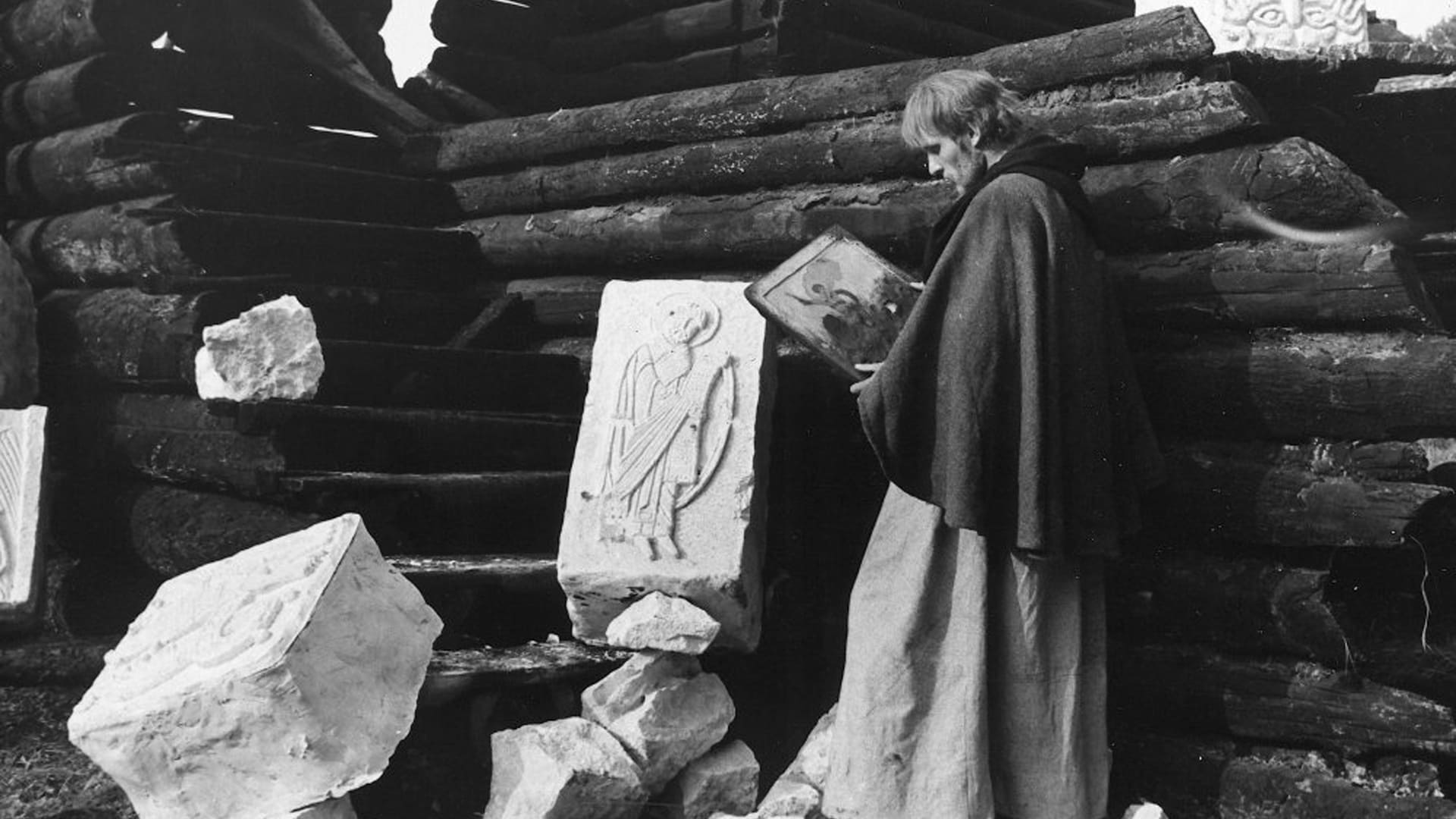
Andrei Rublev is Andrei Tarkovsky’s second feature, made in 1966, and it is loosely, almost defiantly loosely, based on the life of the real Andrei Rublev, a Russian Orthodox monk and icon painter working in the early 1400s whose surviving work (most famously his icon of the Holy Trinity) is still considered the high water mark of Russian religious art. But please understand this – Tarkovsky doesn’t give you a biopic in any conventional sense. There’s no birth to death arc, no tidy narration of a great man’s rise. Instead the film unfolds as a series of episodes, essentially standalone vignettes strung across roughly two decades, each one dropping Rublev into a different moment of crisis, spiritual, political, or personal, set against the brutal backdrop of medieval Russia under constant threat from Tatar raiders and torn apart by its own princes. And they are disorienting at best.
After finishing watching the film, I was so confused, and so baffled, I had to go find out more about how this film got made and how we even got here and the production history is almost as fascinating as the film itself. Tarkovsky shot it under the title The Passion According to Andrei, and what came out the other end ran into a wall of Soviet censorship almost immediately. The state didn’t love a film that argued, essentially, that faith and artistic vision are inseparable, made at a moment when the official Soviet position was atheism as policy. Authorities objected to its violence, its historical framing, its refusal to spell out a tidy ideological message. The film sat on a shelf, discussed at the level of Mosfilm and Goskino and reportedly even the Communist Party’s Central Committee, while Tarkovsky refused to make the cuts they wanted. It got a single screening for film professionals in Moscow in 1966 and then largely vanished from view.
Cannes tried to get it in 1967 as part of a Soviet retrospective and was told the film wasn’t finished. They tried again in 1969, and this time Soviet officials relented enough to let it screen, once, out of competition, at four in the morning on the festival’s final day. It still won the FIPRESCI prize from the international critics. The film wasn’t shown inside the Soviet Union itself until the autumn of 1971, and when Columbia Pictures brought it to the US in 1973 they trimmed it for commercial release. Today, depending on which cut you land on, you’re watching anywhere from roughly three hours to three and a half.
Structurally, the film moves through episodes with titles like The Jester, The Feast, The Passion According to Andrei, The Raid, and The Silence, tracking Rublev leaving the monastery to paint, wrestling with a commission for a Last Judgment fresco he can’t bring himself to render as pure fire and damnation, witnessing (and participating in, through an act of violence) a Tatar raid on Vladimir, and eventually taking a vow of silence as penance. The whole thing is bookended and interrupted by a hot air balloon flight that has nothing and everything to do with the rest of the film, depending who you ask. This is not a director interested in holding your hand, and it wasn’t designed to be.
My reaction to Andrei Rublev
My very first thought, only thirty minutes into the film, was that I had embarked on an impossible enterprise. I was going to watch two hundred fifty movies, and we begin with Andrei Rublev? An inscrutable Russian retelling of an iconographer I’d never heard of, in a language and a historical moment I have basically zero grounding in? Are you kidding me?
Practically speaking, as I’ve already stated, the film really is a pile of vignettes loosely tracing his life, his art, and it’s all told at the intersection of an extremely complicated stretch of Russian history. It became obvious pretty fast that Tarkovsky wasn’t going to walk me through any of it. What he seemed intent on arguing, as far as I could tell, was the importance of Christianity to Russia writ large, or maybe more precisely, the importance of faith to the artist specifically. That out of belief comes all art, and anything worth making at all.
Where this gets genuinely complicated is that Tarkovsky was making this argument during an era when the Soviet state’s official position was atheism, full stop. So you’ve got this movie essentially narrating a skipping record of Rublev’s life. Young Rublev leaving the monastery to find work as a painter in Moscow. Him having a real problem with a commission for a Last Judgment painting, a story he clearly doesn’t want to tell the way he’s being asked to tell it. Then a raiding party of Tatars tears through, which forces Rublev into an act of self defense that leaves someone dead, after which he takes a vow of silence as penance.
It is difficult to grok. Primarily because this is the story of a 1500s religious icon painter, told through narrative choices muddled by history and culture, on top of which the whole thing is filtered through a serious Russian director with a real bone to pick against the Russian atheist state and its campaign against faith of any kind. That’s a lot of layers stacked on top of each other before you even get to the images themselves.
But ultimately, I was genuinely intrigued by some of the philosophical and theological arguments running through the film’s three hour runtime. The discussions of the religious state’s materialism were extremely interesting to sit with. There seemed to be real arguments happening on screen about true faith, about selling out, about the desire to stay true to your belief even in the face of overwhelming temptation or a culture built on sin. I literally understood maybe ten percent of what was happening in this movie, and I enjoyed struggling with it. The multiple lenses at work, especially the way Tarkovsky plays with time dilation across the episodes, complicated the viewing experience while also making the underlying themes and stories more interesting to chew on afterward.
Should you watch Andrei Rublev?
If you’re the kind of viewer who needs a plot to hold your hand, or who wants your history lesson delivered in digestible chunks with clear signposting, skip this one, or at least don’t start here. Andrei Rublev asks you to sit in confusion for long stretches and trust that the confusion is doing something. If you’re the kind of person who gets energized by wrestling with a film rather than deflated by it, if you like your movies to argue with you about faith and art and complicity rather than reassure you, this is worth the three hours. Go in knowing you won’t catch everything on a first viewing. I didn’t. I’m not sure that’s a flaw in how I watched it so much as the point of how it was made.
Current Status of the IMDB Challenge
That’s one down, two hundred forty nine to go. If the randomizer decided to open with a three hour black and white Soviet meditation on faith and censorship, I genuinely have no idea what it’s got waiting in the wings next. And if you are interested in finding all the films in this series, you’ll be able to do so through this link. Come back in a couple days to see what it throws at us next. I’m going to try and get to these posts every couple of days? Hopefully not more than a week. But who knows. This is a hill to climb, and I’m here for it. This movie blew my mind, and I’m better for it, knowing that it exists in the world.