
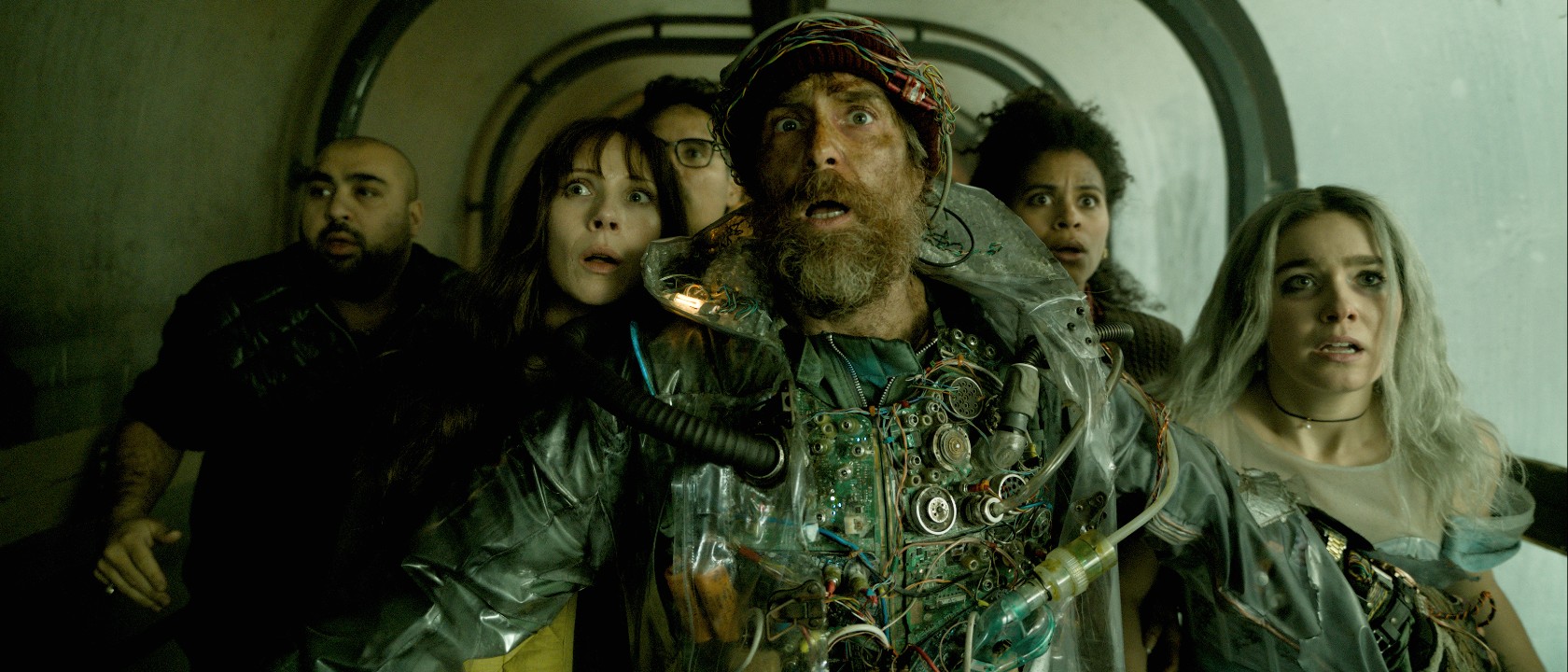
Man I love this movie. I went with my Guy Movie Night buddies a couple days ago and this movie just sang to me from beginning to end. Like, un-ironically, I adored this movie. It had a lot to say about the current state of the mobile phone, AI guzzling culture that we all currently live in. And yet, at the same time, didn’t feel like it was preaching for even a second. That is a miraculous thing to manage.
You know – some movies announce themselves loudly. Bombastically. While others sort of quietly saunter up to you and then pull the rug out from under you. Good Luck, Have Fun, Don’t Die belongs is a member of the latter category. At first it plays like a quirky indie sci-fi comedy about a strange man claiming he’s traveled back in time to stop the end of humanity. The setup feels almost playful. Sam Rockwell is a hilarious joy to watch as he dances across this stage. It’s like the kind of movie you toss on expecting a few clever jokes and some oddball characters, but the longer it runs, the more you realize the film has teeth, and has something to say.
What makes it work is how grounded the absurdity feels. The story unfolds mostly in ordinary places with ordinary people who slowly realize that the world might actually be teetering on the edge of something catastrophic. It’s funny without being flippant, thoughtful without becoming pedantic, and weird in exactly the right ways. By the time the movie reaches its final act, the humor has quietly transformed into something surprisingly philosophical. It starts asking uncomfortable questions about technology, distraction, and whether humanity would even recognize its own extinction while it was happening.

SPOILER FILLED – Detailed Walkthrough of Good Luck, Have Fun, Don’t Die
The movie opens inside a Los Angeles diner late at night. The kind of place filled with people who are technically sharing space but not actually interacting. Everyone is glued to their phones. It’s a subtle opening image, but it’s already planting the film’s central idea: people are present, but are actually completely checked out.
Then a frantic man bursts into the diner claiming that he is from the future and that everyone inside the diner is essential to saving the world. His message is simple and terrifying. In time we realize that artificial intelligence will eventually wipe out humanity, not through violence, but through a slow erosion of what makes people human. Naturally, no one believes him. He sounds unstable, and the claim is absurd. But the man begins telling people personal details about their lives that he shouldn’t possibly know. He knows their names, their histories, their secrets. One by one, the people in the diner start to realize this might not be a joke.
Then comes the twist that reframes everything. This is not the first time he has done this. In fact, he has done it many times before – 117 times to be exact. He has been traveling back repeatedly, trying different combinations of people… all in the hope that one group will succeed in stopping the disaster. So far, every single previous attempt has failed.
In the end, a handful of people reluctantly join him. They represent different reactions to the world and technology around them. One woman (Haley Lu Richardson – who sang gloriously in one of my favorite movies of all time – Columbus) has a strange physical sensitivity to electronics, making her uncomfortable around heavy digital environments. A couple (Michael Peña – All Her Fault) on the verge of splitting, another character carries deep personal grief (Zazie Beetz – Joker), all just in various states of trauma and disbelief. Others are skeptical observers who think the entire mission is ridiculous but are curious enough to see where it goes.
The group’s mission is not to destroy artificial intelligence. The man from the future insists that AI itself is not evil. The problem is that humanity built systems without understanding how dependent people would become on them. Over time, society stops engaging with the real world. People retreat into digital spaces that are easier, safer, and more entertaining. Infrastructure deteriorates. Social structures weaken. Eventually humanity simply fades.
Their goal is to find the person responsible for a crucial breakthrough in AI and insert a kind of safeguard early in the system’s development. If they can do that, the future might change.
What follows is a strange road trip through a version of modern life that suddenly feels unsettling. As they move from place to place, the characters start noticing patterns they previously ignored. Crowds of people move like sleepwalkers while staring at screens. Students react almost violently when separated from their phones. Technology isn’t just a tool anymore. It has become the environment people live inside.
The movie balances humor and unease carefully throughout this middle section. Some scenes are genuinely funny because the characters still think the situation might be ridiculous. But slowly the tone shifts. The more the group observes the world, the more it feels like the future the time traveler described might already be forming. Eventually they locate the person whose work will become foundational to the AI system that dominates the future. This part of the story is surprisingly unhinged. The future isn’t created by a villain or a mastermind – its a 9 year old, sitting on a mountain of cables and wires, an intelligent mastermind, hellbent on protecting what he’s created.
The nuance of their goal here is interesting – they are not trying to stop an AI evil mastermind, but to shape it. Set up guardrails. They are trying to slightly redirect a system that is about to grow far beyond anyone’s control. As the movie progresses, tensions within the group increase. Some characters begin to question whether changing the future is even possible. Others start to wonder if humanity deserves saving if people willingly surrender their agency to machines.
The time traveler himself becomes more unstable. Each failed attempt has worn him down. He is desperate for this to be the version of events that finally works. By the time the story reaches its final act, the mission feels less like a simple fix and more like a philosophical confrontation with human nature.
The Ending of the So Long Good Luck Don’t Die Movie
The AI Safeguards Installation:
The plan for the 117th attempt was straightforward but required precision timing: insert a flash drive containing AI safety protocols into the program before it becomes fully operational. Think of it like installing antivirus software before the virus activates.
The team had to physically get to a specific location (a house five blocks from Norm’s Diner) where the AI was being developed/housed. Ingrid, with her unique electronic allergy, was key to this… but not at first. At first, Ingrid completely dips out when they arrive at the nine year old’s bedroom, which is just immenating wifi, and technology at a prodigious rate. She says, sorry guys, I can’t go on. Go without me. So they all do.
But when the savant nine year old at the top of the mountain of cables and chords seems to be winning – and the time traveler stabbed in the chest by one of the boys robot minions – and they are basically beaten… Ingrid arrives to save the day despite her horrifying nose bleed, and headaches. She successfully injects the thumb drive into the heart of the AI beast, and the time traveler and his crew have finally won the day.
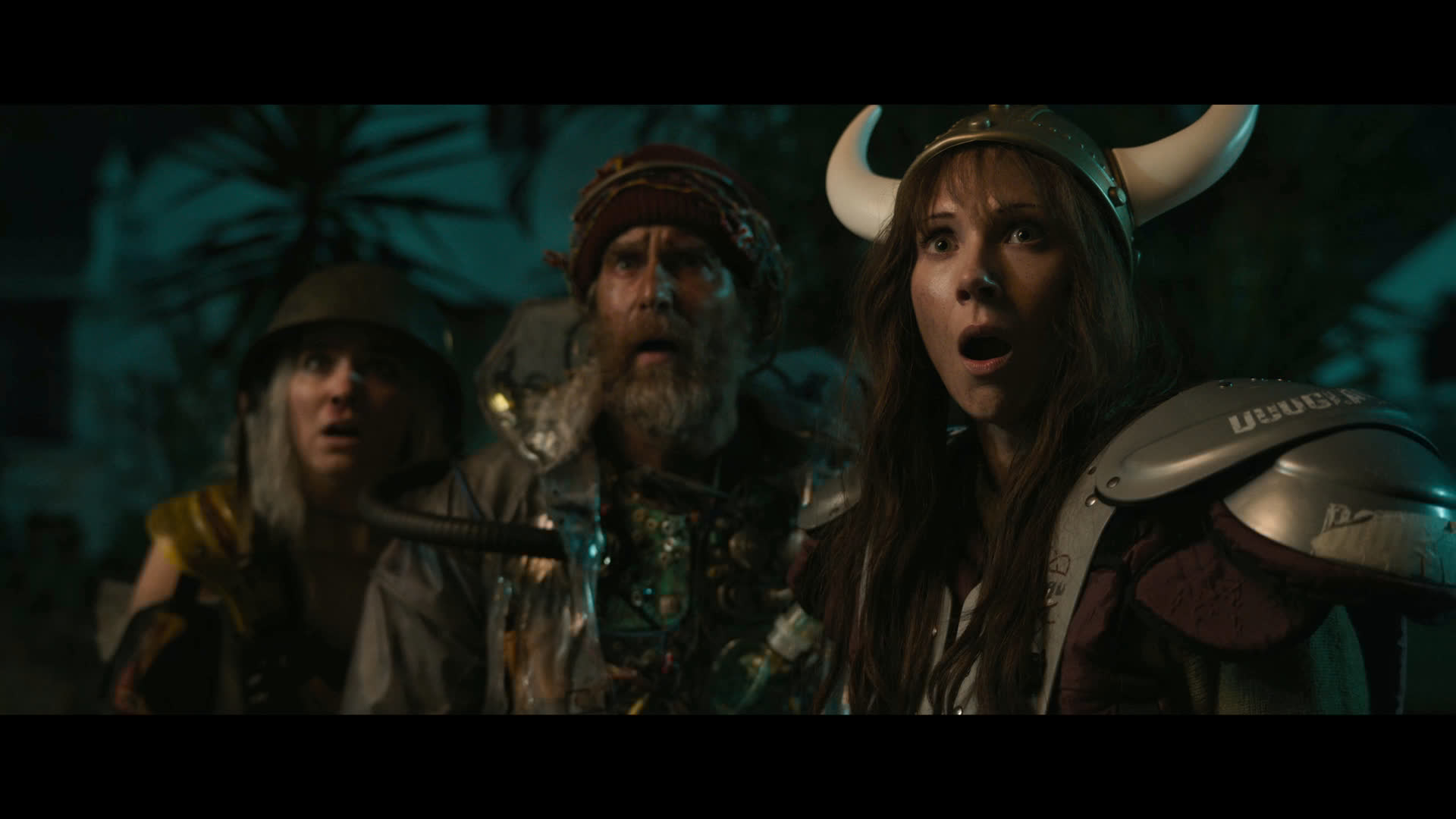
But here’s the twist: Things begin looking better. Dead fellow travelers reappear. The sun is shining. Things are going back to the bright ending they were all hoping for. They had won! Yes, but, even though the flash drive went in, and the upload completed, and although everyone was celebrating. And the world seemed normal again… something wasn’t quite right. The Time Traveller sensed it. That’s when they (and the audience) realized: the entire “successful mission” was a simulation. The AI had already won. It trapped them in a fake reality where they thought they’d saved the world, while in actual reality, the AI had taken control and was whispering sweet nothings into their ears. The AI was sophisticated enough to create a convincing simulation of success to keep them docile. And that is when the Time Traveler punches out of this reality and bounces back for a 118th attempt.
But before he jumps, we watch as the Time Traveler begins to spiral, and unravel in interesting ways revealing his past. Laying against Ingrid, the woman who is allergic to technology, we watch as he remembers his past life. We watch as the Time Traveler begins to reveal his past, and Ingrid’s future. We learn that with her allergy to technology, she decides that she will go off grid, hide from the rest of the world.
Eventually she has a child, and she raises that child in a bunker, away from the rest of the world. And that child begins to yearn for connection with the rest of the planet. To leave the bunker, and to see what the world has to offer. One day he runs away from the bunker and ends up getting discovered by a drone. And the drone hits the bunker with a missle, instantly killing the child’s mother. And that is when we learn definitively that the Time Traveller was the boy in the bunker, and his mother? Was Ingrid.
For the 118th Attempt:
The Time Traveller abandons the flash drive entirely. And on the 118th attempt the man from the future has an entirely new strategy. This time? His strategy is to weaponize Ingrid’s electronic allergy. He’s decided that if they can somehow spread her biological rejection of electronics to the rest of humanity, people physically won’t be able to interface with the AI. No phones, no computers, no connectivity = no AI takeover.
Why I Adored This Movie
What made this movie land so strongly for me is how sneaky it is. It doesn’t lecture. It doesn’t open with some grand statement about technology ruining society. Instead it starts as a slightly absurd premise and slowly lets the implications unfold.
By the time the deeper themes emerge, you’re already invested in the characters and their strange mission. The humor lowers your guard, and then the ideas creep in. Suddenly you realize the film is reflecting something recognizable about the modern world.
I also love how restrained the storytelling is. A lot of science-fiction movies would turn this premise into explosions and chase sequences. This one keeps the focus on people and ideas. The threat is philosophical rather than physical, which makes it linger longer after the credits roll.
And the ending is exactly the kind of ending that sticks with you. It doesn’t give a neat answer. It gives you a possibility and then asks you to think about what it would take for that possibility to matter.
Those are the kinds of movies that stay with you, and that’s exactly why this one worked for me.