
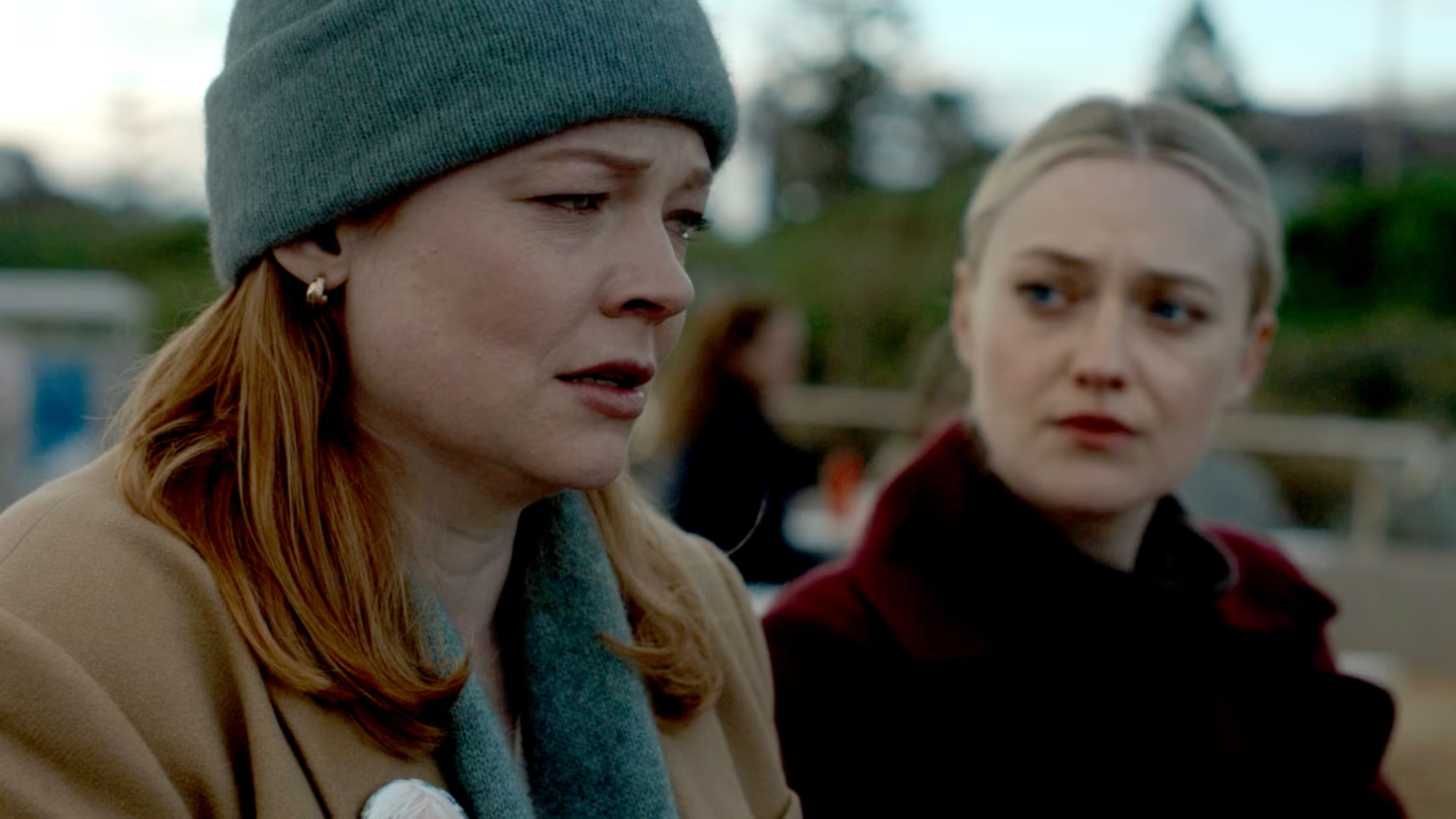
Stop whatever you’re doing. Cancel your plans. Call in sick to work. I don’t care. You need to watch All Her Fault on Peacock immediately, and I’m about to tell you exactly why without spoiling a single delicious twist.
Look, I’m not prone to hyperbole. Okay, maybe a little bit. But, I’ve watched enough streaming thrillers to know that most of them promise everything and deliver lukewarm mediocrity with a side of predictable reveals. But All Her Fault? This eight-episode limited series is what happens when you assemble a cast so phenomenally talented that they could read the phone book and make you weep, then hand them a script packed with more twists than a pretzel factory, and wrap the whole thing up with a bow so satisfying you’ll want to immediately rewatch it just to catch everything you missed.
The Setup: Every Parent’s Nightmare
The premise is deceptively simple: Marissa Irvine goes to pick up her five-year-old son Milo from his first playdate at a new friend’s house. When she arrives at the address, the woman who answers has never heard of Milo, has never heard of Marissa, and certainly never scheduled a playdate. The number that texted her the address? Disconnected. Her son? Gone.
That’s it. That’s all you need to know about the plot, because everything else is spoiler territory, and I refuse to rob you of the experience of watching this thing unspool like the world’s most beautifully constructed nightmare.
Sarah Snook: The Master Class Continues
If you thought Sarah Snook peaked as Shiv Roy in Succession—and what a peak that was—think again. Her performance as Marissa Irvine is nothing short of extraordinary. Snook has this remarkable ability to play overwhelming emotion without ever crossing into melodrama or phoniness. Every tremor in her voice feels earned. Every tear feels real. Every moment of rage, desperation, guilt, and determination registers with the kind of authenticity that makes you forget you’re watching someone act.
What’s particularly impressive is how Snook navigates the impossible tightrope this role demands. Marissa has to be simultaneously sympathetic and suspicious, vulnerable and calculating, loving and potentially dangerous. In lesser hands, this character would be a mess of contradictions. Snook makes her feel like a real person caught in an impossible situation, making choices that make sense in the moment even when they don’t make sense at all.
Watch her face during the interrogation scenes. Watch how she processes information in real-time. Watch how she interacts with her husband, with Jenny, with the police. This is Emmy-level work, and if there’s any justice in the television universe, she’ll be collecting hardware for it.
Dakota Fanning: The Revelation
Dakota Fanning as Jenny Kaminski is the kind of performance that makes you sit up and go, “Wait, when did she become this good?” Not that Fanning hasn’t always been talented—she was getting SAG nominations at age seven—but this role showcases a depth and maturity that’s genuinely stunning.
Jenny is Marissa’s unlikely ally, another mom at the private school whose nanny becomes the prime suspect in Milo’s disappearance. On paper, she’s everything a modern parent should be: accomplished, organized, put-together. In Fanning’s hands, she becomes something infinitely more complex and human. The friendship between Marissa and Jenny—forged in a bathroom at a school social over shared exhaustion—becomes the emotional backbone of the entire series, and it works because Fanning and Snook have chemistry that feels lived-in and real.
What Fanning does brilliantly is show you all the layers of judgment, guilt, and invisible labor that Jenny carries without ever making it feel like a performance about Those Things. She’s not giving you a thesis statement; she’s giving you a person. And when the twists come—and oh, do they come—Fanning navigates them with such skill that you believe every single beat.
Abby Elliott: The Surprise MVP
Here’s something I wasn’t expecting: Abby Elliott, best known for her SNL work and her Golden Globe-nominated turn in The Bear, absolutely crushes it as Lia, Peter’s recovering addict sister. This is a tricky role that could easily veer into caricature, but Elliott plays Lia with such raw vulnerability and barely-concealed damage that every scene she’s in crackles with tension.
The sibling dynamics between Lia, Peter, and their younger brother Brian are some of the most fascinating elements of the show, and Elliott is the lynchpin that makes it all work. She has to make you believe in this codependent connection forged in childhood trauma while also keeping you guessing about exactly what role she plays in everything that’s unfolding. It’s a performance that deserves way more attention than it’s getting.
The Twists: A Masterclass in Structure
I can’t tell you what happens. I won’t tell you what happens. But I will tell you this: All Her Fault has more genuine surprises than any thriller I’ve watched in years, and they all feel earned rather than cheap. This isn’t a show that withholds information to create artificial mystery. This is a show that gives you pieces of the puzzle and lets you try to assemble them, then reveals you’ve been looking at the picture upside down the entire time.
Critics have described the show as having multiple endings—reveals stacked on reveals in a way that could feel exhausting but instead feels exhilarating. The true identity revelations. The family dysfunction. The role of various characters that I absolutely cannot name. You won’t see most of it coming, and the stuff you do see coming? The show knows you see it coming and uses that against you.
What makes the twists work isn’t just that they’re surprising—it’s that they recontextualize everything you’ve watched. You’ll finish an episode and immediately want to go back and watch earlier scenes with your new knowledge. The rewatch value here is off the charts.
The Bow: Sticking the Landing
Here’s the thing about mystery thrillers: they almost never stick the landing. They promise the world and deliver a soggy ending that makes you want to throw your remote at the TV. Not All Her Fault. This show wraps up its eight episodes with such precision and satisfaction that you’ll sit there after the finale thinking, “That’s how you do it.”
The ending doesn’t cheat. It doesn’t pull some deus ex machina nonsense. It doesn’t leave you hanging with an ambiguous non-conclusion designed to generate discussion but actually just generates frustration. It resolves the mystery, addresses the emotional arcs, and does it all in a way that feels both surprising and inevitable—the mark of truly great storytelling.
Multiple viewers have described needing to pick their jaw up off the floor after the final episodes. That’s not exaggeration. The last three episodes in particular are an absolute roller coaster that will have you yelling at your screen, texting your friends, and possibly questioning everything you thought you knew about human nature.
Why It Works: The Supporting Cast and the Craft
I haven’t even mentioned Michael Peña as Detective Alcaras, whose methodical investigation anchors the show in something real even as the plot gets increasingly wild. Or Sophia Lillis as the nanny Carrie, who makes every scene she’s in feel unsettling in ways both obvious and subtle.
The show was created by Megan Gallagher and based on Andrea Mara’s bestselling novel, and what Gallagher does brilliantly is balance the domestic thriller elements with genuine social commentary about maternal guilt, paternal arrogance, and the invisible labor women perform. But—and this is crucial—she never lets the commentary overwhelm the story. The themes are there for those who want to engage with them, but first and foremost, this is a propulsive mystery that will keep you glued to your screen.
The direction is sharp, the pacing is tight, and the whole thing is shot through with this atmosphere of creeping dread that makes even mundane scenes feel loaded with menace. This is prestige television in the best sense—it looks expensive, feels cinematic, and never wastes a frame.
The Verdict: Just Watch It
All eight episodes dropped on Peacock on November 6th, which means you can binge the entire thing right now without waiting. And you should. Not next week. Not when you have time. Now.
This is the kind of show that reminds you why we still get excited about television. It’s smart without being pretentious. It’s twisty without being gimmicky. It’s acted with such skill that you forget these are performances at all. And it wraps up in a way that will leave you satisfied but still thinking about it days later.
Sarah Snook, Dakota Fanning, and Abby Elliott deliver brilliant work. The supporting cast is uniformly excellent. The mystery is genuinely mysterious. The twists actually twist. And the ending—that beautiful, satisfying, perfectly-constructed ending—pays off everything that came before it.
I started watching All Her Fault with cautious optimism and finished it wanting to immediately call everyone I know and force them to watch it so we could discuss every single detail. That’s the mark of something special.
So do yourself a favor. Clear your schedule. Stock up on snacks. And prepare to be absolutely riveted for eight hours straight. You’ll thank me when you get to the ending.
Trust me. You’ll know exactly what I mean when you get there.