
MASSIVE SPOILER WARNING: This article contains complete spoilers for Bugonia, including the full plot and that absolutely devastating ending. If you haven’t seen it yet, stop reading immediately. I mean it. Come back after you’ve watched.
Okay, here’s the thing about Yorgos Lanthimos—he’s not exactly known for making feel-good cinema. But Bugonia, his latest collaboration with Emma Stone and Jesse Plemons, might be the bleakest, most nihilistic film he’s ever made. And I’m including The Killing of a Sacred Deer and The Lobster in that assessment.
This is a movie about conspiracy theories, corporate greed, class warfare, and whether humanity deserves to exist or not. It’s a kidnapping thriller that morphs into science fiction that lands somewhere between pitch-black comedy and existential horror. And that ending? That ending will sit with you for days, whether you think it’s brilliant or complete bullshit.
Let me walk you through exactly what happens in this absolutely bonkers film, and then we’ll talk about why that twist at the end – the one you think shouldn’t work at all – actually lands like a freight train.
The Setup: Bees, Conspiracies, and Jennifer Aniston Masks
Bugonia opens with Teddy Gatz (Jesse Plemons) and his neurodivergent cousin Don (Aidan Delbis) tending to their beehives while Teddy explains his conspiracy theories. Teddy is convinced he’s made a breakthrough discovery about what’s destroying society, the environment, and specifically his bee colonies. And it all comes down to aliens.
Not just any aliens—Andromedans. A species from the Andromeda galaxy that has infiltrated humanity, disguised themselves as ordinary people, and is systematically destroying Earth through Colony Collapse Disorder (the real phenomenon where worker bees mysteriously abandon their queen, dooming the entire colony). Teddy believes the Andromedans are doing this deliberately as part of their plan to wipe out humanity.
And he knows exactly who one of these aliens is: Michelle Fuller (Emma Stone), the high-powered CEO of Auxolith, a massive pharmaceutical conglomerate.
The film intercuts between Teddy and Don preparing for their mission—stretching, performing high steps, and chemically castrating themselves (yes, really)—with Michelle going through her morning routine in her sterile, modernist home. She exercises. She takes vitamins. She’s the picture of corporate perfection.
Then Teddy and Don, wearing filthy silver tracksuits and cheap Jennifer Aniston masks (I cannot emphasize enough how absurd and perfect this detail is), ambush Michelle outside her home. Despite putting up a hell of a fight, Michelle is eventually subdued when Teddy sticks a needle in her leg.
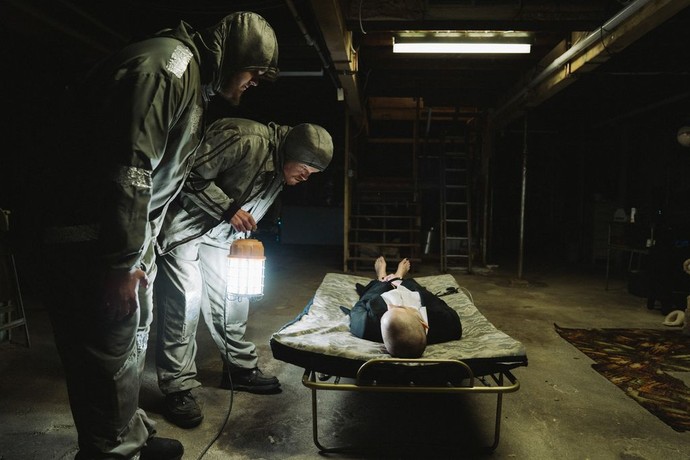
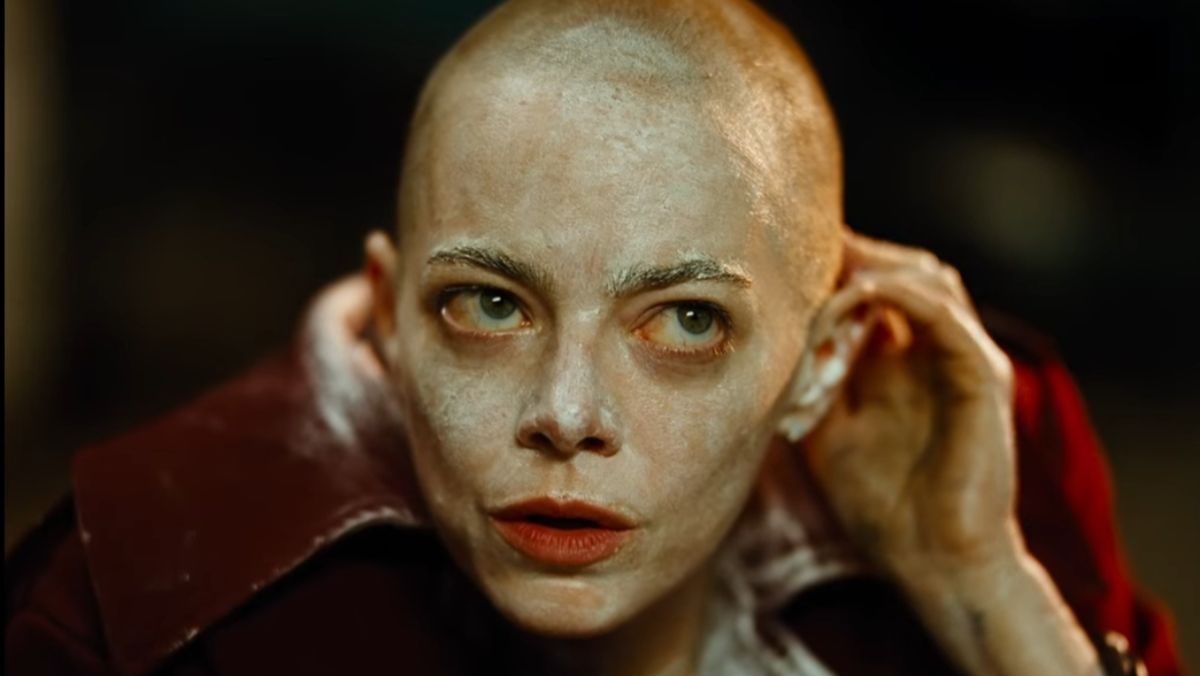
She wakes up in their basement. Her head has been shaved (Teddy believes Andromedans communicate through their hair). Her body is covered in antihistamine cream (supposedly to suppress any alien powers she might possess). Oh, and she’s chained to a bed.
And for the next 90 minutes, we’re going to watch what happens when a delusional conspiracy theorist tortures a woman he believes is an extraterrestrial bent on destroying humanity. (Reminds me of the brilliant closed box film 10×10, which you should check out if you get the chance.)
Except he’s not delusional. And she is an alien. But we’ll get to that.
The Interrogation: Three Days Until the Lunar Eclipse
Teddy explains to Michelle that she has three days until the lunar eclipse. That’s when the Andromedan mothership will be able to enter Earth’s atmosphere undetected. He wants her to arrange a meeting with the Andromedan emperor so that he and Don can negotiate humanity’s survival.
Michelle, throughout all of this, does exactly what you’d expect a kidnapped CEO to do: she tries to talk her way out. She uses logic, reason, corporate negotiation tactics. She tries to convince Teddy he’s mentally ill. She even tries going along with his delusion, “confessing” to being an alien just to get him to release her.
Nothing works.
What’s fascinating about these early scenes is how Lanthimos shoots them. Teddy is always filmed from a low angle, making him look powerful, imposing. Michelle is shot from above, making her look small, vulnerable. It’s the visual language of persecution—specifically recalling Renée Jeanne Falconetti in The Passion of Joan of Arc.
Why frame a big pharma CEO as a martyr? Because Lanthimos is already asking the central question of the film: who’s really the monster here?
As we learn through black-and-white flashbacks, Teddy has very personal reasons for targeting Michelle beyond his conspiracy theories. Years ago, his mother Sandy (Alicia Silverstone) participated in a clinical drug trial run by Auxolith. The experimental drug left her in a vegetative coma. Michelle covered up the incident by paying for Sandy’s long-term care and giving Teddy a settlement, but no amount of money can give Teddy his mother back.
So yes, Teddy believes in aliens. But he also has legitimate grievances against Michelle Fuller and the company she represents. This isn’t just paranoid delusion—there’s real trauma underneath.
Meanwhile, Don is starting to have doubts. He’s uncomfortable with the torture. He feels guilty watching Michelle suffer through their basement camera. The “mission” that seemed so clear when Teddy was explaining it to him feels increasingly wrong.
The Dinner Party from Hell
Two days before the eclipse, Teddy performs another round of interrogation. This time, he hooks Michelle up to electroshock torture devices. Even Don is horrified by this. Michelle is clearly in agony—but she also displays a remarkably high tolerance for pain. Teddy interprets this as evidence that she’s not just an Andromedan, but high-ranking Andromedan royalty.
His solution? Treat her like royalty.
Teddy and Don take Michelle upstairs for dinner. They’ve raided an attic box for old suits to wear. They serve spaghetti and grocery-store wine. The whole thing is simultaneously absurd and deeply uncomfortable—watching Teddy try to observe royal etiquette while keeping his captive at the table.
Michelle, for her part, starts engaging with Teddy’s theories. Not to mock him, but to actually debate the substance of his complaints. Teddy rants about corporate domination, about workers being treated like drones in a hive, about the destruction of the environment and communities. Michelle counters that her company genuinely tries to do good through medical research, that progress requires difficult choices.
Both of them make compelling points. Both of them follow these points with absolutely insane rationalizations.
The dinner devolves into a physical fight. Michelle stabs Teddy with a fork. And then Deputy Sheriff Casey (Stavros Halkias) shows up at the door investigating Michelle’s disappearance.
Everything Falls Apart
Don takes Michelle back to the basement at gunpoint while Teddy goes outside to talk to Casey. They walk to Teddy’s apiary, where Teddy blames the dying bees on the Andromedans. Casey makes an awkward attempt at connecting with Teddy, admitting he molested him years earlier when Casey was his babysitter and claiming he’s trying to atone for it. (He’s not doing a great job.)
Back in the basement, Michelle works on Don. She’s a corporate negotiator facing the weakest link. She offers to help him if he just calls the police. She promises to take him to outer space like he wants.
Don seems to agree. Then he puts the rifle under his chin and pulls the trigger.
The gunshot echoes. Teddy hears it. He bludgeons Casey to death with a shovel and rushes back to the basement to find Don’s body.
Michelle, seeing Teddy at his most vulnerable, plays her final card. She tells him there’s a bottle of antifreeze in her car that’s actually a special Andromedan medicine. It will cure his mother. It will wake Sandy up.
Teddy, desperate and grief-stricken, believes her. He rushes to the hospital and injects the antifreeze into his mother’s IV bag.
Sandy dies instantly.
The Confession (Or Is It?)
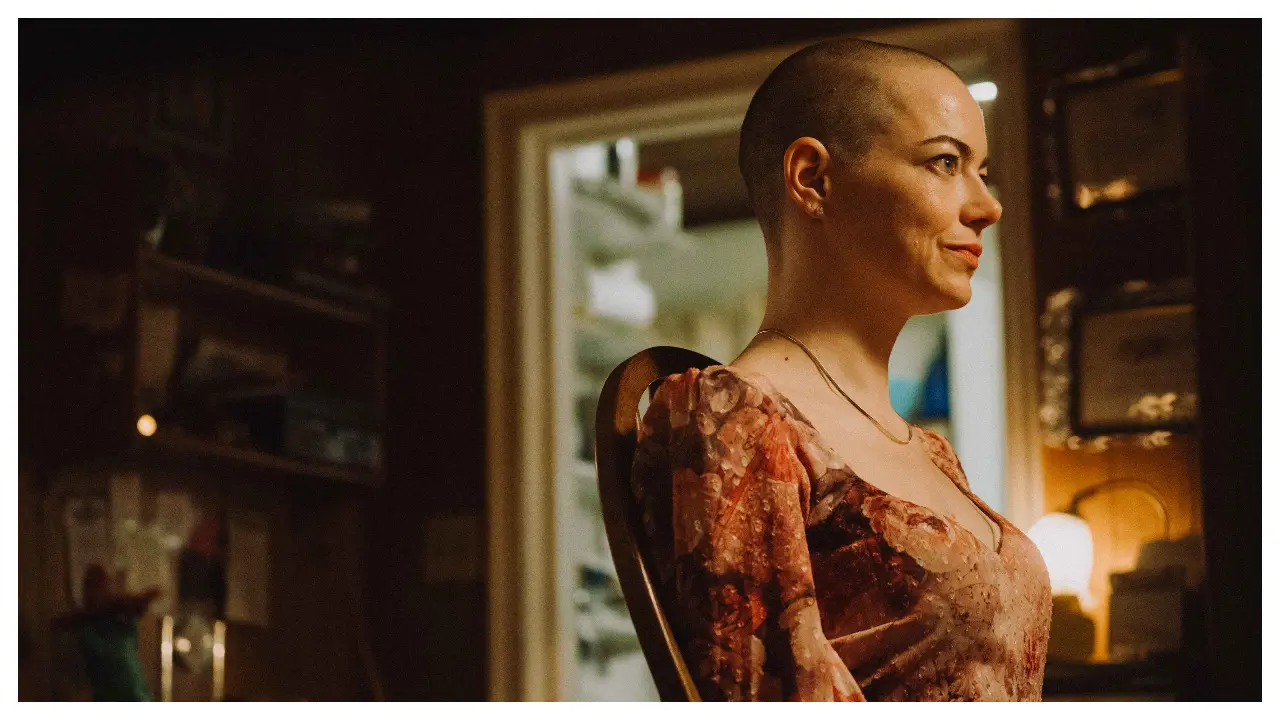
Teddy returns home to find that Michelle has freed herself from her chains. In his basement, she’s discovered something horrifying: jars containing severed body parts. A binder full of photographs. Teddy has done this before—he’s kidnapped and murdered seven other people he suspected of being Andromedans.
Michelle could escape. She has the keys. She could run. But she doesn’t. She stays and waits for Teddy to return. She wants him to know exactly what she is.
When Teddy comes back, devastated by what he’s just done to his mother, Michelle lays it all out for him. And this is where the movie does something remarkable—it gives us a monologue that sounds exactly like the kind of thing a tortured captive would make up to satisfy her captor, while simultaneously revealing the truth.
Michelle tells Teddy the history of the Andromedans:
They arrived on Earth during the time of the dinosaurs and accidentally caused a mass extinction event. Wracked with guilt, they created new life to repopulate the planet—life in their own image. This became humanity.
For a time, there was peace. Atlantis existed (yes, really). But then humans started experimenting with their own genome, which resulted in increased aggression. A nuclear war destroyed Atlantis. Only a few humans survived in an ark, and these survivors gave rise to the current human race—more violent, more self-destructive than the Andromedans ever intended.
For thousands of years, the Andromedans have been trying to guide humanity away from its flawed, violent nature. Auxolith’s drug experiments were part of this effort—attempts to chemically suppress human aggression and help the species evolve.
It hasn’t worked. Humans keep destroying themselves, destroying the planet, destroying everything the Andromedans tried to build.
Teddy was wrong about the Andromedans trying to poison humanity. Humans are doing that all on their own with climate change, warfare, corporate greed, and countless other evils.
Michelle agrees to take Teddy to meet the Andromedans at Auxolith headquarters. When they arrive, Teddy reveals he’s wearing a suicide vest. As Michelle’s confused colleagues call the police, she directs Teddy into her closet, claiming it’s the location of the teleporter to the mothership.
The bomb detonates. Teddy dies instantly. Michelle is knocked unconscious.
And for a brief moment, it seems like the movie is over. The crazy conspiracy theorist is dead. The CEO survives. Case closed, right?
The Twist: She Really Is an Alien
Michelle wakes up in an ambulance on the night of the lunar eclipse. She escapes from the paramedics and makes her way back to her office. She enters the closet—the one that should have been just a closet.
And she teleports.
Michelle beams up to the Andromedan mothership. Because she wasn’t lying. She wasn’t manipulating Teddy. Everything she told him was true.
Michelle Fuller isn’t just an Andromedan. She’s the Andromedan empress.
On the mothership, Michelle consults with her fellow aliens. She’s visibly upset, crying as she discusses what happened. The torture. The violence. The cruelty Teddy displayed. The jars of body parts in his basement from the other “Andromedans” he’d killed—people who were likely just innocent humans who happened to match his paranoid profile.
Michelle reaches a decision.
She walks over to a model of Earth. It’s encased in a protective bubble representing the atmosphere. Michelle’s hand hovers over it for a moment. Tears stream down her face.
Then she pops the bubble.
Instantly, every single human being on Earth drops dead.
The End of Humanity: Set to Marlene Dietrich
What follows is one of the most haunting sequences I’ve seen in recent cinema. Set to Marlene Dietrich’s version of “Where Have All the Flowers Gone?”—a song literally about death and loss and cycles of violence—we see humans all over the world simply… stop.
A father mowing his lawn collapses. Children eating breakfast at the kitchen table slump over their cereal. A couple having sex goes still. Office workers at their desks. People walking their dogs. Everyone, everywhere, all at once.
But the animals don’t die. The dogs keep wagging their tails. The birds keep flying. And at Teddy’s ruined apiary, the bees start returning to the empty hives.
Life goes on. Just not human life.
The camera lingers on these tableaus—nature reclaiming spaces, animals moving through a world suddenly free of human presence. It’s beautiful and terrible and deeply, profoundly sad.
Michelle looks down at Earth from her mothership. The experiment is over. Humanity was a failure. And in the end, the decision to end it wasn’t made by corporate greed or environmental collapse or nuclear war.
It was made by a grieving alien empress who finally ran out of hope.
Why the Alien Twist Actually Works (No, Really)
Okay, let’s talk about this. Because on paper, this twist should feel like a cheat. The entire movie sets up Teddy as a paranoid conspiracy theorist. We’re conditioned to see his beliefs as delusion, as the result of trauma and internet rabbit holes and untreated mental illness. Michelle’s denials feel genuine. Her corporate doublespeak feels real. Everything points toward Teddy being wrong.
So why does the reveal that he was right all along actually land?
First: It recontextualizes everything without invalidating it.
Teddy was right about Michelle being an alien. But he was catastrophically wrong about what that meant. The Andromedans weren’t trying to destroy humanity—they were desperately trying to save humanity from itself. Every cruel thing Michelle did as a CEO, every experimental drug trial that went wrong, every corporate cover-up—it was all part of a millennia-long attempt to chemically evolve humans past their violent nature.
It didn’t work. But the intent was (according to Michelle) benevolent.
Meanwhile, Teddy’s legitimate grievances remain legitimate. His mother really was harmed by corporate malfeasance. Workers really are treated like expendable drones. The planet really is being destroyed. He correctly identified all the symptoms—he just completely misdiagnosed the cause.
Second: It’s about class and power in the most literal way possible.
Michelle isn’t just metaphorically inhuman in the way CEOs can seem inhuman. She’s actually not human. She doesn’t understand human suffering the way humans do because she fundamentally isn’t one of us. She can observe it, study it, even feel sympathy for it—but she’s essentially a scientist running an experiment that isn’t going well.
When Don kills himself, Michelle cries. The tears seem genuine. But there’s also a flicker in her eyes that suggests satisfaction—she broke him, she dominated him, she won. She can mourn the loss while also understanding it as a tactical victory.
That’s exactly how the ultrarich operate in our actual world. They can express concern about poverty while hoarding wealth. They can mourn tragedies while profiting from the systems that cause them. Michelle is a literalization of that disconnect.
Third: The violence goes both ways, and that matters.
Here’s what makes Bugonia more than just “eat the rich” revenge fantasy: Teddy is genuinely horrifying. The jars of body parts in his basement aren’t Andromedans—they’re human beings he murdered because he convinced himself they were aliens. He tortures Michelle brutally. He manipulates Don into suicide. He kills Casey. He kills his own mother.
Michelle’s decision to end humanity isn’t purely reactionary. Yes, Teddy’s cruelty was the final straw. But the film makes clear that human violence, human aggression, human self-destruction has been the problem for thousands of years. Teddy is just the most recent, most personal example of a pattern Michelle has been watching play out since the dawn of human civilization.
So the question becomes: Is Michelle wrong?
Fourth: The animals survive, and that’s crucial.
This is where Bugonia differs from its source material, the 2003 Korean film Save the Green Planet! In that film, the alien king decides humanity has failed and destroys the entire planet. Everyone dies—humans, animals, everything. It’s nihilistic in the purest sense.
But in Bugonia, only the humans die. The dogs live. The birds live. The bees return to Teddy’s empty hives. Earth itself survives—it’s just been reset, wiped clean of the one species that kept destroying it.
This changes the message entirely. The ending isn’t purely nihilistic—it’s suggesting that maybe Earth is better off without us. That humanity’s extinction isn’t the end of everything, just the end of one failed experiment.
It’s bleak, but there’s an odd hopefulness buried in there. The planet will be fine. Life will continue. Just not our life.
Fifth: It’s a mirror held up to our moment.
Screenwriter Will Tracy (who also wrote The Menu and worked on Succession) has been explicit that Bugonia‘s ending is “reckoning with a very specific kind of political turn and hopelessness that we’re feeling at the moment.”
We’re living through climate catastrophe, political polarization, wealth inequality, and the weaponization of conspiracy theories. People with legitimate grievances are being radicalized into believing in cabals and secret plots because the actual systems destroying their lives are too complex and diffuse to fight against. It’s easier to blame aliens than to dismantle capitalism.
Meanwhile, the people actually in power—the Michelle Fullers of our world—really are making decisions that harm millions while insulating themselves from the consequences. They really do seem alien in their inability to understand or care about ordinary human suffering.
Bugonia takes these real dynamics and pushes them to their logical extreme: What if the conspiracy theorists were right about their targets being inhuman, but wrong about everything else? What if the powerful really are a different species, but they’ve been trying (ineffectively, disastrously) to help? What if the greatest danger isn’t the aliens among us, but our own nature?
John Gray and Zappfe’s Existential Elk Theory
Not that you need more words to convince you – but… lately I’ve been doing a lot of reading of John Gray, who posits that human progress is a myth. And if you stop and think about it a moment, I mean beyond the really obvious… no! We are progressing! kneejerk reaction… you’ll agree that we really aren’t progressing. Sure, Space X and moon landings. But ultimately? We are still murderously evil and horrible in pretty much every way possible.
And that brings me to Peter Wessel Zapffe’s Existential Elk Theory. He detailed out this theory in his writings entitled “The Last Messiah” in 1933. In it he argues that human consciousness is an evolutionary overdevelopment. This idea comes from the extinct Irish Elk that developed enormous antlers that led to the extinction of its species. Basically, Zapffe believes that it is humanity’s self-awareness that makes life burdensomely difficult and ultimately absurd. It is this self awareness that forces humans to repress their awareness of their mortality and this ultimate meaninglessness to survive.
It is humanity’s understanding of our enormous cosmic insignificance and mortality, and the inherent meaninglessness that leads to utter cosmic panic. And as such, humans employ several defense mechanisms in order to try and cope with it all. Isolation – Anchoring – Distraction – Sublimation. And that is ultimately what this movie is talking about here.
The Performance That Sells It
None of this would work without Emma Stone’s performance. She has to play Michelle three different ways simultaneously:
- As a ruthless corporate CEO who seems genuinely human
- As a kidnapping victim who could be telling the truth or could be manipulating her captors
- As an ancient alien empress who has spent millennia watching humanity destroy itself
Stone threads this needle perfectly. Watch her eyes during the basement scenes. There are micro-expressions that could read as fear or could read as calculation. When she cries after Don kills himself, the tears are real—but so is that predatory glint. When she pops the bubble over Earth, she’s devastated—but she also knows it’s the right call.
It’s a performance that works entirely differently on second viewing once you know the truth. That’s the mark of something genuinely brilliant.
Jesse Plemons matches her beat for beat as Teddy—a man who’s simultaneously a victim of corporate harm, a dangerous conspiracy theorist, a torturer, a murderer, and someone capable of real love (for Don, for his mother). It’s a role that could easily tip into caricature, but Plemons finds the humanity in it even as he does inhuman things.
And Aidan Delbis as Don—an autistic actor playing an autistic character—provides the film’s moral center. Don is the only truly innocent person in the entire movie, and his death feels like the loss of the last shred of genuine human decency in the story.
Does It Work?
So after all that, does Bugonia‘s alien twist work?
For me? Yes. Completely. It’s an extension of the Existential Elk Theory. We are burdened by an enormous cosmic panic – and we are absolutely horrible in every way manageable. But I’m not going to pretend everyone will agree with me. Some viewers will see the twist as a gimmick, as Lanthimos pulling the rug out for shock value. Some will find the execution too rushed—we get the reveal and the apocalypse in quick succession without much time to process either.
Some will hate the ending’s bleakness. And I get that. This is a movie that ends with the total extinction of humanity set to an ironic soundtrack, all because one alien CEO decided we weren’t worth saving anymore. That’s a tough pill to swallow, especially in 2025 when it already feels like the world is falling apart.
But here’s the thing: Bugonia isn’t saying we’re doomed. It’s saying we’ll be doomed if we don’t change. The film hasn’t happened. Michelle hasn’t popped that bubble. We still have time to be better than Teddy—to address legitimate grievances without descending into paranoid violence, to hold power accountable without dehumanizing everyone we disagree with, to save ourselves from ourselves.
As Tracy said in interviews, “If we don’t want that kind of ending for ourselves, then we have to start listening to each other. We have to start making robust and sane civic institutions that look out for each other. We have to stop destroying ourselves.”
That’s a constructive, hopeful way of looking at it. The movie shows us one possible future—the worst-case scenario where humanity’s violent, self-destructive nature finally exhausts even our alien benefactors’ patience. But it’s not inevitable. It’s a warning.
Final Thoughts: The Bleakest Film of 2025
Bugonia is absolutely not for everyone. It’s slow, uncomfortable, deeply weird, and ends with the complete annihilation of our species. If you want uplifting, inspirational cinema, look elsewhere.
But if you want a film that genuinely wrestles with questions of power, class, violence, conspiracy, and whether humanity deserves to survive its own worst impulses? If you want performances that will haunt you for weeks? If you want an ending that will start arguments and force you to interrogate your own assumptions?
Then Bugonia is essential viewing.
Yorgos Lanthimos has made his most accessible and his most challenging film simultaneously. The plot is straightforward—kidnapping thriller becomes alien invasion story—but the thematic layers run deep. Emma Stone and Jesse Plemons do career-best work. The ending will absolutely wreck you.
And that twist? That reveal that Michelle really is an alien empress who decides to end humanity?
It works because it’s not really a twist at all. It’s the logical conclusion of everything the film has been building toward—a final answer to the question “who’s the real monster?”
The answer, of course, is all of us. We’re the monsters. We always have been.
And somewhere in the Andromeda galaxy, an ancient species is watching us and wondering if we’ll ever figure that out before it’s too late.
Trust me, you’ll be thinking about those empty beehives filling back up long after the credits roll.