Ok, I’ll admit it. I almost didn’t watch this one.
Apex showed up on my Netflix feed and I did what I suspect most of you did — I clocked the thumbnail, thought sure, Charlize Theron survival thriller in the Australian wilderness, how bad can it be, and then immediately started mentally preparing myself for two hours of obvious green screen, badly composited wall-climbing sequences, and the kind of CGI wilderness that looks like someone built a national park in a computer and forgot to add the soul. You know the look. You’ve seen it a thousand times. Gravity did it. Infinite did it. Most of these things do it.
And then I hit play, and within about four minutes my jaw was somewhere on the floor, because Apex is not that movie at all.

Apex Director: Baltasar Kormákur Starring: Charlize Theron, Taron Egerton, Eric Bana Streaming on Netflix
Let me start with the thing that caught me completely off guard, because I want to give credit where credit is due before we get into the actual plot mechanics. The cinematography in this film is genuinely stunning. I’m not talking about good for a Netflix film stunning, or serviceable thriller stunning. I’m talking about shots that have no business being in a streaming thriller — camera angles and vantage selections that felt like they were ripped straight out of Free Solo, Alex Honnold’s documentary that redefined what climbing footage could look like on screen. There are moments in Apex where you are legitimately looking down the face of a rock wall and your stomach drops, and it is not because of anything digital. Kormákur — who you’ll know from Everest, which did similar things with mountain footage — made a decision early and stuck to it: real locations, real climbing, real exposure. Theron was apparently on rock faces the director himself wouldn’t go near. And it shows, in the best possible way.
Ok. With that on the table, let’s walk through this thing.
The Troll Wall — Where Everything Begins and Breaks
We open not in Australia but in Norway, on the Troll Wall — one of the most imposing vertical rock faces on the planet. Sasha (Charlize Theron) and Tommy (Eric Bana) are somewhere in the middle of a tandem climb, sleeping in a portaledge — basically a hanging tent affixed to the wall itself — waiting out the weather to push toward the summit the next morning. This opening sequence is quietly extraordinary. The way the camera introduces us to these two people is entirely visual — you understand their relationship, their ease with each other, their total comfort in a situation that would give any sane person a full cardiac event, just from how they move together on the wall. No clunky exposition. No one explains that they’re experienced climbers. You just know.
But here’s the thing about the Troll Wall. There’s a shelf. A specific section of the route that Sasha cannot clear. She tries it, and she can’t make it, and they agree to come back to it in the morning. And then the storm rolls in, and they have to start rappelling down — and that’s when the avalanche hits, and Tommy gets knocked off the wall.
I want to sit here for a moment because this scene is brutal and it’s doing a lot of work. Tommy is limp, unconscious, hanging from the rope connecting him to Sasha. She hasn’t had time to secure it. She’s holding his entire weight with her hands, on a vertical rock face, in the middle of a storm, and the rope is slipping. And she cannot hold him. And she watches him fall into the fog and disappear.
She lets go of the rope. He falls. She survives. And that guilt — that specific, particular guilt of the person left behind — is going to carry through this entire film like a stone she can’t put down.
Into the Australian Wilderness
Jump forward. Sasha is not okay. She is just functioning. She takes a solo kayaking and wilderness trip into the Blue Mountains of New South Wales — pushing herself, punishing herself, looking for something to fill the space Tommy used to occupy. This is where we meet the hunters early on, a group of rough, loud, conspicuously menacing men who feel like they have been assembled specifically to be the obvious bad guys. And here’s where the film makes its first smart move.
You absolutely think it’s going to be them. All of the classic cinematic shorthand is there — the leering looks, the aggressive energy, the sense that Sasha is being watched and sized up in a way that has nothing to do with friendliness. Hollywood has trained us for fifty years on this particular setup. The obvious threat is the obvious threat. The aggressive men in the wilderness are the danger. We settle in for a fairly predictable predator-prey dynamic, and we think we know how this is going to go.
Ben. Just Ben.
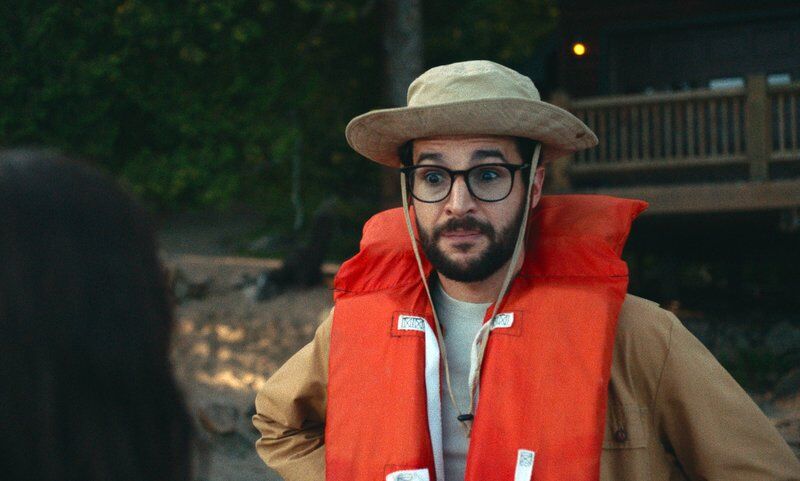
Enter Ben, played by Taron Egerton, who — and I cannot stress this enough — plays this character with such disarming, pleasant, genuinely warm energy that you immediately like him. He’s the local. He knows the area. He’s helpful, he’s funny, he makes his own beef jerky … and boy how that beef jerky place an outsized lift in this scene. Sasha buys some, and man, he just seems so normal. He seems almost too pointedly normal, particularly in contrast to the conspicuous menace of the hunter group. He’s the safe option. The good guy in the wilderness. The one who isn’t the threat.
And this is the head fake I didn’t see coming.
So later on, after Sasha escapes away from the supposed threat of the neanderthals, and kayaks off into the blissfully sweet environs of the Australian wilds, she coincidentally meets back up with Ben. Crazy coincidence, no? I mean, to find Ben way the heck out in the middle of nowhere?? Turns out, Sasha notices that Ben is wearing one of her bracelets… she realizes that it was actually Ben that was behind the stealing of her stuff, not some wild animal, or the neanderthals.
So yeah, I gotta give credit to my wife for guessing this twist in advance. But me, the movie blog writer, how I explained to her how Hollywood just isn’t that clever these days! hahaha. So yeah, I want to give the film enormous credit for executing it as cleanly as it does, because Hollywood (yes, that is meant as derisively as I can muster) almost never actually pulls this off. The bad guy in these movies is always the neanderthal. It is always the loudest, most obviously aggressive presence. The nice guy in the Australian wilderness never turns out to be the serial killer with a bracelet he stole from your bag and a very specific ritual for hunting people he’s been researching for months. And yet.
Sasha is getting ready to leave when she notices it. Her bracelet. On Ben’s wrist. The same bracelet she assumed she’d just lost somewhere along the way. And Ben, rather than trying to pretend otherwise, simply drops the pretense entirely. He brings out his crossbow. He tells her that he researched her after Tommy fell, that he has been fascinated with her, and that he picked her specifically. He tells her she has until the end of the song playing on his stereo before the hunt begins. And off goes Sasha like a frightened hare.
Taron Egerton’s eyes in this scene, by the way, are among the more unsettling things I’ve encountered in a while. The warmth just evaporates. And what’s left underneath is something genuinely cold.
The Hunt
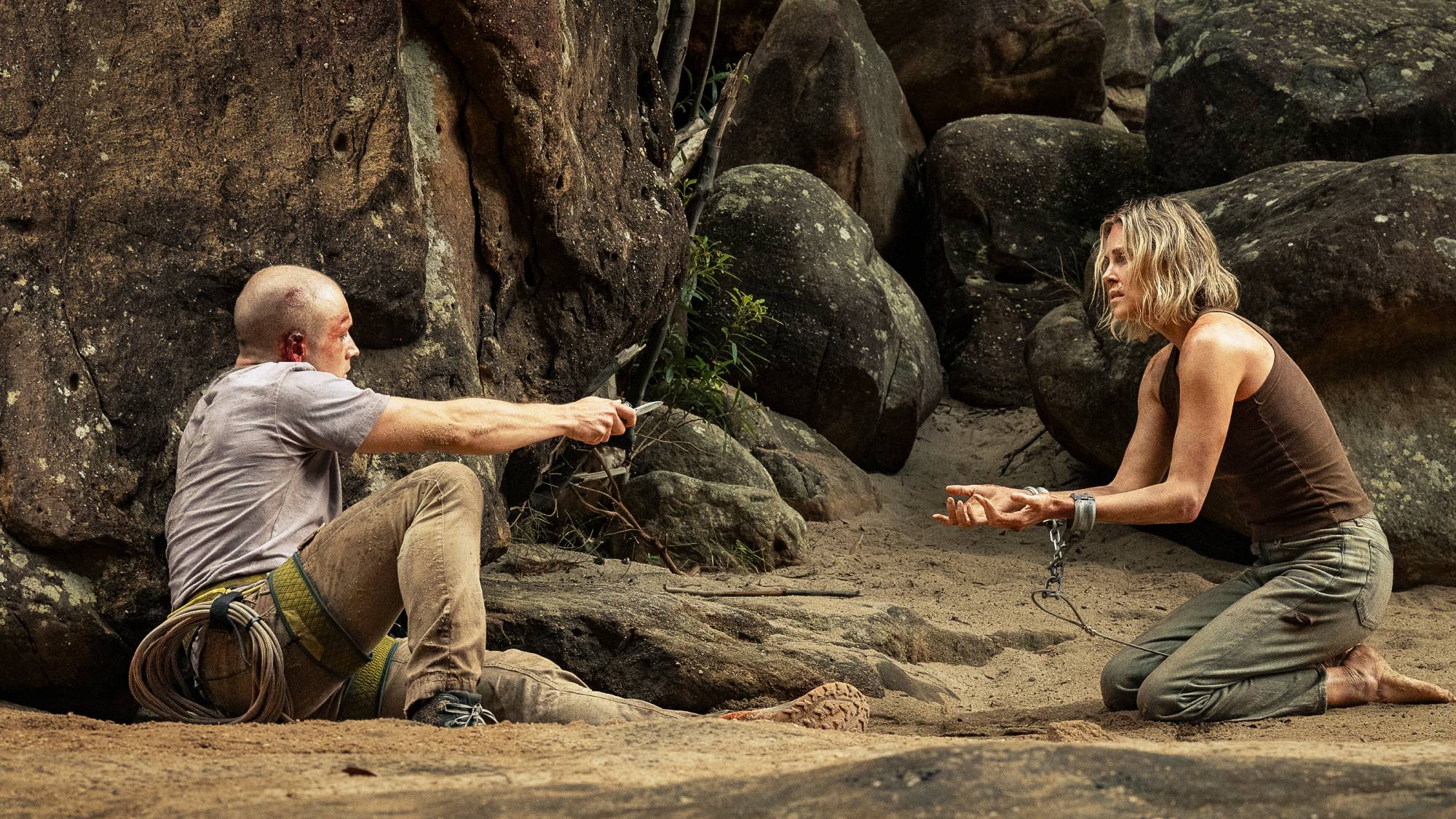
Sasha gets to her kayak and runs. Ben chases. She hits a waterfall and loses the kayak. An arrow catches her in the thigh. She sets off a bear trap and Ben uses the moment to restrain her, which brings us to the canoe sequence — Ben paddling upriver toward a cave, Sasha chained and being dragged through rapids behind him, and the revelation that this is a ritual for him. Something he’s done before. Something he’s planned for her specifically.
The Australian wilderness in these sequences is absolutely breathtaking and absolutely terrifying in equal measure. Kormákur keeps you disoriented in the best way — you understand the geography just well enough to feel trapped by it. And Theron is doing something interesting throughout: Sasha is not the action hero who suddenly becomes invincible the moment the plot demands it. She is hurt. She is exhausted. She makes decisions out of desperation and some of them don’t work and she adapts. The arrow wound stays in play. The bear trap injury stays in play. She is accumulating damage, which makes every moment she survives feel genuinely earned.
The Final Climb and the Circle Closing
Ben gets Sasha to his cave, and this is where the film’s final act turns back to where it started. Sasha gets the upper hand for a moment, and shatters Ben’s leg. Wicked compound fracture. Grizzly wound. But they are still attached to one another with a rope Sasha can’t get free from. So Ben gives her a simple, vile proposition: climb the rock face above them to the top, and he will free her. He will hold her rope, and if she tries anything, he’ll pull her off the wall.
And here’s where everything in this movie pays off.
Because this isn’t just any rock face. This is a climb with the same configuration Sasha couldn’t clear on the Troll Wall — the same shelf, the same move that defeated her in that opening sequence in Norway. The move she and Tommy had planned to go back and try again, and never got the chance because the avalanche came and Tommy fell and the rope slipped through her hands. The last climb she couldn’t finish.
She starts up the wall. Hoisting Ben as she goes, cantilevering up as they go together. It’s an impossible climb. And yet, as she climbs, you start to notice something — she’s moving differently than she was at the beginning of the film. Not stronger, exactly, but more desperate, and somehow more free. Because she has nothing left to lose, and that is a specific kind of clarity. And somewhere along the way, Sasha figures out how to free herself. Ben, sensing she’s done something, jerks the rope, intending to cause her to fall to the ropes length, and have to start over, but instead, he pulls free the harness she was wearing. And then, just like that, he falls to the rocks below, killing him instantly.
But the imposing shelf is still looming up ahead. She can’t stop now. The move that beat her in Norway is still up ahead. This time though, she has no safety gear, and only one chance to get it right. And she goes for it. Just her hands and the rock and everything she’s carrying. And she tops out.
The Ending — The Compass and the Ocean
She makes it back to civilization — stumbling through dark forest, finding a car, returning to the ranger station and telling them where to find the others. The practical aftermath of survival. And then, at the very end, we find her at a beach. She’s holding Tommy’s lucky compass, the one that’s been with her the whole film, the one she’s been carrying like a talisman and a wound, and she throws it into the ocean.
Let it go. Finally let it go.
And that’s the full arc of Sasha’s story, and it’s genuinely moving when you trace it back to the beginning. She couldn’t hold the rope. Tommy fell. She couldn’t clear the shelf. She spent whatever came after in a fog of guilt and grief and adrenaline-seeking, trying to outrun the moment she couldn’t save him. And then a psychopath with a crossbow and a ritual put her on a wall with absolutely nothing left, no gear, no partner, no way out except up, and she cleared the shelf. She finished the metaphorical climb she and Tommy never got to finish. And in doing so, she finally put it down. The guilt, the grief, the accident, the fall, the rope that slipped through her hands. All of it.
Apex is better than it had any right to be. It is not a perfect film — Ben’s backstory stays a little too thin, and the middle section occasionally loses its momentum — but the cinematography is legitimately extraordinary, the head fake is the best villain reveal Hollywood has managed in a little while, and Charlize Theron gives a performance that carries the full weight of a woman who came into the wilderness looking for something and left having found something she didn’t know she needed.
The summit was always going to be hers. She just needed the right kind of impossible to get her there.