
Backrooms Youtube eps 1 – 10 explanation post
Backrooms Youtube eps 11 – 17 explanation post
Backrooms Youtube eps 18 – 22 explanation post
Backrooms Movie explanation walkthrough
Backrooms Movie Theories Explanation
Backrooms Definitive Timeline
Here’s the thing about The Backrooms that its angriest critics can’t forgive and its biggest fans can’t stop talking about: the movie refuses to tell you what it is.
Kane Parsons built a film with one deliberate hole at the center of it, and he’s said outright that the only interpretation he wanted to rule out is the lazy “it was all a dream” cop-out. Everything else? Fair game. He left the door open on purpose. And into that open door, the internet has poured roughly a thousand competing readings.
So this is the post where I sort through all of it. Every major theory, taken seriously, taken all the way down… the full evidence, the strongest counterargument, and how each one reads that gut-punch of an ending. I’ve arranged them on a spectrum, from the most literal (“the backrooms is a real place and that’s that”) to the most psychological (“the backrooms is a mind coming apart”). That spectrum isn’t decorative. The literal-versus-psychological tension is the central argument of this movie, and where you land on it determines which film you think you watched.
One thing before we start the descent: I don’t think these five are strictly mutually exclusive. The single most impressive thing about The Backrooms is that it actively supports more than one of them at the same time. That’s not a flaw in the writing. That’s the architecture.
If you haven’t read my full plot-and-ending breakdown yet, start there — this post assumes you already know what happens, who dies, and how it ends which I covered in my Backrooms Deep Dive post
Massive spoilers for the entire film below. Last warning.
Theory 1: The Literal / Lore Theory
“The backrooms is real. Full stop.”
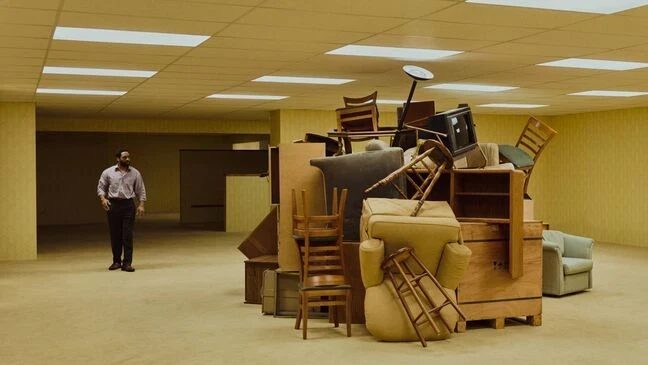
The thesis: There’s no metaphor you need to decode. The backrooms is a genuine anomalous dimension — a real, physical, infinite space that the Async Research Institute cracked open through their threshold technology, a spinoff of the company’s old MRI research. It copies and degrades the real world. It’s leaking into reality through “null zones.” And by the final act it’s spreading uncontrollably. The monster is a real monster. Clark really died in there. Mary really got caught. Nobody is hallucinating anything.
The case for it. This reading has the easiest job, because the movie films its supernatural apparatus as cold, concrete fact. Start with the cold open: a researcher, lost in the backrooms, recording a tape dated June 19, 1990, hunted and killed by the giant — and that footage is being reviewed by people in white coats. That entire sequence happens before Clark exists in the story. It is not filtered through his perception or Mary’s. It just happened. And here is the bit that might sell many of you on this theory all by itself: Clark later physically finds that researcher’s bag, with the tapes, the floppy disks, and the ID badge inside. The dead man was real. His stuff is real. You can’t write that off as anyone’s delusion.
Then there’s Async itself, rendered with bureaucratic specificity: CCTV feeds of the rooms, hazmat capture teams, gas traps disguised as those friendly multilingual greeter standees, a brain scan run on Mary, a whole facility on the other side of a literal portal they walk her through. Phil doesn’t speak in riddles — he confesses. The company used to make MRI machines. Now it does this. He goes in himself. They’re studying it. And within his closing ramble he admits that doors are opening all over the place, and nobody knows why. And that is the literal reading of this mission statement: the backrooms is real, it’s expanding, and humanity has lost control of it.
For anyone who followed Kane’s YouTube series (which I did a deep dive on), this all clicks into established canon: the Async Research Institute, Project KV31, “the Complex,” the threshold. The melted two-chairs-fused-into-one furniture and the Voyager-golden-record standee greeting visitors in fifty languages aren’t dream logic — they’re artifacts of a place that builds and copies physical matter. Even the dates line up with the series timeline (the YouTube finale Static Dead End is dated May 29, 1990; the cold open here is June 19; Clark’s first CCTV-logged entry follows shortly after).
How it reads the ending. Cleanly and bleakly. Mary doesn’t escape — she’s captured and absorbed into Async as a research asset, which is why Phil can say “that’s not up to me” without flinching. The backrooms is spreading. And the final shot of the still-life Mary frozen in a replica interview room is exactly what it appears to be: the backrooms has copied her, the same way it copied Cat and Bobby’s home, Clark’s store, and Mary’s demolished childhood house with the handprints back in place. The place duplicates everything it touches. Now it’s got her too.
Where it strains. If the place is purely, literally real and indifferent to its visitors — why is it so eerily, specifically shaped by Clark? The monster is his pirate-sultan persona. The murals are signed in his handwriting. His store gets recreated room for room. A truly neutral dimension wouldn’t keep coughing up one man’s psychology. The literal reading has to shrug off an enormous amount of personal specificity as coincidence or hand-wave it as “the place copies whatever’s nearby” — which, notice, is already conceding ground to the next theories on this list.
What it says the movie is about: human institutions poking holes in reality they have no business poking, and getting people killed for it. Cosmic horror with a corporate logo.
Theory 2: The Capitalism / Async-Is-the-Villain Theory
“Forget the monster. Follow the money.”
The thesis: Still mostly literal — but it argues you’ve been watching the wrong threat the whole time. The real horror of The Backrooms isn’t the giant in the pirate hat. It’s the institution that discovered an infinite dimension and immediately started asking how to monetize it. Async treats the backrooms as free real estate and treats the people lost inside it as raw inventory. The monster is the misdirection. The men in the white coats are the actual antagonists.
The case for it. Watch how the movie brackets itself. It opens on Mary’s childhood home being demolished to make way for a development tower — memory, history, and home all liquidated so something more profitable can go up in their place. It closes on a corporation calmly deciding the fate of a traumatized survivor it now regards as a data point. That’s not an accident of editing. That’s a frame the film is building around everything in between.
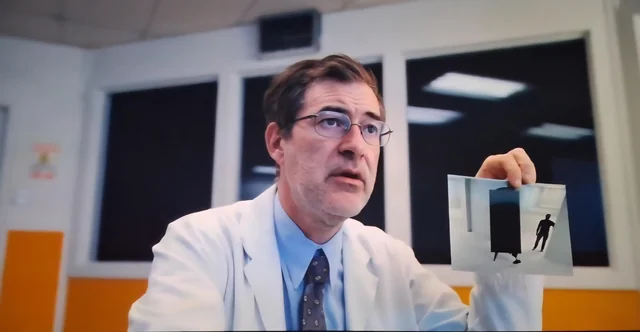
The details reward this reading. There’s the framed newspaper clipping about Async’s MRI research grant — capital funding the science that punched the hole. There’s Phil’s quietly monstrous “I’m convinced nothing in our lifetime, or in all of recorded history, means more than this,” which is the voice of a man who has stopped seeing the human cost entirely because the opportunity is too enormous. And there’s the line that should chill anyone who’s ever been processed by a large organization: “that’s not up to me.” Nobody at Async is accountable. The responsibility is diffused across an org chart until it evaporates. Mary doesn’t get released because, to them, she isn’t a person anymore — she’s an asset that walked out of the anomaly, and assets get retained and studied. The greeter standees aren’t there to welcome anyone; they’re harvesting traps. Async isn’t trying to rescue the people in the backrooms. It’s trying to catch the merchandise.
And it all rhymes with the series lore, where Async’s openly stated ambition is to colonize the backrooms as infinite storage and housing — a solution to overpopulation, packaged and sold. Even Clark fits the thesis as a grace note: he’s a small, failing capitalist (an entire furniture store called the Ottoman Empire — empire, consumption, a throne that literally breaks under him) who gets devoured, while big capital, Async, wins and keeps expanding.
How it reads the ending. The ending is simply the system winning. Mary vanishes into the machine, and the machine grinds on, opening more doors, swallowing more people, accountable to no one. The still-life copy of her is almost beside the point — the real horror is institutional permanence. The monster can be trapped. Async cannot.
Where it strains. The movie spends the overwhelming majority of its runtime inside Clark and Mary’s interior lives, not inside Async’s boardroom. The corporate apparatus is a powerful frame, but it’s a frame — it shows up at the edges, at the beginning and the end. Elevating capitalism to the meaning of the film underweights the aching character study that is plainly its emotional core. This reading is most convincing as the political context the movie is steeped in, less so as the thing the movie is fundamentally doing.
What it says the movie is about: that the scariest force in the world isn’t supernatural — it’s an institution that has decided your suffering is an acceptable line item.
Theory 3: The Hybrid / “Shaped By Minds” Theory
“It’s a real place — and it’s built out of you.”
The thesis: This theory is the true center of the spectrum, and in my mind the most textually loaded reading on this entire list. The backrooms is both a real dimension and a psychic mirror. It physically exists — Async genuinely found it — but it builds and rebuilds itself out of the memories and minds of whoever is near it. Clark, the failed architect, is literally drafting the impossible architecture from inside his own head. The place “remembers” people and renders them back as slowly degrading copies. Real and personal, at the same time.
The case for it. This is the reading the film hands you the most breadcrumbs for, and once you see it you can’t unsee it. The single most important clue is scrawled on a mural Mary finds: “The floor plan changed again. I don’t know who signed the plans, but the handwriting looks like mine.” That is the movie telling you, in plain language, that the space is being authored — and that the author is one of its prisoners. Clark spent his life wanting to be an architect and failing. In the backrooms, he finally gets to design. He draws maps. The floor plan obeys him.
Then look at the monster. Captain Clark, the giant, isn’t a random entity. It’s a swollen, deformed version of Clark’s own furniture-store mascot persona, the pirate-sultan he dresses up as to sell ottomans. His buried ego and shame, grown huge and given teeth. The place built his self-image into a predator. And Clark all but narrates the mechanism for us at the dinner table: “This place builds them. Actually, more like it remembers them. And the more times it remembers something, the less it does.” That’s not how a neutral physical dimension works. That’s how memory works. That’s how grief works — every time you recall someone, the copy degrades a little further from the original.
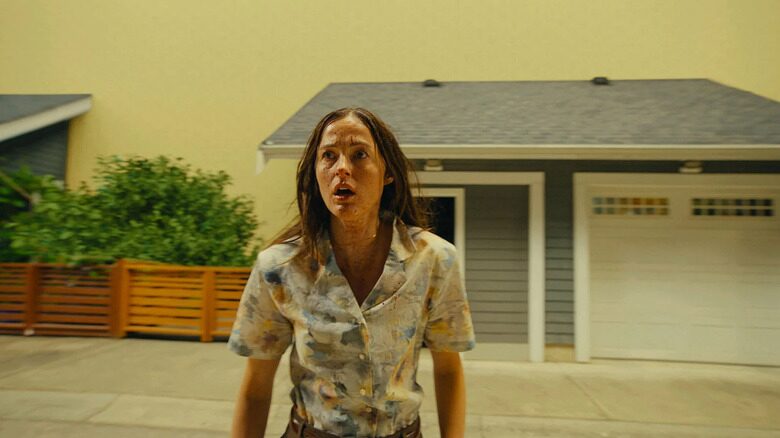
The clincher, for me, is the geography. When Clark moves through the backrooms, it’s the yellow office-maze of his world. When Mary makes her run for the exit, her stretch of the place looks different — more domestic, more suburban, more like her memories. Different minds, different rooms. The backrooms isn’t one fixed map; it’s a mirror that reshapes itself around whoever’s holding it. It even explains a small mystery: why is Phil so eager to locate Clark specifically? Possibly because Async has realized Clark is reshaping the place — that a strong enough mind doesn’t just get lost in the backrooms, it renovates it.
How it reads the ending. Richest of all five. The still-life Mary in the replica interview room isn’t merely a copy (Theory 1) and isn’t merely a symbol (Theory 4) — she’s the backrooms having learned her, the way it learned everyone before her. She’s now part of its memory-architecture, a room the place can rebuild from her mind whenever it wants. The horror is recursive: the more the backrooms remembers her, the less of the real her remains, until she’s just furniture that used to be a person. Both literally trapped and personally consumed.
Where it strains. It’s the most satisfying theory and also the least falsifiable — which should make you a little suspicious of how good it feels. A reading that can absorb literally any detail you throw at it has stopped being a theory and started being a religion. And it rests on a mechanism — minds physically sculpting a real place — that the film strongly implies but never once confirms out loud. It’s a gorgeous inference. Emphasis on inference.
What it says the movie is about: that the spaces we get lost in are the ones we build ourselves, out of the parts of us we won’t look at directly.
Theory 4: The Trauma-Allegory Theory
“The backrooms is the subconscious, made literal.”
The thesis: Now we cross firmly into psychological territory. Under this reading, the backrooms isn’t really a place at all — it’s a metaphor the movie renders in three dimensions. The whole film is a psychodrama about trauma loops, avoidance, and accountability. Clark and Mary are deliberate mirror images of two ways of being broken. Captain Clark is Clark’s rage and avoidance given monstrous form. He “merges” with the backrooms at the precise moment he refuses to take accountability for his life — and Mary survives only by confronting, and literally weaponizing, her own trauma.
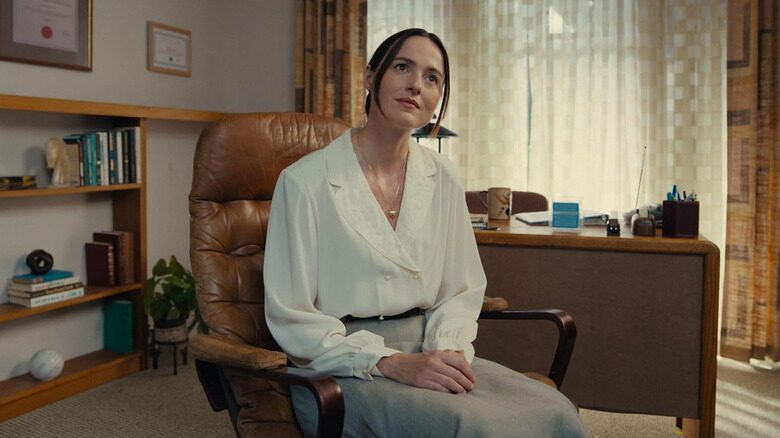
The case for it. The thesis is spoken aloud in the very first scene, before you even know it’s a therapy session: we all have our loops, our habits, the behaviors that keep us walking in circles. The entire movie is framed inside the relationship between a therapist and her client. That’s not a coincidence you decode at the end — it’s the lens bolted onto the camera from frame one.
Every major image maps to interior life. Clark is a man so stuck he’s literally living inside his own failing business, sleeping on a display bed in an empty showroom — a liminal space, before he ever falls through a wall. The window-and-door motif saturates everything: Mary’s self-help book is called The Window Within (“open the window, be the author of your own design”); her mother papered the windows over; Clark’s farewell message is “I opened the window, I won’t be coming back.” Windows and doors are thresholds between the self you hide in and the world you’re afraid of — and this is a movie obsessed with thresholds. Even Async’s origin as an MRI company lands here: an MRI is a machine that maps the inside of your head.
The dinner scene is the allegory’s thesis statement. Mary, playing therapist to the bitter end, has held what the profession calls unconditional positive regard — total nonjudgmental acceptance of the client no matter what. At the dinner table she finally drops it and tells Clark the truth: “Nothing is ever your fault. You blame your brain. You ARE your brain.” And Clark’s response is the disease confirming itself — he doesn’t want to change, he likes it here, “it’s just the way we’re wired.” He chooses the loop. So the loop, in the shape of his own monstrous mascot, picks him up like a baby and eats him. Refusing accountability doesn’t free him; it consumes him. Meanwhile Mary defeats that same manifestation using the concrete handprint — the preserved physical relic of her own childhood trauma. She survives by turning the thing that wounded her into a weapon. That’s not horror logic. That’s therapy, dramatized.
How it reads the ending. Mary “escapes” the literal monster but not her loop. The final still-life Mary, sealed alone in a room, is her oldest trauma made eternal: the little girl whose mother never let her go outside, frozen forever in a sealed box. She confronted the monster and survived the confrontation — and is still imprisoned by the pattern. The allegory’s cruelest note: surviving the breakthrough is not the same as being free of the thing.
Where it strains. If it’s pure metaphor, you have to explain away a great deal of stubbornly concrete machinery. The researcher dies on tape before Clark exists. The hazmat teams, the gas traps, the portal, the brain scan — all of it operates independently of Clark and Mary’s psyches. A clean allegory reading has to demote that entire apparatus to mood lighting, and Kane films it far too solidly for that to sit comfortably. The movie keeps insisting the place is real even as it begs to be read as a mind.
What it says the movie is about: that the hardest room to escape is the one your own avoidance built, and that “it’s just how I’m wired” is the sentence that locks the door from the inside.
Theory 5: The “It’s All Mary” / Unreliable-Narrator Theory
“We never left the ward.”
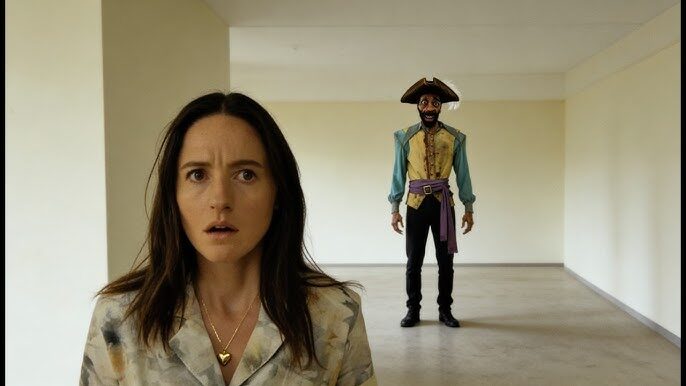
The thesis: The far end of the spectrum, and the boldest swing on the board. The entire descent is Mary’s own psychological break. She — not Clark — is the one who ends up institutionalized, exactly as her mother was before her. Clark, the backrooms, the monster, even Async: distortions and projections of Mary’s deepest terror, which is that she is doomed to repeat her mother’s fate, that she can’t save anyone, and that she can’t save herself. The final shot of the still-life Mary frozen alone in the interview room isn’t a backrooms copy at all. It’s the plain truth: she never got out, because she was never out to begin with.
The case for it. Of the two leads, Mary is the one carrying the psychiatric freight. The institutionalized mother. The medication she ducks into side rooms to take. The childhood spent in a sealed home with papered-over windows, terrorized by a parent who believed monsters were “all over the place.” A lifelong, almost religious fixation on windows and doors. If anyone in this film is a candidate for a dissociative break, it’s not the furniture salesman — it’s his therapist, who has spent her whole career trying to fix broken people because she could never fix the broken person who raised her.
Read the back half through that lens and it reorganizes itself. Clark becomes a patient she couldn’t save. He’s a stand-in for the mother she couldn’t save. The monster becomes her terror of inheriting her mother’s madness. The backrooms becomes the sealed, windowless home of her childhood, infinitely extended. And the ending is the tell: the movie’s final, lingering horror is of a woman trapped alone in a room she’s not allowed to leave. Which is Mary’s specific childhood trauma, not Clark’s. Why would the film climax on her nightmare if this were really his story? The Async interview room is shot like a cell, the framing slowly drowns her in backrooms-yellow as she sits there, and her final expression is a small, knowing smile — the smile of someone who has just understood exactly where she actually is, and has been the whole time.
How it reads the ending. There is no escape and there was never an outside. The still-life Mary is Mary, sitting in the institution, frozen in her break. The “facility,” the “portal,” the “brain scan” are the dream-logic costuming her mind has draped over a psychiatric ward. The whole film has been the inside of her collapse, and the last shot simply stops pretending otherwise.
Where it strains. It strands the cold open badly. That researcher dies on a recovered tape, watched by white coats, before Mary is anywhere near the plot — so if the entire film is her projection, who is the dead man, and why does Clark later find his physical bag? It also flirts dangerously with the one ending Kane explicitly disowned (“it was all a dream”), and only survives if you frame it precisely as dissociation rather than hallucination — a real psychological state distorting real events, not a fantasy invented from nothing. It’s the most provocative theory on this list and the one that demands the most squinting to hold together.
What it says the movie is about: that the deepest fear isn’t a monster in the dark — it’s becoming your mother, alone in the sealed room you swore you’d escape.
Can They All Be True At Once?
Here’s the move that separates The Backrooms from a movie with a “twist” you’re supposed to solve: it gets richer when you let these readings overlap, not poorer.
Run two or three of them simultaneously and nothing breaks. The backrooms can be a literally real dimension (Theory 1) that a corporation is criminally exploiting (Theory 2) and that shapes itself from the minds of the people lost inside it (Theory 3) and that therefore functions as a perfect externalization of trauma and avoidance (Theory 4). All four of those can be true in the same frame. That’s not contradiction; that’s layering. Kane built a literal box and a psychological box and nested them inside each other so cleanly that you can’t pry them apart — which is exactly why the “true horror fans” who showed up for a monster-rulebook left so angry. There’s no rulebook. There’s a mirror with a monster living in it.
Only Theory 5 is genuinely greedy — it wants to be the whole answer and demote everything else to delusion, and that’s why it cracks against the cold open. But even Theory 5 earns its place, because it’s the logical endpoint of taking the psychological reading as far as it can possibly go, and the movie flirts with it hard enough that you can’t dismiss it.
Where I Land
After sitting with it, the reading I keep coming back to is Theory 3 — the hybrid. The backrooms is real, and it’s made of us.
I plant my flag here basically because it’s the only theory that doesn’t have to throw anything away. The literal reading has to ignore why the place is so Clark-shaped. The capitalism reading has to ignore the interior character study. The pure-allegory reading has to ignore the researcher’s corpse on the tape. The all-Mary reading has to ignore that same corpse twice as hard. But the hybrid reading swallows all of it whole: the place is physically real (so the tape, the bag, the hazmat teams, the portal all stand), and it sculpts itself from the minds of the people inside it (so the handwriting on the murals, the pirate-monster, the divergent geographies, and the degrading copies all make sense). The mural says it out loud — the handwriting looks like mine — and I’ve learned to trust a movie when it tells me what it is in its own words.
It’s also the reading that does the most damage on the way out. Under the hybrid theory, the still-life Mary in that final room is the worst of every world at once: she’s literally trapped, she’s been psychologically consumed, and the more the place remembers her the less of her survives. Clark wanted to be an architect his whole life and never built a thing that lasted — and in the end the only structure he ever completed was the prison that ate him, drafted in his own handwriting, out of his own refusal to change. That’s the movie. That’s the whole devastating joke of it. The backrooms is real. And we are the ones who keep building it.
Kane Parsons is twenty years old. I cannot wait to see what he does next.