
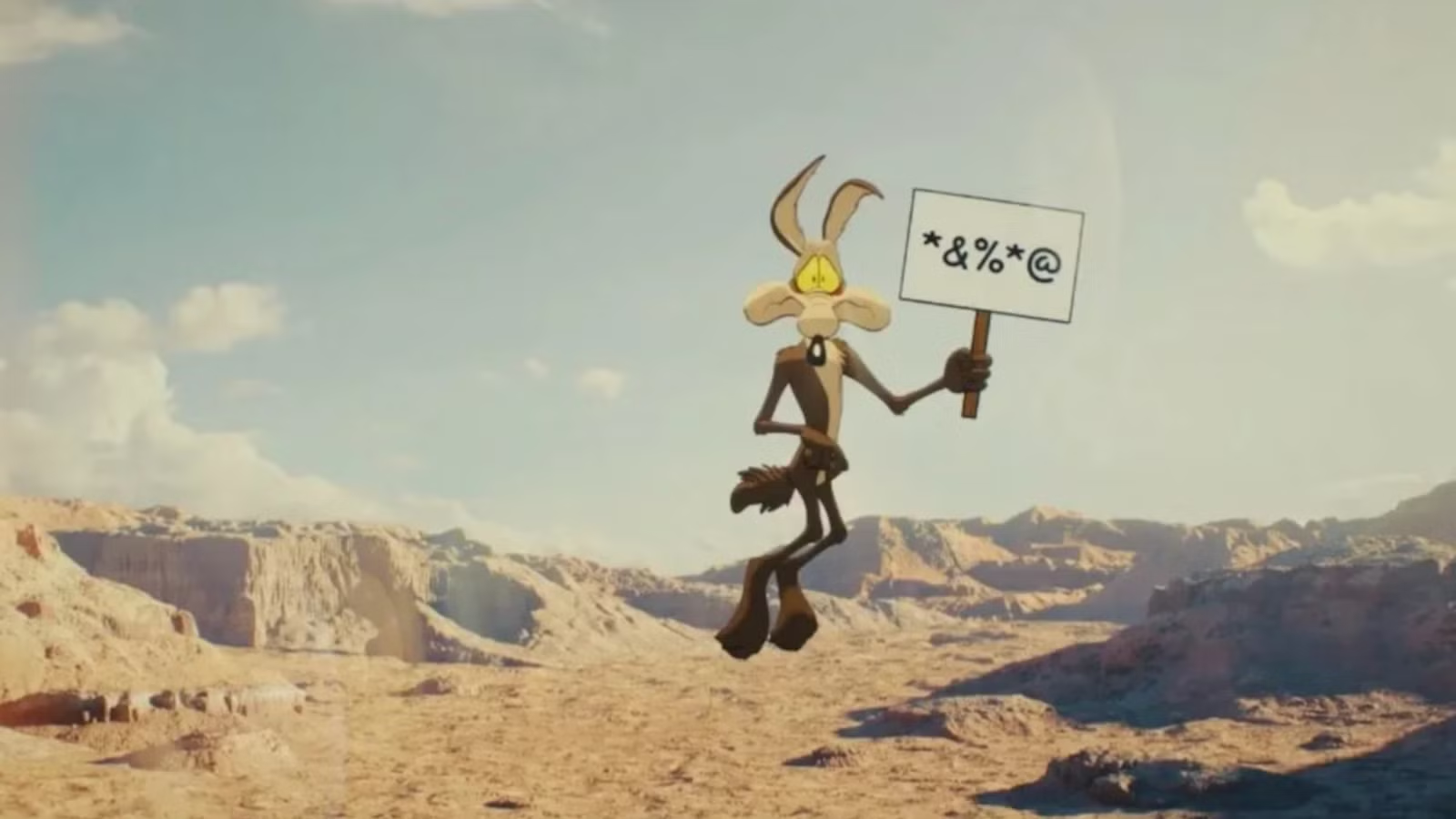
Fair warning up front, this is not going to read like my normal reviews. I watched Coyote vs. Acme and something about it wouldn’t let go. So I thought about it. And I thought about it… and I decided what I was going to actually do was a full philosophical deep dive, using a Looney Tunes courtroom comedy as the on ramp into Nietzsche, of all people, and this search for meaning inside a life that keeps handing you the same boulder over and over. Yes, I am aware I am about to do a philosophy essay about a cartoon where a coyote sues a mail order company. I’m doing it anyway. I think the movie earns it.
Here’s the trailer if you haven’t seen it:

Full spoilers from here on out, including the ending and the big reveal in the third act. Go watch it first if you care about that.
Coyote vs Acme Full Spoiler Walkthrough
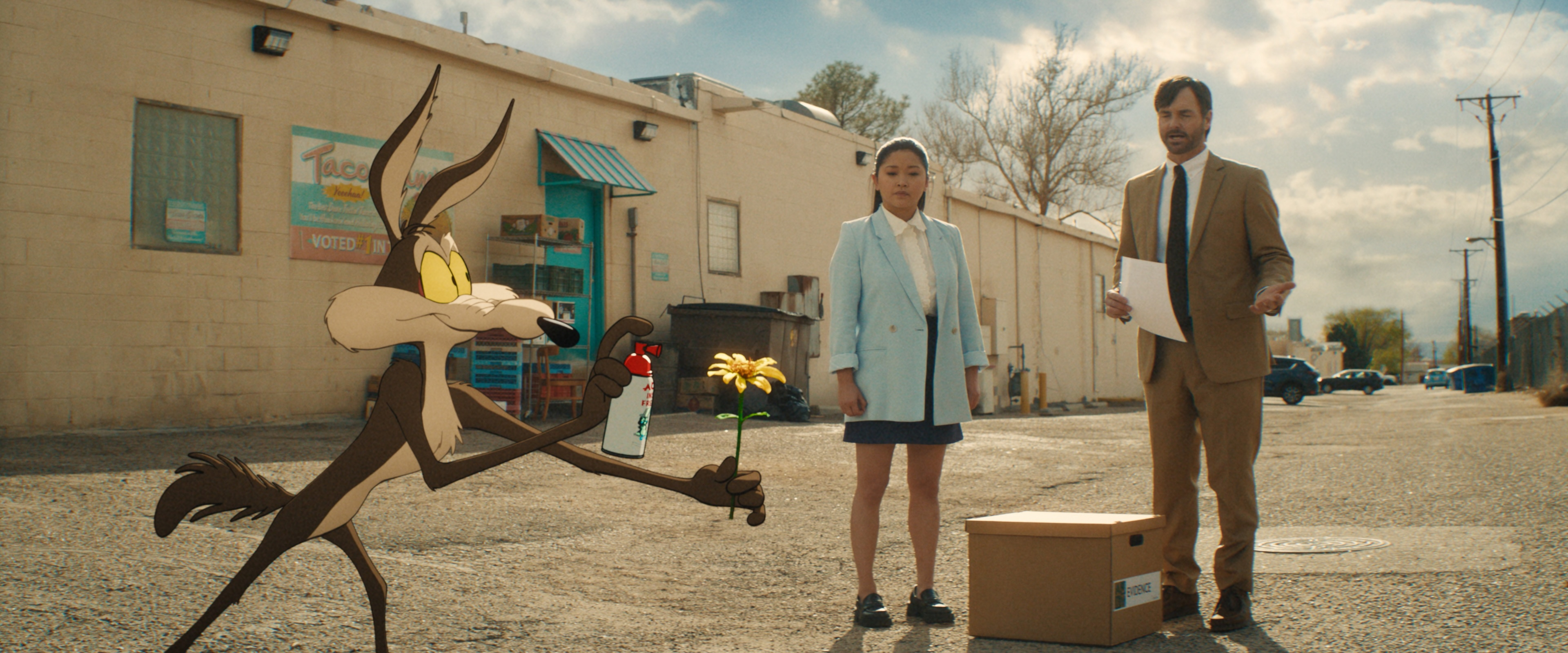
Quick plot rundown before we go anywhere philosophical. Wile E. Coyote hires a struggling attorney named Kevin Avery to sue the Acme Corporation for decades of defective products, rocket skates that explode, anvils that fall on the wrong head, the usual catalog of Looney Tunes carnage. Except it turns out that’s not really why he’s suing. His actual plan is to get the Road Runner subpoenaed and forced to appear in court, where Wile E. can finally, legally, get his hands on him. It’s a con from the start. But the deeper into the case Kevin and his niece Paige dig, the more it becomes clear Acme itself is the real villain, not because their products are badly made by accident, but because they’re intentionally defective, all part of something called Project Sisyphus, a research program that used cartoon suffering, on a loop, specifically to refine and improve the same products for human customers. Acme knew. They named the program after the exact myth you’d expect, and when a whistleblower inside the company objected, she got buried right along with everything else.
So yes. That’s the hook. A children’s cartoon adaptation just built its entire third act conspiracy around the most famous parable of futile, endless labor in all of Western philosophy, and once you notice that, you cannot watch this movie the same way again.
Where Sisyphus Actually Comes From
Quick mythology refresher because it matters for what comes next. Sisyphus was the king of Corinth, and by most tellings kind of a menace, he murdered travelers who came through his city, which was a serious violation of the sacred hospitality codes the Greek gods took personally, and he had the nerve to rat out Zeus to a river god after Zeus kidnapped someone. But the detail that actually earns him his punishment is his arrogance, he decided he was cleverer than the gods themselves, and he proved it twice. First he tricked Death, chaining up Thanatos when he arrived to collect him, which meant nobody in the world could die until Ares eventually stepped in and freed him. Then, after finally being dragged down to the underworld, Sisyphus talked Persephone into letting him go back to the surface, claiming he needed to properly scold his wife for not burying him with the right rites. He had no intention of returning. He just didn’t.
Zeus was done being outsmarted. The punishment fits the crime with an almost cruel elegance, an eternity spent pushing a boulder up a mountain, and every single time Sisyphus gets close to the top, the boulder rolls back down, and he has to start over. Forever. No progress, no finish line, no reward, just the task itself, repeating.
How Philosophy Has Chewed On This For Centuries
The obvious modern landmark here is Albert Camus, whose 1942 essay The Myth of Sisyphus turned this story into the founding text of absurdism. Camus’s whole starting question is basically, if life is meaningless, does that mean suicide is the only honest response, and his answer is no, the honest response is revolt, living fully inside the contradiction instead of resolving it with false comfort, religious or otherwise. Camus zeroes in on Sisyphus specifically as his model absurd hero, and the detail people usually get slightly wrong, myself included until I went back and reread it for this, is that Camus’s famous moment of clarity isn’t actually at the top of the mountain. It’s on the walk back down. That’s the part where Sisyphus isn’t straining, isn’t distracted by the labor, he’s just conscious, fully aware of his own condition, watching the boulder he’s about to have to push again. Camus calls that walk down “the hour of consciousness,” and it’s there, not at the peak, where he says Sisyphus becomes genuinely tragic and genuinely free at the same time, because he sees the whole absurd shape of his life clearly and keeps going anyway. Which is where you get that line everybody quotes without always knowing the context, one must imagine Sisyphus happy.
But here’s the thing that most casual retellings skip entirely, and it’s the part that actually matters for this movie. Camus didn’t invent this out of nowhere. He was explicitly building on Nietzsche.
Getting to Nietzsche, Which Is Really the Point
Nietzsche never wrote his own version of the Sisyphus myth by name the way Camus did, but he built the entire philosophical engine that makes Camus’s ending work, and I’d argue Nietzsche’s version is actually the sharper, more useful lens for a movie about somebody stuck redoing the same doomed task on a loop. Nietzsche’s concept is amor fati, love of one’s fate, and he states it about as plainly as a philosopher ever states anything in Ecce Homo, my formula for greatness in a human being is amor fati, that one wants nothing to be different, not forward, not backward, not in all eternity. He ties this directly to his idea of eternal recurrence, the thought experiment where you imagine living this exact life over again, identically, forever, every triumph and every humiliation on repeat with no changes allowed. Nietzsche’s test for whether you’re actually living well isn’t whether you’d avoid that fate. It’s whether you’d want it. Whether you could stand at the base of your own mountain, boulder included, and mean it when you say yes, again, gladly.
That’s a fundamentally different flavor of meaning than Camus’s quiet, clear eyed walk down the hill. Nietzsche isn’t asking you to calmly accept the absurd. He’s asking you to actively, joyfully will it, to love the repetition itself rather than just tolerate it with dignity. And I think that’s the version Coyote vs. Acme is actually chasing, even if it never says Nietzsche’s name once. The image I can’t shake from this movie isn’t the walk down, it’s the split second the boulder crests the hill, right before gravity takes it back, that one flash where the whole absurd machine briefly looks like it might hold. That instant is Wile E. Coyote’s entire existence compressed into a single frame, decades of exploding gadgets and cliffside failures, and the movie’s real insight, buried inside a courtroom farce about defective rocket skates, is that the chase was never about catching the Road Runner. Winning the lawsuit was never really the point either. The point was always the running itself, and once Wile E. and the humans around him figure that out, the movie stops being a revenge story and starts being, unmistakably, amor fati with a coyote in it.
The Roger Rabbit of It All
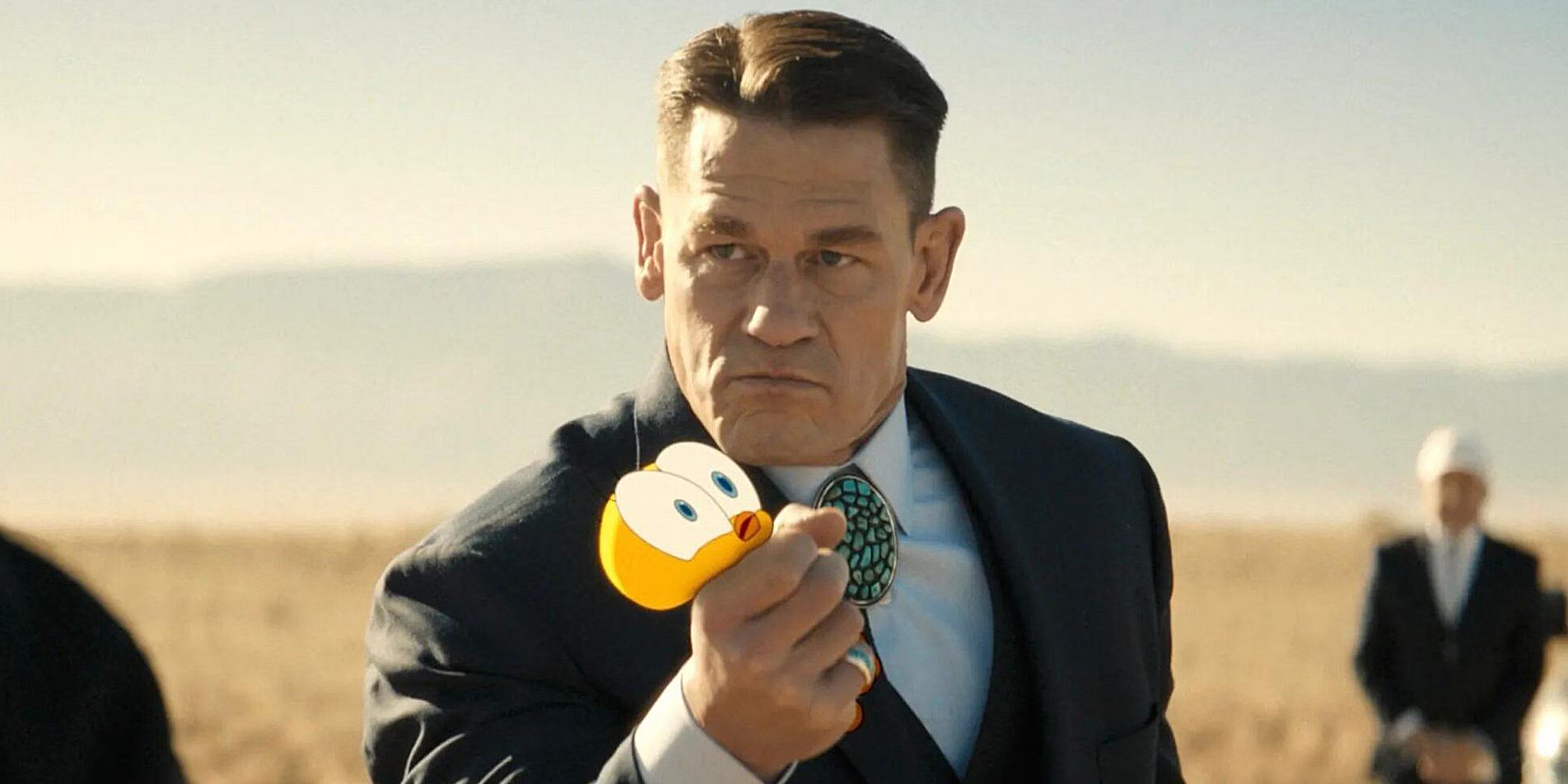
I have to mention this because I’ve loved Who Framed Roger Rabbit since I was a kid, and Coyote vs. Acme is doing something that feels like a genuine spiritual sequel to it, a legal, human-world plot dropped directly into a universe where cartoon logic and real world consequence collide and somehow both stay true to their own rules. Technically, Roger Rabbit is still the more dazzling achievement, that seamless blend of animation and live action still holds up as a genuine miracle of filmmaking craft. But philosophically, I think Coyote vs. Acme actually goes further than its predecessor ever tried to. Roger Rabbit is a noir mystery wearing cartoon skin. Coyote vs. Acme is a straight up meditation on futility and meaning wearing cartoon skin, and it earns the comparison by being willing to end up somewhere Roger Rabbit never even attempts to go.
So that’s my read. A studio-shelved, nearly-buried Looney Tunes movie turned out to be the clearest pop culture explanation of amor fati I’ve encountered in years, hiding behind an anvil joke. Push the boulder. Love the pushing. That’s the whole movie, and it might be the whole thing worth knowing, honestly.
Further Reading…
If you are a complete glutton for punishment, and want to go REALLY deep on this topic, here are my personal favorite books on this topic:
Camus, The Myth of Sisyphus (1942). This is the one, obviously, and it’s short, more of a long essay than a dense philosophical treatise, so it’s approachable even if you’ve never read philosophy before. It’s where “one must imagine Sisyphus happy” comes from, and the Sisyphus material itself is really just the closing chapter of a longer argument about the absurd, so the whole thing is worth reading rather than skipping to the end.
Nietzsche, The Gay Science (1882). This is where eternal recurrence gets introduced, in the famous passage numbered 341, where Nietzsche poses it as a thought experiment, a demon asking whether you’d be willing to live this exact life again, identically, forever. It’s a much easier entry point into Nietzsche than people expect, written in short, punchy aphorisms rather than one long argument, so you can dip in and out of it.
Nietzsche, Ecce Homo (written 1888, published 1908). This is where the actual phrase amor fati and Nietzsche’s cleanest one line formula for it shows up, “that one wants nothing to be different, not forward, not backward, not in all eternity.” It’s also just a strange, entertaining read since it’s Nietzsche’s autobiography and he’s fairly unfiltered in it about how great he thinks his own books are, which makes it oddly fun compared to his more austere work.
Nietzsche, Thus Spoke Zarathustra (1883-85). If you want eternal recurrence dramatized rather than just stated, this is where it shows up as a lived, mythic idea rather than a philosophical proposition. Fair warning, it’s written like scripture or prophecy rather than argument, so it’s the hardest of the four to get through, but it’s the emotional core of his whole project.
Now… if these works above are too much – and you think it might be better to have a secondary source to help hold your hand through these concepts… the two I’d point you toward are: Walter Kaufmann’s Nietzsche: Philosopher, Psychologist, Antichrist. This is the classic scholarly rehabilitation of Nietzsche for English readers and does a genuinely good job untangling the idea of amor fati and eternal recurrence from the popular misreadings of him. And then there is Sarah Bakewell’s At the Existentialist Café. This is a much lighter, more narrative read that covers Camus, Nietzsche, Sartre, and the whole existentialist circle together, and it’s a great “how did we get here” book if you want the broader context as opposed the density of the primary texts.
The fact that a cartoon could even conjure this sort of conversation is an amazing testimony to the depth and breadth of the screenplay writ large here. I hope it’s a gateway drug to philosophy for some of you. The examined life and all that.
beep beep.