
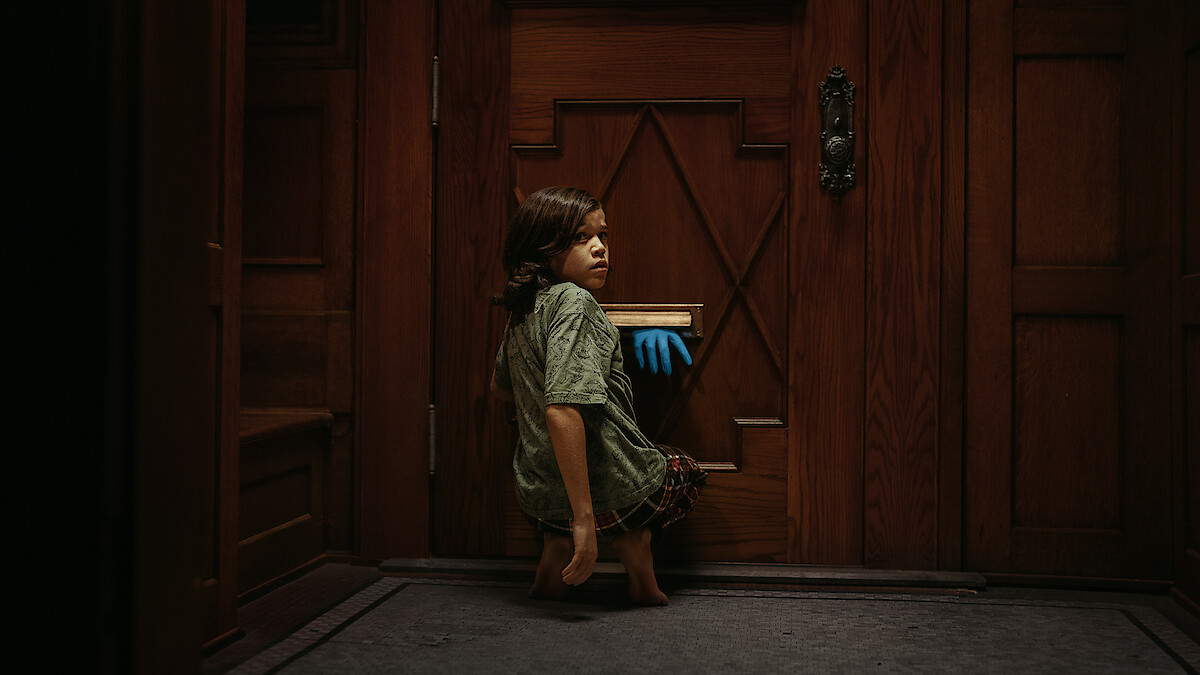
If you are looking for a movie where Robert De Niro and Michael Keaton spend a bunch of time staring each other down across a table while discussing a serial killer who whispers to children before abducting them… I mean… come on. WHAT ARE WE DOING HERE?!? This is one of the darkest, and most brilliantly plotted and dark downward spirals I’ve seen in a long time… and I can’t recommend it highly enough.
The Whisper Man is the new Netflix thriller based on Alex North’s bestselling novel, and it stars Adam Scott, Robert De Niro, Michelle Monaghan, and Michael Keaton. And honestly, that cast is ridiculous. Adam Scott! Robert De Niro! Michelle Monaghan! MICHAEL KEATON! You had me at “Michael Keaton plays a terrifying serial killer,” and then you went ahead and added Robert De Niro as the retired detective who originally caught him.
The basic setup is pretty straightforward. Tom Kennedy is a widowed father who has moved with his young son Jake to a new house after the death of his wife. Jake is already struggling with everything that has happened, and then, one night, he disappears. The problem is that the disappearance looks an awful lot like the work of the infamous Whisper Man, a serial killer who abducted children years earlier.
Except there is one tiny problem with that theory… The Whisper Man is already in prison. So who the hell is doing this?

And that, more or less, is the movie. Except, of course, that isn’t really the movie. Because once The Whisper Man starts peeling back what happened to the original Whisper Man, what happened to his son, what happened to Tom and his father Pete, and what exactly is going on with the mysterious little girl Jake keeps seeing in a blue sweater… there is a LOT more going on here than “serial killer kidnaps kid.”
And I actually think the family stuff is what makes this movie work. The murders are obviously the engine driving the story, but underneath all of that is a movie about fathers and sons and what happens when a child spends his entire life trying to understand whether his father actually loves him.
Which is a pretty dark thing to build a serial-killer thriller around. So. Let’s get into it.
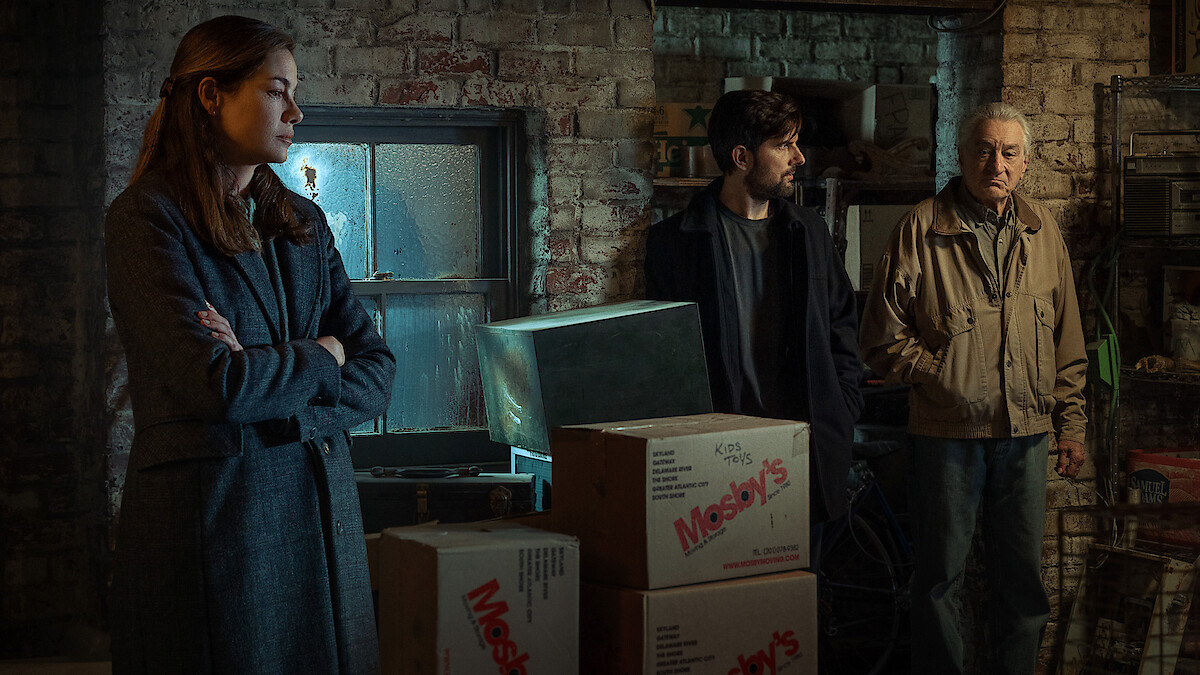
Initial Thoughts on the Movie The Whisper Man
I went into The Whisper Man mostly because of the cast. Robert De Niro and Michael Keaton sharing a movie about a serial killer? Yep. I’m there. And Adam Scott is actually a really interesting choice for the father at the center of the story because he doesn’t feel like your standard action-thriller dad. He’s not Liam Neeson suddenly becoming a one-man SWAT team because somebody kidnapped his daughter. He’s a crime novelist who has lost his wife, is trying to raise his kid, and is pretty clearly not doing a particularly great job of processing any of it.
And then there is Robert De Niro, who gets to play Pete Willis, the retired detective who originally caught the Whisper Man. Pete has been carrying this case around with him for decades, and, more importantly, he has been carrying around the failure of his relationship with his own son, Tom. That becomes the part of the movie I found much more interesting than the actual serial-killer mystery, because you slowly realize that almost every major character in this story is dealing with some version of the same problem. Frank Carter has a son. Pete has a son. Tom has a son. And every one of these fathers has screwed up that relationship in a different way.
So when Jake disappears, Tom is forced back into a relationship with the father he has spent years avoiding, and Pete is suddenly given a chance to do something for his son and grandson that he couldn’t do when Tom was a kid. The serial-killer mystery is what gets everybody into the same room, but the movie is really interested in what happens when these damaged fathers are given another chance to deal with the consequences of what they have done.
And then there is Jake’s little imaginary friend, the Girl in the Blue Sweater, who seems like she is probably just part of the “kid dealing with grief” setup until the movie starts giving her an awful lot of information she shouldn’t have. She knows where to go. She seems to understand what is happening. She helps Jake hide. And eventually the movie gives us a photograph that makes you go, “Wait… hang on a second… WHO is that?”
That is where this thing gets much more interesting.
Okay, Full Spoilers From Here On Out. Do Not Keep Reading If You Haven’t Seen The Whisper Man
Also, I’m going to go through the story in chronological order rather than simply walking through the movie exactly as it presents things, because The Whisper Man deliberately holds some information back from us. That’s part of what makes the mystery work, but it also means that if we’re trying to actually understand what happened, it makes more sense to put the pieces together first and then talk about what the ending means. So let’s start with the original Whisper Man and work our way forward.
Section 1: Frank Carter and the Original Whisper Man
You have to understand how this all kicked off – because its seminal to how it continued.
Frank Carter (Michael Keaton, Birdman, anyone?) is the original Whisper Man, and he has been sitting in prison for years after Pete Willis (Robert DeNiro – Taxi Driver anyone? Killers of the Flower Moon, The Irishman, The Joker, etc etc etc.) caught him. His method was pretty horrifyingly simple. He would whisper to children, convince them to leave their homes, and then abduct and kill them. He became this almost mythological figure in the town, which is important because the new murders are not simply similar to the old ones. They are deliberately recreating the mythology of Frank Carter.
Pete has never really gotten over the case. He still visits Frank in prison, and Frank has sent him hundreds of letters over the years. When Tom (played by Adam Scott – Severance, Parks and Recreation) discovers the letters, he initially assumes that his father has somehow maintained a relationship with the man who destroyed so many lives. But the reality is more complicated. Pete has kept the letters because Frank has essentially become a physical reminder of everything Pete lost, including his relationship with Tom. Frank knows exactly where to stick the knife, too, because he spends years needling Pete about his son and about the fact that Pete failed as a father.
That becomes particularly important once Jake disappears, because Frank tells Pete something that initially sounds like one of his usual psychological games: the Whisper Man only takes children who want to be taken. Jake had actually gone with the kidnapper willingly at first, right after he had fought with Tom. And suddenly Pete is looking at his own son, his own grandson, and Frank Carter’s relationship with his own son and realizing that there is a pattern here.
Frank even talks about how, when a child is denied a father’s love, that child can begin to mythologize the father instead. At first that sounds like Frank simply being cruel, but Pete eventually realizes that Frank isn’t really talking about Tom at all. He’s talking about his own son.
And that is the clue that breaks the entire case open.
Section 2: The House Tom and Jake Move Into
The house is important because Jake is the one who wanted to move there. Tom is initially just trying to give his son a fresh start after Rebecca’s death, but Jake is strangely drawn to this particular house, and he keeps talking about a boy in the floor. Tom doesn’t really understand what he means until he and Pete start investigating the basement and discover that Jake was not imagining it.
There are bodies hidden in the house.
One of them is Tony Smith, who was the Whisper Man’s fifth victim. Another is Dominic Barnett, a man who had been involved in the strange network of people interested in Frank Carter and his crimes. Suddenly the house itself becomes part of the mystery, because Jake somehow knew there was something underneath the floor before Tom had any idea what was there.
This is also where Norman Collins comes into the story. Norman is a true-crime obsessive with a house full of murder memorabilia, and Tom has already caught him trespassing in the basement. So, naturally, everybody starts wondering if Norman is the new Whisper Man. He certainly looks like the kind of guy who might be.
But Norman isn’t the killer.
What he actually did was much stranger. Norman had made a deal with Frank Carter, and he became involved with Dominic Barnett and the old Whisper Man house because he wanted access to the remains and history surrounding the murders. Barnett had been essentially acting as an intermediary, giving people access to the house and the things associated with Frank Carter. Norman eventually kills Barnett after Barnett mocks his interest in Tony Smith and the Whisper Man.
So Norman is absolutely involved in the story, but he isn’t the person kidnapping children. He knows who the real killer is, though, and when the police start closing in on him, he chooses to kill himself rather than give them the answer. Which leaves Pete with one option. Go back to Frank.
Section 3: Pete Goes Back to Frank Carter
So this is where this movie just grabs you by the jugular and doesn’t let go – and yes this is probably my favorite part of the movie. Why? Because you have Robert De Niro and Michael Keaton sitting across from each other in a prison visiting room and the entire scene is basically two people trying to figure out who is going to psychologically manipulate the other person first.
Pete needs information. Frank knows exactly what Pete needs. And Frank knows that Pete will do almost anything to find Jake. Frank starts talking about his son, and about how children respond when their fathers don’t love them the way they need to be loved. And this is where Pete finally understands what Frank has been talking about all along. Frank’s son, Francis Carter Jr., has spent his entire life living in the shadow of his father. He didn’t simply reject his father and run in the opposite direction. He became obsessed with him.
He wanted to understand him. And eventually, he started becoming him. That is the reveal. The new Whisper Man isn’t some random copycat killer who happens to know all of Frank Carter’s methods. It is Frank Carter’s own son, Francis Jr. And once you know that, a LOT of the movie falls into place.
Francis Jr. has been living under another identity and working as a teaching assistant at Jake’s school. He has had access to Jake. He has been able to watch him and get close to him without looking like a stranger. And he isn’t simply kidnapping children because he enjoys killing them. His whole identity has become wrapped around trying to please the father who could never be pleased.
Which is a pretty horrifying way to spend a childhood.
Section 4: Frank Carter’s Son Becomes the Whisper Man
There is a really nasty irony here, because Frank Jr. is almost the first victim of the Whisper Man before he ever becomes the second one.
His father is a monster, and Frank Jr. grows up trying to make sense of that. Instead of being able to separate himself from what his father did, he turns his father into this larger-than-life figure and tries to understand him by imitating him. He becomes the thing his father was. And Frank Sr. knows exactly what his son is doing.
That’s what makes their relationship so disturbing. Frank isn’t shocked that his son has become a killer. He isn’t horrified. He isn’t proud, either, at least not in any normal sense of the word. He seems almost fascinated by the fact that his son has spent his life trying to get his approval.
Pete eventually makes a deal with Frank. If Frank tells him where Jake is, Pete will make sure Frank gets the thing he has been asking for: time alone with his son.
And this is one of those moments where you think you know where the movie is going. You assume Frank wants to see his son because he wants some kind of reunion. Maybe he wants to manipulate him. Maybe he wants to give him advice. Maybe he wants to say goodbye.
Nope. Frank wants to kill him.
The movie eventually makes clear that Frank had always had this strange fixation on his own son. The children he killed were, in some twisted way, substitutes for the person he actually wanted to get his hands on. Pete realizes that when he tells Frank that he finally understands why Frank always covered the victims’ faces. There was someone Frank couldn’t get to, someone too close to home, and the other children became a substitute for that rage.
Which is about as dark as this movie gets, and that’s saying something.
Section 5: Amanda Finds the New Whisper Man
While Pete is talking to Frank, Amanda Beck (White Lotus, True Detective) is following another lead and eventually arrives at the house of the police psychiatrist who interviewed Frank’s family years earlier. There is a young man living there, and Amanda eventually realizes that this is Frank Carter Jr.
And Jake is there.
This is where the movie goes from mystery to full-on chase. Amanda discovers the psychiatrist’s mutilated body, realizes what she has walked into, and Francis Jr. attacks her. He seriously injures her and manages to escape with Jake.
At this point Pete and Tom know enough to realize where Francis is taking him. Frank Jr. is taking Jake back to the beginning, back to the house, back to the basement where Tony Smith’s body was hidden. And that is where Tom and Pete finally catch up with them.
Section 6: Pete Finally Gets His Chance to Be a Father
The final confrontation happens in Tom and Jake’s house. Jake has been put into the hidden crawlspace where Tony Smith’s body was found, and Tom eventually finds him there. Pete arrives to help, and everything falls apart into a brutal fight between Frank Jr., Tom, and Pete.
Francis Jr. stabs Pete in the stomach with a screwdriver, and at that point Pete knows he isn’t going to make it. But he has enough time to get Jake out. He tells his grandson to run, and Jake does.
That moment is really the culmination of Pete’s entire story.
Earlier in the movie we learn about Tom’s childhood imaginary friend, Mister Night. Tom remembered this mysterious figure who would come into his room at night, read him stories, take him on little adventures, and kiss him goodnight. Eventually Tom discovered that Mister Night wasn’t imaginary at all. It was Pete, sneaking into his son’s room because even though Pete had basically destroyed his relationship with Tom, he still wanted some connection with him.
Pete didn’t know how to be a father. He didn’t know how to fix what he’d broken. But at the end of his life, he finally gets one completely unambiguous opportunity to do something for his son and his grandson.
He saves Jake. And then he dies.
There is something pretty sad about that because Pete spends the entire movie trying to solve the Whisper Man case again, as if solving the case might somehow repair the damage that happened the first time around. But it doesn’t. The thing that finally gives Pete any kind of redemption isn’t catching Frank Carter. It isn’t identifying Frank Jr. It isn’t solving the mystery.
It’s choosing his grandson.
Section 7: What Happens to Frank Jr.?
Tom eventually catches up with Frank Jr. and the fight continues upstairs. Earlier in the movie Tom had noticed that part of the attic floor was dangerously weak, and during the struggle Francis Jr. steps onto that section and crashes through it. He survives the fall, but he is captured. And this brings us back to Frank Carter.
Remember that deal Pete made? Pete promised Frank that he would get his five minutes alone with his son if Frank told him where Jake was. Well, Frank gets those five minutes. And he uses them to kill Francis Jr. Frank puts a shirt over his son’s face and strangles him in the same basic manner that he used to kill his victims.
And that, to me, is probably the bleakest part of the entire movie, because Francis Jr. spent his entire life trying to get something from his father that he was never going to get. He became a murderer because he wanted his father’s approval. He copied his father’s crimes because he wanted to be understood by him. He spent his entire life moving toward his father.
And when he finally gets what he wanted — time alone with his father — his father kills him.
There isn’t really any redemption in Frank’s story. Pete at least gets the opportunity to sacrifice himself for his family. Frank destroys his own. And that contrast feels very intentional.
Section 8: So Who Is the Girl in the Blue Sweater?
Okay. Here is where The Whisper Man stops being a straightforward crime thriller and gets weird. Throughout the movie, Jake has been talking to a little girl wearing a blue sweater. Nobody else can see her. At first it is easy enough to assume that she is an imaginary friend, especially because Jake is grieving the death of his mother.
But after everything is over, Tom and Jake move into Pete’s house, and Tom starts going through old family photographs. And eventually he finds a photograph of Rebecca when she was a child. She’s wearing the blue sweater. And she looks exactly like the girl Jake has been seeing.
So… what the hell?
The movie very deliberately doesn’t give us a clean answer here. And I absolutely love that from this black and white film. The dark and scary gets real and seeps into the rest of the film. I really think that is the right decision, because there are two ways to understand what happened.
Theory #1 To Explain the Ending of The Whisper Man
The supernatural interpretation is that Jake’s mother really has been with him. She died, Jake is grieving her, and somehow her presence has manifested to him as the little girl she once was. She guides him. She helps him hide. She seems to know things she shouldn’t know. And then, at the end, Tom finds the photograph that essentially confirms that the girl Jake has been seeing looks exactly like Rebecca. If you want to believe that Rebecca is actually there, the movie gives you enough evidence to make that reading work.
Theory #2 To Explain the Ending of The Whisper Man
But there is another way to look at it, and I think this is where the movie gets more interesting. Jake has lost his mother. He is a little kid trying to process something he doesn’t understand. His brain creates a person who represents safety and familiarity, and that person takes the form of his mother. The fact that the girl looks like Rebecca as a child doesn’t necessarily mean that a ghost is walking around the house. It could mean that Jake’s mind has created a representation of his mother that he can actually interact with.
And the movie refuses to tell us which one it is.
That ambiguity isn’t an accident. James Ashcroft has talked about wanting the Girl in the Blue Sweater to work on both a psychological and supernatural level, and I think that is pretty clearly what the movie is doing.
So What Is This Movie Actually Saying? A Few Theories
The first thing I kept coming back to is that The Whisper Man is really a movie about fathers and sons disguised as a serial-killer movie. Think about the three generations here. You have Frank Carter and Francis Jr. You have Pete and Tom. And you have Tom and Jake. Each relationship is basically a different version of the same question: What happens to a child when the father doesn’t give him what he needs?
Frank Jr. responds by running toward his father. He wants to become him. He wants to earn his approval so badly that he eventually turns himself into the thing he hates. Tom responds by running away. He cuts Pete out of his life and spends years refusing to deal with him.
And Jake is the next generation. He’s watching his father grieve. He’s lost his mother. He’s vulnerable. And he is right at the age where the things his parents do are going to start shaping who he becomes. The movie could have made this much more explicit, but I actually like that it doesn’t. It lets the serial-killer plot carry the theme instead of stopping every twenty minutes to tell us what the theme is.
And then there is the Girl in the Blue Sweater.
If she is really Rebecca, then the movie has this strange supernatural counterweight to all of the terrible fathers. Frank’s son is destroyed by his father. Tom is nearly destroyed by his relationship with his father. Pete spends his final moments trying to repair his relationship with Tom. And meanwhile Jake has this mother who, even in death, is somehow still protecting him.
But if the Girl isn’t literally Rebecca, I don’t think that ruins the idea at all. In fact, it may make it more poignant. Jake has lost his mother, so his brain creates a version of her that can still be there for him. He needs her, so he creates her.
And that is basically what all of these characters have been doing throughout the movie. They create stories about their parents because the actual relationships are too painful or too incomplete to understand. Frank Jr. creates a mythology around Frank. Tom spends his life trying to understand Pete. Jake creates the Girl in the Blue Sweater. Everybody is trying to fill in the missing pieces.
My Actual Read on The Whisper Man
I don’t think The Whisper Man is really about the question “Who is the serial killer?” even though that’s obviously the question the movie gives us first. The answer is Francis Jr., and once we get there, the movie immediately becomes more interested in why he did it than in the mechanics of how he did it.
Francis Jr. is what happens when a child decides that the only way to understand his father is to become his father. Tom is what happens when a child decides the only way to survive his father is to get away from him. And Jake is the third possibility. He can inherit all of this damage, or he can be the person who finally breaks it.
That’s why Pete’s death matters so much.
Pete can’t go back and fix Tom’s childhood. He can’t undo everything he did. He can’t suddenly become the father he should have been. But he can make one choice at the end that is completely different from the choices Frank made. He can protect the child. And he does.
That is probably why I ended up liking this movie more than I expected to. It starts out looking like another serial-killer mystery where you’re waiting for the clever reveal about who has been copying the original killer. And there is certainly some of that. But underneath it, the movie is really interested in the ways people inherit the damage their parents leave behind, and whether that damage has to continue forever.
Francis Jr. says yes. Pete, eventually, says no. And Jake gets to live with the difference.
As for the Girl in the Blue Sweater… I don’t know. Maybe Rebecca really is there. Maybe Jake’s grief has given him a way to keep his mother with him. Maybe the movie wants us to believe both things at the same time. And honestly, I think that’s a much better ending than having somebody walk into the room and explain it.
What did you make of that final photograph? Because the serial-killer mystery has a pretty definitive answer, but that last little supernatural question is where I think the movie gets genuinely interesting. And, yeah… Robert De Niro and Michael Keaton sitting across from each other arguing about serial killers was basically all I needed to click play in the first place.