
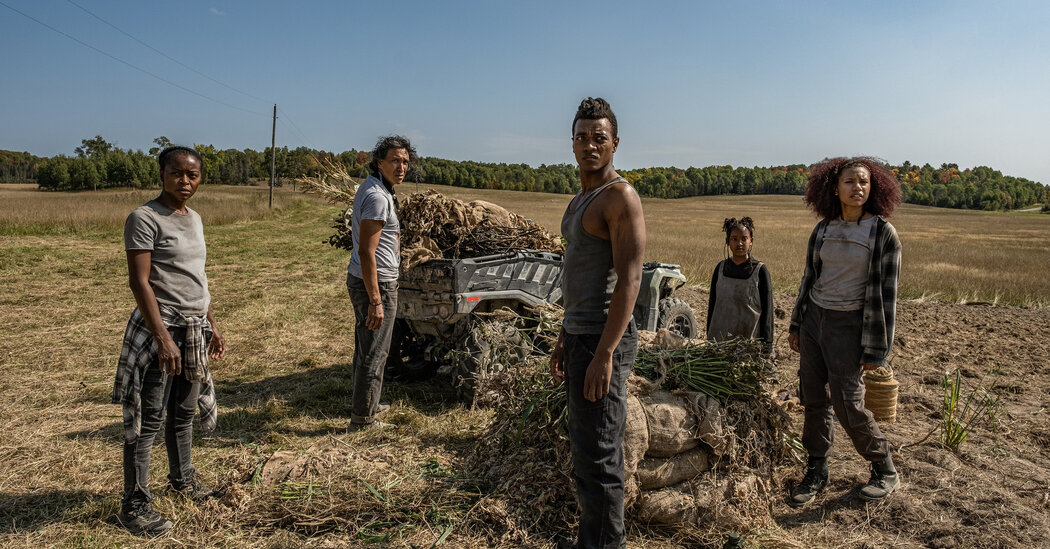
If there’s one thing I love, it’s a genre film that knows exactly what it wants to say. I also love a low budget film that isn’t afraid to swing big. 40 Acres, the feature debut from director R.T. Thorne, does exactly that – it points to the fence and then proceeds to knock one out of the park. On the surface, it’s a post-apocalyptic survival thriller. But underneath the tense standoffs and the silence of decimated farmland is a film that simmers with grief, generational weight, and the harsh lessons of history.
Anchored by an absolutely riveting performance from Danielle Deadwyler, 40 Acres manages to feel both painfully intimate and apocalyptically vast. It’s a story about a single family guarding their land at the end of the world — but it’s also about what that land has always meant. Promises broken. Legacies carried. Trauma inherited.
40 Acres is set in a future ravaged by a fungal blight that has decimated animal life and collapsed food systems. We drop into the fortified homestead of the Freeman family. Their land — 40 acres passed down from freed slaves in the 1800s — has become a last stand, a redoubt of hope and heritage. But not even the past can protect them from what’s coming.

Spoiler Warning: Full Breakdown of 40 Acres (2024)
Beyond this point: spoilers ahead. Here be dragons. If you haven’t seen 40 Acres yet, do yourself a favor and stop here. Go watch it. You can find it for rent on Prime, Google, and AppleTV. Once you’ve watched, then come back and join in on the discussion of this fantastic indie film.
The film opens in silence. Wide shots of decaying farmland. A single house. Barren fields. No animals. The air is thick with fungal spores — the byproduct of a global agricultural collapse. Cities are gone. Supply chains are shattered. And humanity has regressed to the point of scavenging and territorial violence.
The Freeman family — Hailey (Danielle Deadwyler), her partner Galen (Michael Greyeyes), and their teenage son Manny (Kataem O’Connor) — have survived by staying isolated on their ancestral land in rural Canada. It’s not just a home. It’s a fortress. Hailey, an ex-U.S. Army survivalist, has drilled her family in defense and routine. No one gets in. No one goes out.
Except Manny has been sneaking out.
He meets Dawn (Milcania Diaz‑Rojas), a malnourished and traumatized teen who’s been wandering through the woods, alone. Against his mother’s teachings, Manny brings her back — hiding her in an old tool shed. He feeds her. Talks to her. Bonds with her.
When Hailey discovers Dawn, the already strained family tensions explode. Galen, more sympathetic, believes in helping. Hailey sees risk. And that risk quickly proves justified. Unbeknownst to the family, Dawn is being hunted by a nomadic gang of cannibals — former city-dwellers driven to horrifying lengths by hunger.
As the siege begins, initially, the Freeman’s hold them off with sniper shots, traps, and raw determination. But it’s not sustainable. The invaders leave threats etched into trees. They poison the water. They wait. The tension peaks when Galen is wounded defending the perimeter. Hailey, exhausted and desperate, finally begins training Dawn alongside Manny, trusting them with defense tactics, firearm drills, and watch rotation.
Flashbacks intercut these events, showing Hailey’s military past, the trauma of a failed evacuation years earlier, and the origin of the Freeman land grant — “forty acres and a mule,” a promise made, and broken, in American history. We see Hailey’s ancestors fighting to keep that land during earlier generations of oppression.
The final act is a hellstorm.
The gang launches a full assault, breaching the farmhouse. In a brutal, close-quarters fight, Galen is killed. Hailey and Dawn are separated. Manny is captured but uses his training to escape, setting the barn ablaze as a diversion. In a last stand echoing her ancestor’s stories, Hailey lures the gang into a trench she dug weeks earlier — filled with gasoline and nails — and lights it. The fire consumes the attackers and half the house.
In the final moments, we see Manny, Dawn, and Hailey regrouping in the smoking remains. The farm is burned, but they’re alive. They bury Galen. The final shot lingers on a charred sign in the soil: “Freeman Land – Est. 1875.” The camera pans upward as birds — real birds — fly overhead for the first time in the film.
There’s a lot that works here, but let’s start with the obvious: Danielle Deadwyler’s performance is first and foremost. This is Deadwyler’s film, full stop. She’s steely and haunted, commanding and broken. Hailey is a woman carrying centuries of trauma, military guilt, and maternal anxiety — and Deadwyler sells every minute of it. You believe she can protect this land. You believe it’s killing her to do it.
Secondly, this is a post-apocalypse movie that’s actually about something. Unlike most survival films, 40 Acres is about something. It’s not just the end of the world — it’s the end of a system that already failed the Freeman’s generations ago. The “forty acres” aren’t just real estate; they’re legacy. They’re justice. And the fact that this family is still having to fight for them? That hits hard.
Also, R.T. Thorne’s direction is precise and controlled. The horror isn’t flashy. It’s lurking. The silence is as terrifying as the violence. Thorne trusts us to sit with the slow moments — to understand what’s at stake when the camera lingers on Manny hesitating to pull a trigger. The film could’ve stopped at being an effective thriller. But it goes further. It weaves in climate change, racial injustice, colonialism, land rights, and survivalism — without becoming preachy. It’s not a lecture. It’s a lived-in narrative.
The History of “40 Acres“
The phrase “40 acres and a mule” refers to a promise made to formerly enslaved African Americans after the Civil War. Literally it comes from General Sherman’s Field Order Number 15. This order, issued in January 1865, allocated plots of land, generally 40 acres, along the southeastern coast of the United States to Black families to help them establish economic independence. While the order was a significant attempt to provide reparations, it was ultimately overturned, and most of the promised land was returned to its previous owners.
Woah, okay… so this means that the movie, 40 Acres, which is led by black and indigenous family members, might just be about something else entirely. Maybe. With that understanding, now we can see the movie in an entirely different light. The movie is about reparations. The movie is about generational strife and a tiring fight for what is theirs, and what is due. The movie is all about lost opportunity and failed promises.
In Conclusion – 40 Acres is Fantastic
40 Acres isn’t just a great indie thriller. It’s a generational story told through the lens of survival and sacrifice. It’s what happens when genre storytelling meets historical resonance — when survival is more than just about food and water. It’s about meaning. There’s a moment late in the film when Hailey says to Manny, “They’ve taken everything from us before. Not this time.” It’s not melodrama. It’s not movie posturing. It’s an echo — from history, from pain, from every fight for justice that’s gone ignored.
Edited by: CY