
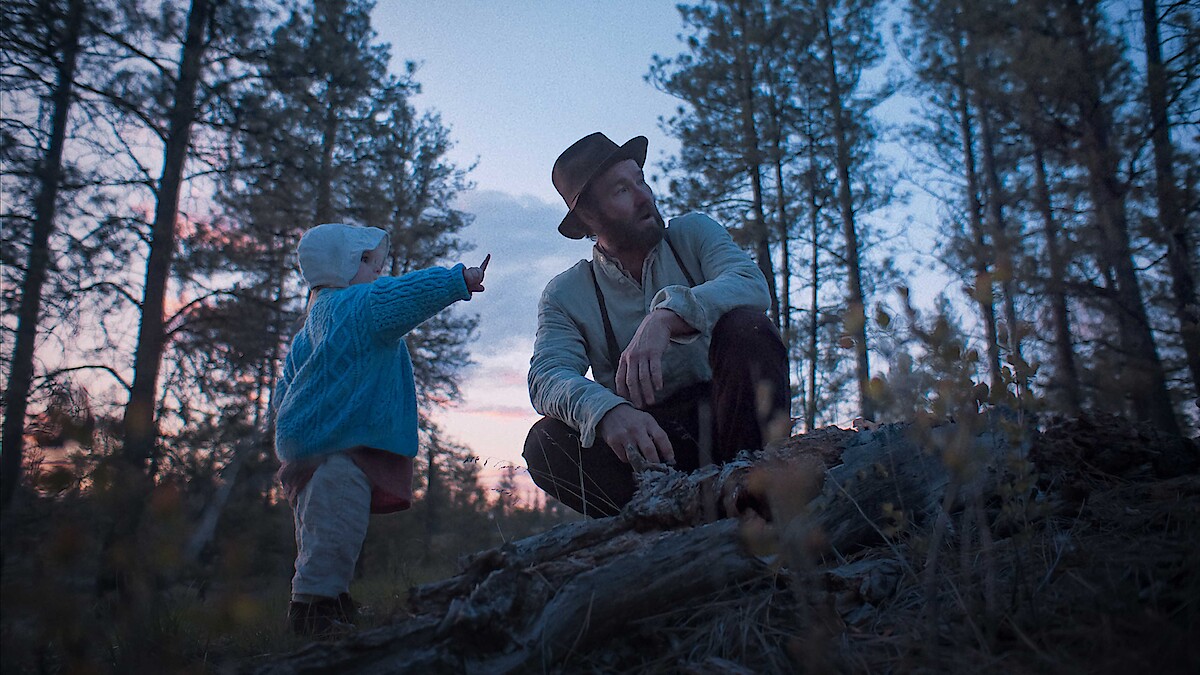
Look. I’m not your average movie reviewer. I don’t care how others view movies and I definitely am not swayed by popular films in Hollywood (the current best example is One Battle After Another… I just did not get that movie at all.) At the end of the day, I just want to feel something when watching a movie. And Train Dreams has emotions and depth to it in spades. Clint Bentley’s Train Dreams belongs to this rarest of categories—a work of cinema so quietly profound, so achingly beautiful, that it lingers in your consciousness long after the credits roll, reshaping how you perceive the texture of everyday existence.
Based on Denis Johnson’s acclaimed novella and adapted by Bentley alongside Greg Kwedar (the team behind Sing Sing), Train Dreams is a birth-to-death character study that follows Robert Grainier, a railroad laborer in the early 20th century American West. But to describe it merely as a biographical drama would be to miss the point entirely. This is a film about echoes. It’s a film about how lives reverberate across time, how the individual connects to the earth and to history, how ordinary existence contains within it something eternal and sacred.
A Life Observed
Up until Train Dreams, my favorite Joel Edgerton movie is, by far and away, The Green Knight. But in Train Dreams, Edgerton does something entirely different than in the rest of his oeuvre. This is a story about a man who speaks sparingly but whose interior life pulses with complexity beneath a stoic exterior. Edgerton plays a character who watches more than speaks, conveying Robert’s essence through eyes and body language rather than dialogue. It’s a masterclass in restraint, the kind of acting that reminds us how much can be communicated through a glance, a shift in posture, the way a man holds his hands after decades of hard labor.
The genius of Bentley’s approach lies in his deployment of narration by the incomparable Will Patton, whose voice becomes the film’s beating heart. Patton’s narration is both soothing and powerful, speaking for the often-silent Robert and conveying his inner monologue in a way that feels transcendent, like listening to a great storyteller. Normally, I think that narration is just a crutch for really lazy screenwriting (especially when the source material comes from a novel). But here, the voiceover becomes something more profound—a reminder that every life, no matter how humble, deserves to be witnessed and remembered with eloquence.
The Poetry of Labor and Loss
Train Dreams opens with an image that encapsulates its entire philosophy: a pair of worker’s boots nailed to a tree, weathered by time and the elements, perhaps forgotten by everyone except the forest itself. It’s the kind of thing you might spot in the woods and pause to consider—whose were they? What was their story? This is cinema as archaeology, asking us to see the mythical grace in the mundane, to recognize that these boots represent someone’s entire existence, their labor, their dreams, their passage through this world.
Robert’s work building the railroad becomes a meditation on progress itself. The trains that cut across the American landscape represented connection and expansion, bringing distant communities closer together. Yet this progress came at a cost—ancient forests felled, ecosystems disrupted, indigenous lands carved up by steel and steam. The railroad tracks symbolize both progress and destruction, something that made the world smaller by connecting people while altering the landscape by cutting down trees that had been there for centuries. Robert lives within this duality, building the future while haunted by what’s been lost.
The film’s opening sequences have a dreamlike quality, memories rendered in images that are simultaneously ethereal and grounded in physical reality. Working with cinematographer Adolpho Veloso (who also shot Bentley’s gorgeous Jockey), the director creates scenes that feel tactile—you can smell the fire keeping workers warm, feel moisture in the air, sense the cold penetrating worn clothing. Yet there’s also something mythic about these moments, as if we’re watching legend crystallize into being.
Guilt and Moral Witness
One of the film’s most haunting elements is Robert’s lifelong burden of guilt stemming from a formative moment on the railroad. Early in his working life, he witnesses the murder of a Chinese immigrant, and his inaction in that crucial moment becomes something he carries for the rest of his days. This isn’t presented as melodrama but as quiet moral reckoning—Robert wonders whether his failure to intervene somehow invited the tragedies that would later befall him, as if the universe demanded payment for his silence.
This thread runs beneath the entire film, never explicitly stated but always present. It adds moral complexity to Robert’s character, reminding us that even good people can fail in critical moments, and that we live with those failures whether we speak of them or not. The film treats this with the same restraint it brings to everything else—not as a plot point to be resolved but as a scar that becomes part of who Robert is, shaping how he moves through the world even decades later.
Love Against the Landscape
When Robert meets Gladys, played with luminous grace by Felicity Jones, Train Dreams reaches toward its most hopeful heights. The courtship scenes recall Days of Heaven in their use of magic hour cinematography, two figures silhouetted against skies ablaze with color, imagining the life they’ll build together. There’s a particular scene, almost unbearably tender, where Robert and Gladys use rocks to map out on the riverside the house they plan to construct. It’s a gem of a moment—two young people with everything ahead of them, building their future from imagination and stone.
They do build that house. They do have a daughter. And then tragedy—swift, merciless, complete—shatters everything Robert has dreamed of and worked for. Bentley handles this devastation with remarkable restraint, understanding that the most profound grief often exists in what’s left unsaid, in the empty spaces where laughter and conversation used to live.
The Ensemble’s Grace
While Edgerton anchors the film, the supporting performances create a rich tapestry of frontier life. William H. Macy appears briefly as an explosives expert, and somehow in just a handful of scenes creates a character that feels lived-in and three-dimensional. It’s an incredibly short performance but also somehow one of Macy’s best, formative to the film in that it helps ground it right when it could become too shapeless. This is the mark of a director who knows how to guide actors—Bentley never lets the film’s poetic aspirations overwhelm the human reality of his characters.
Later, Kerry Condon appears in a brief but crucial role, delivering one of the film’s most resonant lines: “The dead tree is as important as the living one.” It’s a statement that crystallizes the film’s entire philosophy—that loss and life exist in constant dialogue, that what has ended remains present, that we carry our ghosts alongside our hopes.
Threading the Needle
What makes Train Dreams exceptional is how Bentley navigates between brutal reality and wistful poetry without ever losing his balance. The film possesses the quality of a dream or memory while threading the needle between brutal reality and wistful poetry. Lesser films attempting this aesthetic often sacrifice character for imagery, becoming exercises in empty visual style. But Bentley understands that true poetry emerges from authentic human experience, not from artifice layered atop it.
The film’s visual language, enhanced by Bryce Dessner’s haunting score (Dessner is a member of The National), creates an almost hypnotic viewing experience. Scenes unfold with patient deliberation, allowing us to simply exist within moments—wind moving through branches, light changing across a valley, the rhythm of an axe splitting wood. This is cinema that refuses to rush, that insists we slow down and pay attention to the texture of life itself.
Memory and Meaning
The film operates as a meditation on how we are connected to both the earth and those who walked it before us, exploring how an ordinary life is rendered in an extraordinary way. Robert’s story becomes everyone’s story—the struggle to find meaning in labor, the search for connection in a vast and indifferent landscape, the question of whether our brief time on earth leaves any mark worth remembering.
There’s a profound idea woven throughout Train Dreams: that we exist not in isolation but as part of a continuum, links in a chain stretching backward and forward through time. We are connected to each other and the earth like train tracks across the heartland, moving us forward while leaving marks that take generations to fade away. Robert’s life—his loves, his losses, his decades of quiet endurance—matters not because it was extraordinary in any conventional sense, but because all lives matter, all stories deserve telling.
A Film for Our Moment
In an era when cinema often prioritizes spectacle over substance, Train Dreams offers something increasingly rare: a film that trusts its audience to engage with slowness, with silence, with the accumulation of small moments rather than explosive set pieces. It asks us to consider that an ordinary life, observed with sufficient care and attention, reveals itself as miraculous.
The film’s greatest achievement may be its insistence that life is both ordinary and beautiful at the same time. Robert Grainier wasn’t a hero in any traditional sense. He didn’t change history or accomplish anything that would merit remembrance in conventional terms. He cut down trees, laid railroad tracks, built a small house, loved his family, endured unimaginable loss, and kept living. And somehow, in Bentley’s hands, this becomes not just sufficient but transcendent.
The film made me stop and wonder, how many men like Robert have there been? Random men that lived quiet, plodding lives, and died just as quietly. Not heroes. Not men for the newspaper. But men that just continued living in the face of the tragedies of life. And women of course. How many people have there been that just plodded one foot in front of the other, eeking out an existence in the face of extraordinarily short odds?
The Legacy We Leave
The film reminds us that if we’re lucky, there’s someone to tell our story or remember us on their own. Robert’s story survives because Will Patton’s narrator chose to tell it, because Clint Bentley chose to film it, because Denis Johnson chose to write it. But more broadly, we all survive in the memories of others, in the marks we leave on the landscape, in the echoes of our actions rippling forward through time.
Train Dreams is a film of profound empathy and generosity, one that believes deeply in the dignity of every human life. It’s a work that will reward repeated viewings, each time revealing new layers of meaning, new connections between images and ideas. This is cinema as meditation, as prayer, as witness to the beauty and sorrow of existence itself.
In a year crowded with films competing for attention, Train Dreams stands apart—quieter than its peers but no less powerful, perhaps more powerful for its refusal to shout. It’s a film that doesn’t demand your attention but earns it through accumulated grace, through its patient insistence that an ordinary life, truly seen, contains within it all the wonder and tragedy of the human condition.
This is filmmaking at its most elemental and essential—a reminder of why we need cinema, why stories matter, why bearing witness to each other’s lives might be among the most sacred acts we’re capable of. Train Dreams is, quite simply,