
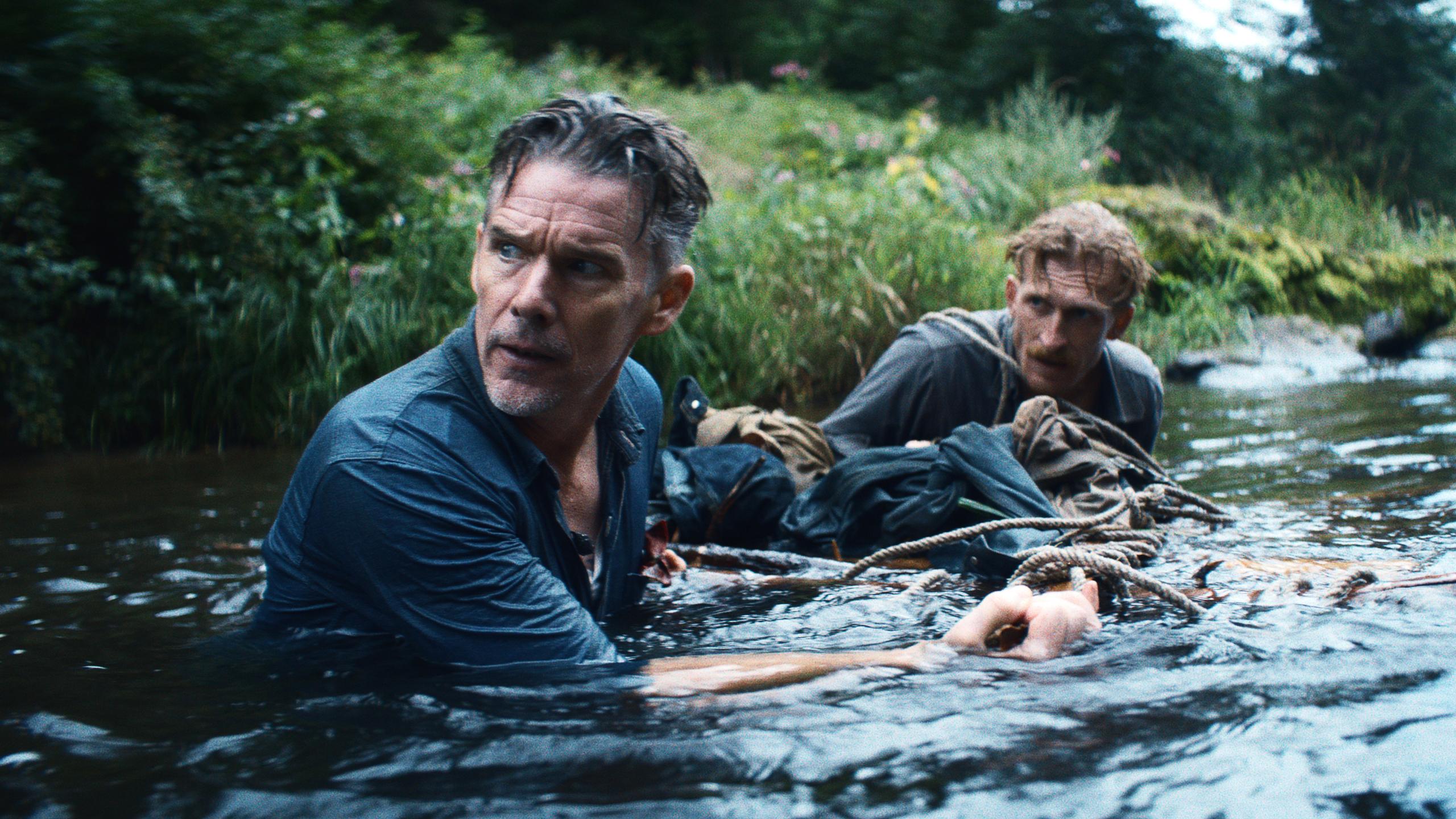
Was The Movie The Weight Historically Accurate. Okay so I need to talk about The Weight because I went into it wanting a historical action movie in the vein of Lawless or The Untouchables and came out having gotten exactly that, just filtered through a completely different lense. BUT WAS IT ACCURATE? There were so many important historical details that needed to come together in order to make this plot even necessary!! But, were they on point? Secondly, was the movie any good?!?
For those that don’t know – or haven’t seen it yet, this is the new movie from Padraic McKinley, and it’s got Ethan Hawke as Samuel Murphy, a widowed single father in Depression era Oregon who loses his house, gets separated from his young daughter Penny, and lands in a prison labor camp run by Russell Crowe’s Warden Clancy. But… thankfully… Clancy dangles a way out. The Weight is currently sitting around 94% on Rotten Tomatoes, and I get why. Go watch it, then come back, and then we’ll discuss whether this movie is anywhere close to being an actual, historically accurate thing or not. Okay?

Full Spoilers From Here On Out, Including the Ending
This is your last exit if you want to go in clean. Go watch it, come back, we’ll talk.
The Setup: A Debt, a Deal, and a Deadline
Samuel Murphy is a widower and out of work mechanic in 1933 Oregon. He’s trying to do odd jobs and keep his rent paid, but while his daughter and he are out at church he is evicted from his apartment. Then, after while he was trying to find work – after a simple misunderstanding and a confrontation – Sam ends up arrested and sent to a prison labor camp. Yes, that is right – this is the emotional engine that jet fuels this entire story… and it is the fact that Penny gets placed in a shelter. Yeah. Worse, Samuel is told flat out that in about a month, Penny is going to be placed with a family permanently. Yes, he will be losing his daughter forever if he doesn’t find some way to get out of prison right away. So yeah – that’s the clock the entire movie runs on. (It’s sort of like the Death Star clock to when it is in range, and will be firing on Yavin Prime at the end of the movie… T-minus 4 hours and 12 minutes til the Death star is in range!!! That’s just a call out to all my real geek readers out there. 98% of you you have never even heard of Yavin Prime before.)
Fade cut from Star Wars back to The Weight. Quickly though, Warden Clancy sees something useful in Samuel after he solves a complex engineering problem quickly by moving a massive boulder in just a few minutes. Clancy knows that Samuel hasgrit and leadership, and the Warden offers him a deal. There’s gold that needs to be moved, gold that’s supposed to be surrendered to the federal government under the new order coming down from Washington, and Clancy wants it moved before it gets stolen. He knows that the gold is at risk, and all over the country, bandits have been storming mines and stealing the gold before the Federal Government cant receive it. And so Samuel accepts the job, and he picks three other inmates to bring with him, Rankin, a loudmouthed racist type, Singh, an articulate socialist, and Olson, a sweet natured young Swede. Two armed guards, Amis and Letender, come along to keep everyone honest, and along the way they pick up Anna, an Indigenous woman fleeing servitude at a nearby mining operation, who ends up being the only one in the group who actually knows how to survive out there. (Gotta admit, she is definitely the biggest loose thread in this entire screenplay… but we’ll get to that in good time.)
Wait, Was the Gold Thing Actually Real?
I had to stop the movie about twenty minutes in because the whole premise hinges on this critical moment during the depression when Roosevelt orders all this gold seized and all these mines to be shut down, and that felt way too specific and way too load bearing to the plot to just be Hollywood inventing a crisis out of nowhere. So I went and actually checked. Well, it turns out the movie is doing a few interesting things here at once. Because there were two very real events that happened – and that were compressed into a single historical event.
The gold seizure part is completely real!! It totally lines up with the movie’s 1933 setting almost exactly. On April 5, 1933, Franklin Roosevelt signed Executive Order 6102, which made it illegal for private citizens to hoard gold coins, gold bullion, or gold certificates, and gave everyone until May 1 of that year to turn theirs in to a Federal Reserve bank. This wasn’t a small ask either, the penalties for holding out were up to ten years in prison and a ten thousand dollar fine, which is somewhere around a quarter million dollars today. The long and short of it was all tangled up in monetary policy. At the time, the country was on the gold standard (you know, every paper dollar bill had to be backed by the equivalent amount of gold in a vault somewhere – aka Fort Knox) the Federal Reserve was nearly maxed out on how much currency it could issue under the gold backing requirements, and the government needed that gold moving through the system instead of sitting in mattresses and safety deposit boxes. So yeah – holding gold stayed illegal for private citizens to own gold bullion for the next four decades, all the way until Gerald Ford signed the law that undid it, effective at the very end of 1974. 40 years! Crazy. So, my 24 carat gold necklace Mr. Roosevelt?!?! I’m sure that was complicated!
Right – so here’s the second bit… and this is the part where the movie takes some serious dramatic license. Apparently, the actual shutdown of America’s gold mines wasn’t part of the 1933 order at all. That came almost a decade later, in December 1942, under something called War Production Board Order L-208, and it had nothing to do with hoarding or currency policy. That one was a World War II wartime labor and materials call, the government needed men and equipment moved over to mining copper, zinc, and lead instead of gold. You know, metals that actually mattered for the war effort, and gold mining was judged to be, in their own words, largely wasted labor by comparison. Fair point – how many canon barrels are made from gold? (Today though, Gold is an enormously important element in the war effort. But that is a different topic entirely. Want to fall down a really interesting rabbit trail? Dig into the world of rare earths mining, and China’s 85-90% control of these important metals, but I digress.)
So yeah – it’s the only industry in the country that got directly ordered to close during the entire war. Gold mining towns like Grass Valley and Nevada City in California, which had actually boomed during the Depression with dozens of active mines, got hollowed out almost overnight, and a lot of miners never came back to the industry once it lifted. So the movie’s premise is really smashing two real, true events together, the actual 1933 gold seizure and confiscation order, and the actual, but much later, 1942 mine shutdown, into one single moment of crisis to make the stakes land harder and faster. I actually respect that as a storytelling choice once I understood what they were doing, it’s not sloppy, it’s compression, and both halves of it really happened, just nine years apart from each other.
Back to the Wilderness
Okay, let’s get back to the movie The Weight shall we? The trip out is brutal in the way these survival treks always are, there’s a rickety bridge crossing where the gold bars have to be tossed across bar by bar over churning white water, there’s a log jammed river crossing where Samuel nearly drowns and Anna saves his life by sharing air with him underwater, and there are other prospectors and opportunists in the area who would happily kill every last one of them for that much gold if they got the chance. And then there’s the tension baked into the group itself. Apparently, people get really funny around gold, and betrayal creeps in during that river sequence specifically, trust eroding in exactly the way you’d expect from four desperate men and two armed guards all watching the same fortune.
One of the three prisoners, hurt badly enough during the journey (shot, and then hitting his head on top of it) becomes too much of a liability to keep moving at the pace the guards need. So in the middle of the night, rather than slow the whole group down or risk him further, the guards quietly kill him. (Can you say Revenant?) It’s a cold, practical, entirely unsentimental moment, and it’s the kind of detail that tells you exactly what kind of movie this actually is underneath the father daughter framing. This isn’t a feel good survival story. People are expendable out here the second they stop being useful.
How It Actually Ends
Samuel, Anna, and the two surviving prisoners make it back to Clancy with the gold. And this is where Samuel does something I did not see coming, he tells Clancy flatly that they are not honoring the original deal. Instead of trading the gold straight for commuted sentences, Samuel renegotiates on the spot, insisting that Clancy, himself, Anna, and the two other surviving prisoners all get an equal cut of the gold. Not just freedom. An actual share. And I just have to say, that this is probably the most historically inaccurate thing in the entire movie. Clancy arguing to lose money to a Native American? Or was he arguing for a share for someone he liked? loved? I’m debating this from a historical accuracy standpoint, NOT FROM A FAIRNESS STANDPOINT. Just for the record!)
From there, Samuel and Anna go together to collect Penny, and the movie closes exactly the way it opened, Samuel and his daughter driving fast down an open road, laughing, the two of them finally back together. It’s a clean, deliberate bit of symmetry, and it lands.
My Thoughts
I loved this. I went in comparing it to Lawless and The Untouchables in my head, and I think it earns the comparison, but it’s doing something a little different than either of those. Lawless is about a family protecting what’s theirs against outside pressure, and The Untouchables is about the law finally catching up to lawlessness. The Weight is neither of those, really, it’s about a man who starts the movie with absolutely nothing left to lose, and by the end has figured out that the rules everyone else is playing by, the deal, the sentence, the hierarchy between warden and prisoner, are only as fixed as the amount of leverage you’re willing to walk in with. Samuel doesn’t get his freedom handed to him as a reward for good behavior. He takes a cut of the actual prize and forces Clancy to renegotiate from a position Clancy never expected a convict to have. That’s a genuinely different, more cynical thesis than either of my two comparison points, and I think it’s the better movie for it.
The one prisoner’s death still sits with me a little uncomfortably, in a good way. It would have been so easy for this movie to treat every member of that crew as precious cargo just because they’re sympathetic, and instead it lets the guards make the exact cold calculation that men in their position would actually make. That’s the moment I trusted the movie completely, because it stopped being interested in being nice to its characters and started being interested in being honest about the world it built.
And that ending, Samuel and Penny driving fast and laughing, mirroring the exact opening shot, it’s not subtle, and I don’t think it’s trying to be. Sometimes you’ve earned the right to a clean, symmetrical, unashamedly warm final image, and after everything this movie puts Samuel through, I was fully on board with letting him have it.