
I need to tell you up front that I am an enormous, unapologetic Aaron Sorkin fan. I’ve watched West Wing beginning to end three or four times. Moneyball is magic. Molly’s Game is criminally underrated. Chicago 7 is just brilliantly written, start to finish. And The Social Network, the first one, is about as close to a perfect movie as exists. Screenplay, acting, score, all of it. So when I tell you that The Social Reckoning did not work for me, understand that it is not coming from someone who walked in looking for a reason to dislike an Aaron Sorkin movie. It’s coming from someone who loves this man’s writing and still thinks he picked the wrong fight to pick, at the wrong moment, for the wrong reasons.
The short version, spoiler free, is this. The movie is beautifully written, the way almost everything Sorkin writes is beautifully written. The performances are solid. The dialogue crackles the way it always does. And underneath all of that craft, the movie is hammering home an insight that we all already had as a collective zeitgeist epiphany somewhere around five to ten years ago. We know Facebook’s algorithm amplifies misinformation because outrage is what keeps people scrolling. We knew that before this movie started shooting. Worse, the back half of the film leans hard into the horror of the January 6 riots at a moment when pardons and quiet historical whitewashing are actively underway elsewhere. The movie is talking to its audience like we don’t already get it. We get it. We’ve gotten it for a while now.

Full spoilers from here on. If you haven’t seen it and want to go in clean, this is your exit.
The Social Reckoning Movie Walkthrough
The Social Reckoning tells the Frances Haugen story, the real Facebook whistleblower who leaked thousands of internal company documents in 2021. Mikey Madison plays Frances, a data scientist inside Facebook’s trust and safety org, and the film’s real emotional entry point into her arc is personal rather than corporate. Frances has a former friend, Kayleigh, played by Portia Doubleday, who used to be a passionate progressive and has since been slowly radicalized by exactly the kind of content Facebook’s recommendation engine is built to surface. Kayleigh ends up arrested for threatening two nonwhite police officers after posting a video to a far right page, and that’s the moment that cracks Frances open. She starts digging into what the platform is actually doing to people like Kayleigh, and what she finds is the internal research the real Haugen actually leaked, including the number that anchors the whole film, that an internal Facebook study found 64 percent of all extremist group joins on the platform were happening because of the recommendation tools itself. Not organic searching. The algorithm doing exactly what it was built to do.
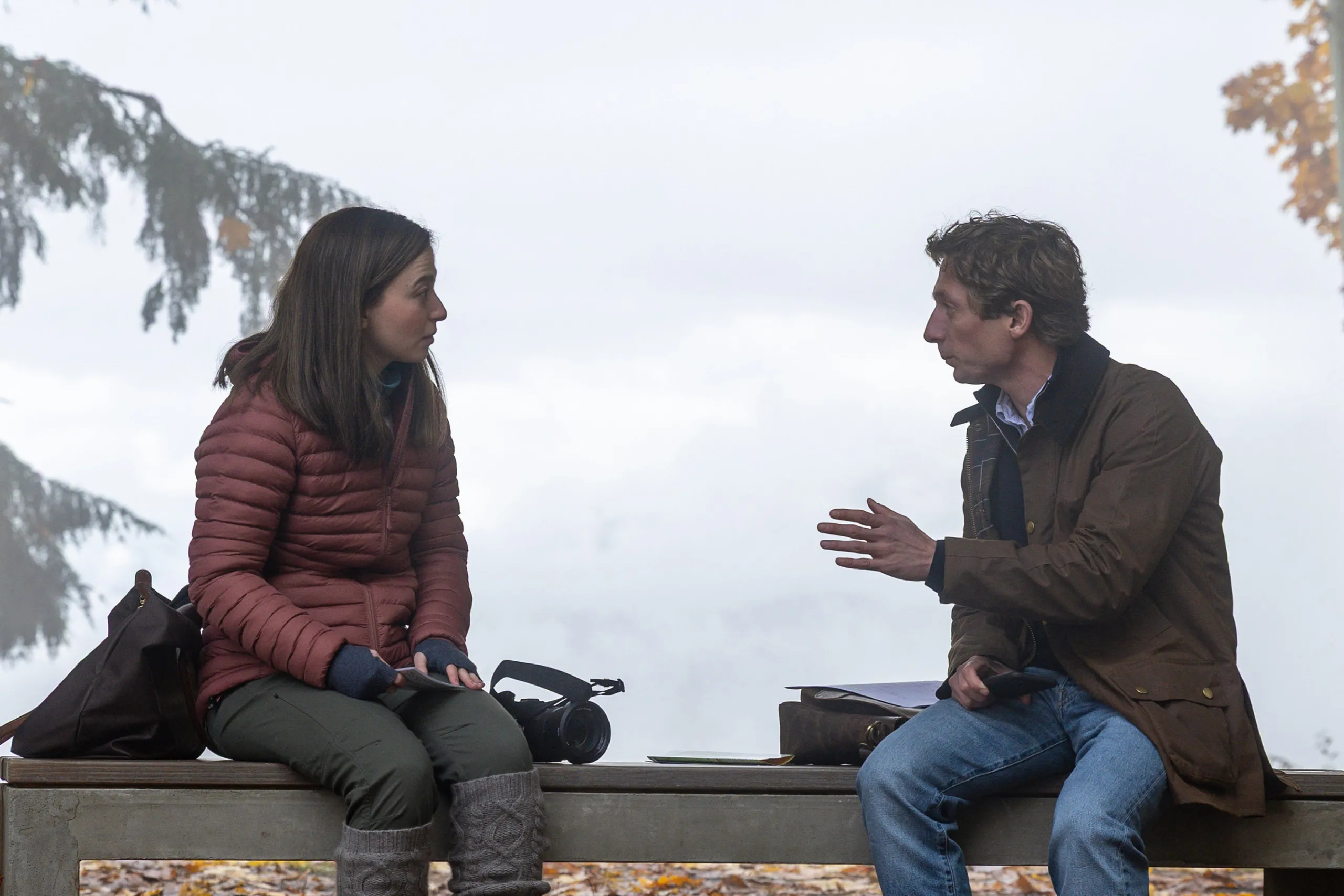
Frances brings what she’s found to Jeff Horwitz, played by Jeremy Allen White, a Wall Street Journal reporter who ends up writing the real Facebook Files series based on her leaks. Jeremy Strong plays Zuckerberg, and the film is careful not to make him a cartoon fascist, he’s written as something colder and more plausible than that, a self interested businessman who has drifted toward anti regulation politics because anti regulation politics are good for engagement and good for the business. There’s a sharp little moment in the film where someone proposes a safeguard that would have slowed the spread of exactly this kind of radicalization, and Zuckerberg kills it because the internal projection says it would cost the platform a single percentage point of engagement. One percent. That’s the whole movie in miniature, honestly. Every bad decision in this film seems to trace back to infinitesimally small business friction points. (Trust me, I optimize funnels for a living, I understand what a 1% hit means… and still, you take the hit.)
The movie builds toward January 6, and it does the thing with Trump and Zuckerberg that I actually think is the most interesting choice Sorkin makes in the entire film, even if it isn’t subtle at all. Trump sits and watches the riot unfold on television rather than intervening. Zuckerberg stands and watches the disinformation flooding his own platform in real time and also chooses not to act. Two powerful men, two screens, two decisions to just let it happen rather than be the one who has to own stopping it. The climax intercuts Frances’s actual Senate testimony with recreated footage of the Capitol attack itself, and there’s a detail I didn’t expect to land as hard as it did, Frances and Jeff end up having one of their conversations in a room that had been used as a triage center for injured police officers during the riot. The film closes on text explaining that the company renamed itself Meta not long after Haugen’s testimony, and that Meta ended its third party fact checking program in 2025. That last line, given everything the movie just spent two hours building toward, is about as bleak a closing beat as a movie gets, we told you, we testified, and the actual outcome was a rebrand and the removal of the one remaining guardrail.
Where It Falls Apart for Me
Here’s my core issue with this movie, laid out as plainly as I can put it. We already know what gets reshared the most on these platforms. It’s misinformation, and we will amplify it and turbocharge it every single time, because outrage is the most efficient fuel there is. If only we hadn’t known this for the last five, ten years. This much is obvious at this point. So what, exactly, is The Social Reckoning reckoning with? There’s a genuinely great line in the movie, something like, change a one to a zero, a zero to a one, just change it, or is it possible that the politicians who stand to benefit the most from misinformation are also the ones most likely to create a more relaxed regulatory environment, the ones least likely to ever reform Section 230. That’s a terrific piece of writing. It’s also an argument I’ve already internalized, and so has most of the audience this movie is actually going to reach.
What These Movies Do
The key here to my outrage with The Social Reckoning is that movies in this genre, which are called “Competence Porn,”, “Process-Oriented Cinema,” or “System Procedurals”… illuminate arcane systems. They educate the user as to how systems work, and then turn them on their head as the movie progresses along its standard trajectory. The Real Estate Market works this way – A + B = C. See? But along come these guys and A – B = Z!! WAHT? Right? We’ve come to love Competence Porn. We eat them for lunch… The Founder, Dumb Money, The Insider, Margin Call, Thank You For Smoking, Snowden, Dark Waters, Enron – The Smartest Guys in the Room… you get the idea. I LOVE ME SOME System Procedural magic.
But when the movie itself pulls the veil back to only reveal… what it is that you already know? You’ve failed at the very core tenet of this genre of movie making. The social contract between the director and the audience is… come with me, and I’ll explain how the British Septic system was supposed to work – but then I’ll show you how these entrepreneurs bankrupted London by doing this instead. Or whatever. But Sorkin spells out the inherently evil practices of Facebook, and says to us while nudging our shoulders… I know awful right? And we all collectively shrug. We know they are evil. We get it that they are shoveling refuse into our faces for money. It’s obvious.
The timing problem compounds the whole thing. Sorkin reportedly spent roughly two years writing this before production started in 2025, and if you place yourself back at that moment, centering the climax on January 6 makes total sense. The wound was fresh, the stakes felt live. But this movie came out in October 2026, into a moment where pardons and quiet historical rewriting of that exact riot are actively happening around us. Hammering home the horror of January 6 right now, while the political apparatus is busy whitewashing it, isn’t brave, it’s just late. It’s like someone grabbing your shoulder to warn you about something they spotted in the rear view mirror a while back, something you already passed while they were asleep. Woah! Except there’s a sharknado on the road directly ahead of us that this same person refuses to even glance at. The whole thing plays tone deaf from beginning to end, and I want to be very clear that this isn’t a both sides complaint. I’m an ex-republican turned liberal (as a response to Trump). I was and remain one hundred percent against what happened on January 6. I just don’t think a movie that arrives this late to an argument this settled, while ignoring the argument that’s actually live right now, is doing anyone any favors.
And that’s really my pitch for what Sorkin should have aimed at instead. The thing eating people alive on Meta’s platforms right this moment isn’t 2016 era misinformation, it’s AI slop, an endless, bottomless feed of fabricated images, fake news clips, and synthetic nonsense that huge swaths of people have no ability whatsoever to distinguish from something real. That’s the version of this story that’s actually still unfolding in real time, the one where the epiphany hasn’t already happened for most of the country yet. That would have been a polemic worth shouting from the rooftops right now. Instead we got a very well written postmortem on a fire that already burned out.
I also have to talk about the Sorkin-isms, because this movie is absolutely loaded with his signature move, the fringe intellectual reference dropped into a scene specifically to make a character, and by extension Sorkin himself, sound a few steps smarter than the room. Someone says they’re not a basset hound sent into the woods to go sniff out truffles, which, respectfully, I don’t think that’s actually a thing basset hounds do. Someone asks, with real sincerity, whether the word spatula is Yiddish. There’s a Cassandra reference that actually lands, with the correction that unlike the boy who cried wolf, Cassandra’s predictions of doom were entirely real and accurate, she just suffered the agony of shouting the truth into a void that chose to ignore her, which, fine, that one’s actually a pretty devastating thing to put in a whistleblower movie. Somebody compares blaming a piece of this mess on something incidental to blaming the Zodiac Killer on pencils and paper. There’s a bit where Zuckerberg’s camp dismisses an accusation of mansplaining by saying they’ve considered the argument, done some introspection, and concluded that’s just something women say when they’re losing an argument, which is a genuinely sharp bit of writing even while being exactly the kind of thing that drew criticism for casual sexism. Someone wishes they had the courage of their convictions like Spartacus, and admits they don’t. And then there’s a full highbrow name check of Antigone, John Proctor, A Tale of Two Cities, and, for God’s sake, Gandalf, as the standard art and literature have supposedly set for moral courage, capped off by somebody remembering that Sydney Carton, the hero of A Tale of Two Cities, gets his head chopped off for his trouble. It’s a lot. It’s very Sorkin. Some of it is genuinely great, especially the Cassandra line, and some of it is a writer reaching so far past the actual scene that you can feel the reach.
The Acting of The Social Reckoning
On performances, Jeremy Allen White is decent, fine honestly, which feels like underselling a guy who was next level brilliant in The Bear, but he’s barely used here, the Horwitz role just doesn’t give him much to chew on. Jeremy Strong’s Zuckerberg has this flat, controlled, almost Mr. Robot kind of affect to it, deliberately so, and I think that’s the correct choice for playing the real guy, but it also means Strong spends the whole movie being held back by the person he’s actually playing. Mikey Madison, coming off Anora, is genuinely next level here, she plays Frances as a quasi-autistic, brilliant, socially out of step engineer type and she’s the best thing in the movie by a wide margin. And yet nothing about this cast really stands out the way a Sorkin ensemble usually does, and I genuinely can’t tell if that’s a formula problem with the script or if it’s because the central aha, the 64 percent stat and the mechanics of the algorithm itself, never gets dramatized as vividly as it should. He could have taken a page from his own Moneyball playbook here, or better yet, borrowed a trick from The Big Short, which took something just as inscrutable and made it completely, viscerally scrutable. This movie explains the algorithm. It never quite makes you feel it.
To be totally fair, and to be clear about where I actually land, in a vacuum, completely divorced from The Social Network or anything else Sorkin’s written, this is a decent movie. It’s fine. Good even, in stretches. Put it in a time machine and send it back to 2020, and this thing kills, it’s exactly the gut punch the moment would have called for. But the choice to bang this particular gong, at this particular time, while the discourse has moved somewhere else entirely, is just a real miss. Brilliant writing in service of an argument we already won.