
Backrooms Youtube eps 1 – 10 explanation post
Backrooms Youtube eps 11 – 17 explanation post
Backrooms Youtube eps 18 – 22 explanation post
Backrooms Movie explanation walkthrough
Backrooms Movie Theories Explanation
Backrooms Definitive Timeline
Here’s the thing nobody talks about enough when they discuss the Kane Pixels Backrooms series. There is a gap. Damage Control was uploaded in early 2023. The next episode — Found Footage #3 — didn’t arrive until September, 2024. That’s roughly eighteen months of silence. And it wasn’t exactly voluntary silence: the series had been acquired by A24, production on the feature film was underway, and there were actual legal complications around releasing new Backrooms content while the movie deal was in motion. Found Footage #3 itself got held back over concerns about how the new material would interact with the film’s development.
So when it finally dropped — 45 minutes long, the longest episode by a wide margin — the fandom lost its collective mind. And then two more episodes came after it, in quick succession. And then: nothing. Because Kane Parsons was directing his first feature film for A24, and the YouTube series had done its job.
Static Dead End, uploaded February 13, 2025, is the last episode before the movie. And it ends exactly where the film needs to begin. You’ll see once we get all the way through it. Let’s finish this.

Episode 19: Found Footage #3
This one is a full film. Not a short. A full, 45-minute found footage feature that feels like Kane Parsons essentially making the movie he knew he was about to make on a much larger scale, as a warm-up lap.
Our subject is Ravi. He’s a regular guy, going about his regular life, when something intrudes. A noise from below his apartment. He investigates, finds signs of a break-in, goes to his basement — and a hole in the cinder block wall is glowing faintly green. Before he can process any of that, the lights flicker, the ground shakes, and Ravi gets knocked through into the Backrooms.
This is now the third civilian noclip we’ve witnessed across the series, and each one lands differently. Kane’s was sudden and accidental. The woman in Found Footage #2 was experimentally curious. Ravi is just a guy who heard something and made the mistake of going to look. He’s the most ordinary of the three, which makes watching him navigate this the most uncomfortable.
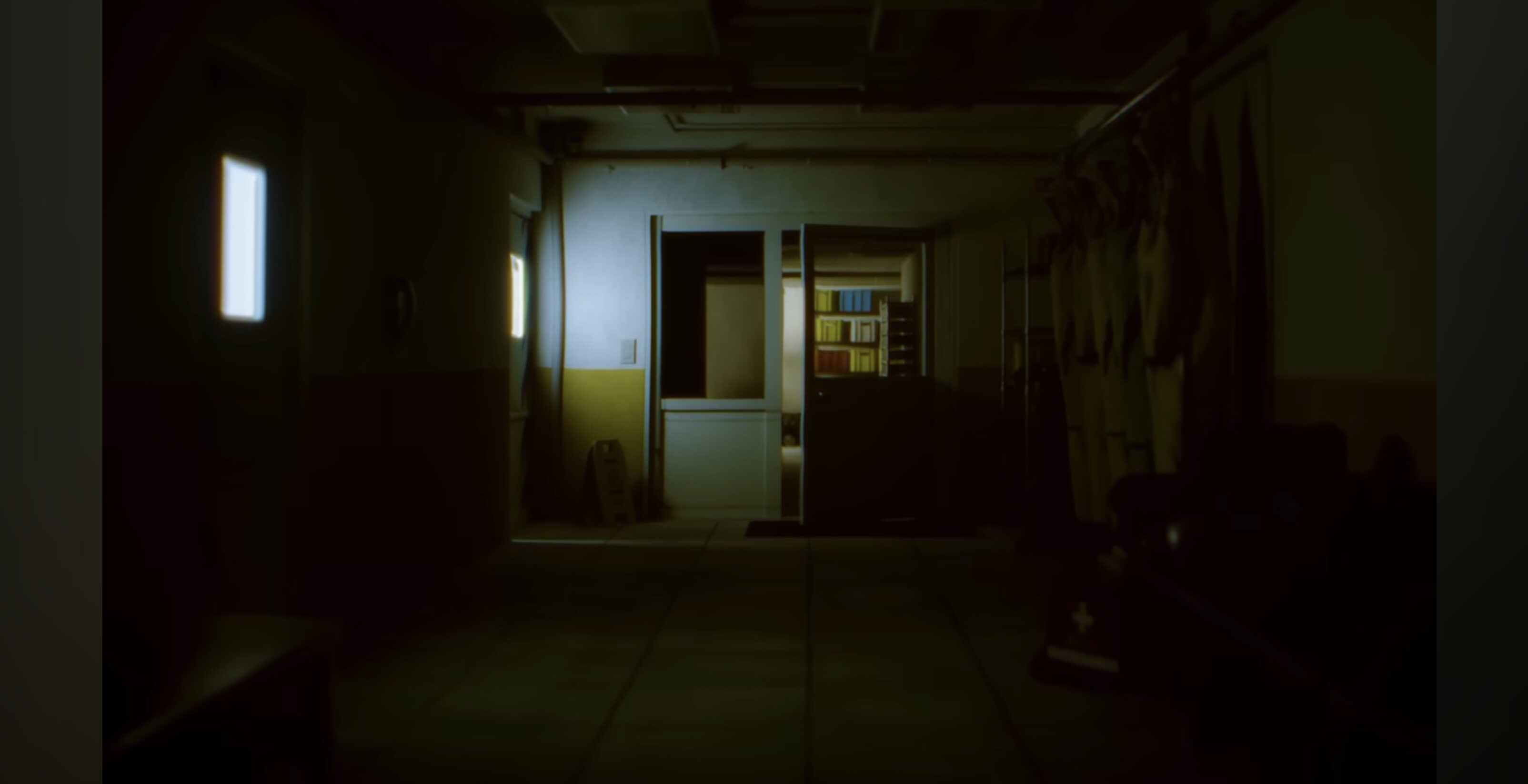
What Ravi finds is a Backrooms that is substantially more varied than anything the previous episodes showed us. Level upon level of different architectures: classic yellow office corridors, a classroom-style space, what looks like a lived-in residence someone abandoned mid-life, a maintenance section full of industrial detail, a skywalk bridging over an open space — and through the windows of that skywalk, for the first time in the series, something that looks like an outside.
A city. Bathed entirely in red light. Buildings with windows that glow like pictures rather than inhabited spaces. Trees. A straight road with a turn sign on it. No people. No movement. The Red City.
It shouldn’t exist in here. The Backrooms is interior by definition — it is the absence of outside. And here is something that looks like outside, except wrong. Except red. Except frozen. It’s one of the most unsettling visual ideas in the entire series, and Kane Parsons renders it and moves on without explaining it.
Ravi keeps going. He finds what seems like a house embedded in the Backrooms — walls, furniture, a creaky staircase — a wholly domestic space dropped into the impossibility of the Complex. He hears a voice. A man’s voice, inside the house. He calls out. And then the man appears.
The man does not know where he is. He has just noclipped in. And in the chaos of his arrival, Ravi ends up separated from him.
And then the Still Life appears.
This is the new entity introduced in Found Footage #3, and it is distinct from the Lifeform. Where the Lifeform is wire and limbs and elongated horror, the Still Life is something different — bipedal, human-shaped, apparently covered in the same black mold-like substance, but moving strangely. Crossing its legs as it walks, as if its motor control is wrong. Wailing in ways that are both animalistic and horribly human in the same breath. It chases Ravi through a speaker room, through hatches and corridors, and Ravi barely gets away.
The episode ends with Ravi bathed in red light, somewhere in or near the Red City, sitting down, exhausted, crying. And he starts talking — quietly, to no one in particular — about running out of time to talk to someone about a job. About a memory from when he was seven years old, at a park, something with a face that used to scare him.
It’s the most quietly devastating ending in the series. Not a chase. Not a monster. Just a man alone in an impossible place, thinking about the life he might not get back to.
Episode 20: Lighting and Tile Survey
Kane Parsons, having just delivered a 45-minute emotional gut-punch, immediately follows it up with… a laboratory analysis of a ceiling tile.
This is the most Async-brained episode in the series, and as a result it’s brilliant. In the lore timeline, Lighting and Tile Survey takes place on November 14, 1989 — just a month after First Contact, making it chronologically one of the earliest Async expeditions ever documented. Dr. Julia Meisner leads a team into the Complex to remove a ceiling light fixture and a tile for scientific examination. The episode is structured as a formal documentation video: a cameraman recording the process, Dr. Meisner presenting findings.
And here’s what Dr. Meisner finds. The light fixture is galvanized steel. The fluorescent bulbs are non-standard in proportion — closest to T12 bulbs but slightly off. They contain phosphor coating, calcium halophosphate, mercury vapor, argon gas. Standard electrical wiring. PVC insulated copper. A G13 base with standard 13mm pin spacing.
In other words: completely, utterly, mundanely normal.
The lights in the Backrooms — those fixtures humming at maximum buzz that the original 4chan comment described, the ones that have been overhead in every single episode of this series — are real lights. Made of real materials. Spec’d like something you’d buy at a hardware store. The Backrooms didn’t generate some alien light source. It built — or copied, or remembered — the exact kind of industrial fluorescent lighting you’d find in any office park or drop-ceiling corridor in America.
That should be reassuring. It is instead one of the most unnerving revelations in the series.
Because if the lights are real, made of real components, indistinguishable from any light fixture in our world — what does that say about everything else in here? About the carpet. The wallpaper. The walls. The rooms themselves. How much of the Backrooms is a copy? How much is original? And if the place remembers things rather than builds them — whose memories are these?
Lighting and Tile Survey is eight minutes of dry scientific narration that quietly expands the horror of the whole series without adding a single monster.
Episode 21: Static Dead End
The final episode before the movie. And it does something that the entire series has been building toward without you quite realizing it.
It opens with a conversation between Marvin and George. Marvin is still processing Peter Tench’s death — he’s convinced the Department of Energy had him killed, that Async covered it up, that the whole official story is exactly the kind of clean narrative that gets constructed over messier truths. George doesn’t necessarily disagree. He just tells Marvin to take some time off. To step back. That they need to keep pushing forward.
Then it cuts to George in Room 14D, which is now unrecognizable from its Pitfalls appearance. A steel frame has been installed over the pit that Marvin fell through. A winch. Infrastructure. Async has been building.
George crosses the newly constructed scaffolding and reaches the door at the far end of the room. The door that Mark briefly entered in Pitfalls — the one with the green light behind it, the one we never got to see inside — is finally, three years of episodes later, opened on camera.
What’s behind it is this: wallpaper that is stretched horizontally, like a broken UV texture map, draped over walls at wrong proportions. Ceilings that are too high. A room that mirrors the layout of Room 14D itself, but wrong — objects half-fused into the floor and walls, embedded as if the Backrooms is slowly digesting them. And in the corner, a hill of carpet with a single plastic chair sitting on top of it.
An unknown screeching sound echoes from somewhere in there. George documents it all with the quiet efficiency of someone who has seen enough of the Backrooms to be frightened without being paralyzed.
Then the episode ends.
And Then: The Movie
May 29, 2026. Today.
Here’s where the timeline locks in. In the lore, Static Dead End takes place on May 29, 1990. The feature film — according to the fandom’s best chronological mapping — takes place after Static Dead End and before The Backrooms (Found Footage). The original episode. The one that started everything.
Which means the movie fills in a gap between Async’s ongoing research in mid-1990 and Kane’s noclip on July 4, 1991. We even know from the lore timeline that Clark — Chiwetel Ejiofor’s character in the film, the furniture store owner whose basement grows a doorway — appears on an Async security camera inside the Backrooms on June 29, 1991. Five days before Kane noclips in. Five days before the event that kicked off the entire series.
The movie isn’t set in the aftermath of the series. It’s set inside the series. It’s happening in a gap in the timeline you’ve been watching for 22 episodes, and the people you’ve come to know — Marvin, George, the whole Async apparatus — are operating in the same world, at the same time, just around a corner.
Kane Parsons was sixteen when he built the first Backrooms corridor in Blender. He is twenty when he walks into a theater to watch the feature film version of the world he made. He composed the score. He wrote or co-wrote the lore. He designed the aesthetic that every Backrooms creator, meme, and interpretation has been riffing on for four years.
The Backrooms started with one photograph and one sentence on a paranormal message board. It became a YouTube series made by a teenager in his bedroom. And now it’s an A24 film.
That arc — from anonymous internet image to Chiwetel Ejiofor in a cinema — is itself kind of extraordinary. Almost liminal. Something that slipped through the floor of one medium and ended up somewhere else entirely, blinking in new light, not entirely sure how it got here.
And tonight, I finally head with my GMN crew to go see Backrooms. I completed the Youtube series just in time to really grasp the timeline, the lore, the universe that is the backrooms /noclipping phenomena. I’m very excited. And tomorrow? You’ll get my thoughts on the entire corpus that is the Kane Backrooms universe. I cannot wait.