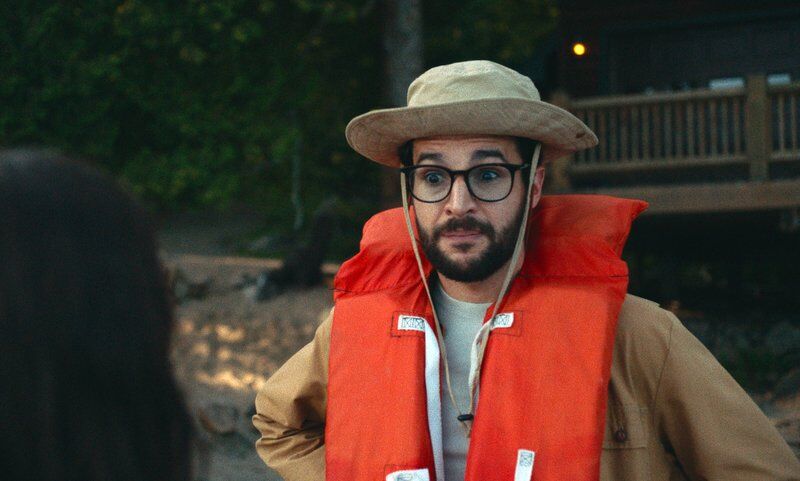
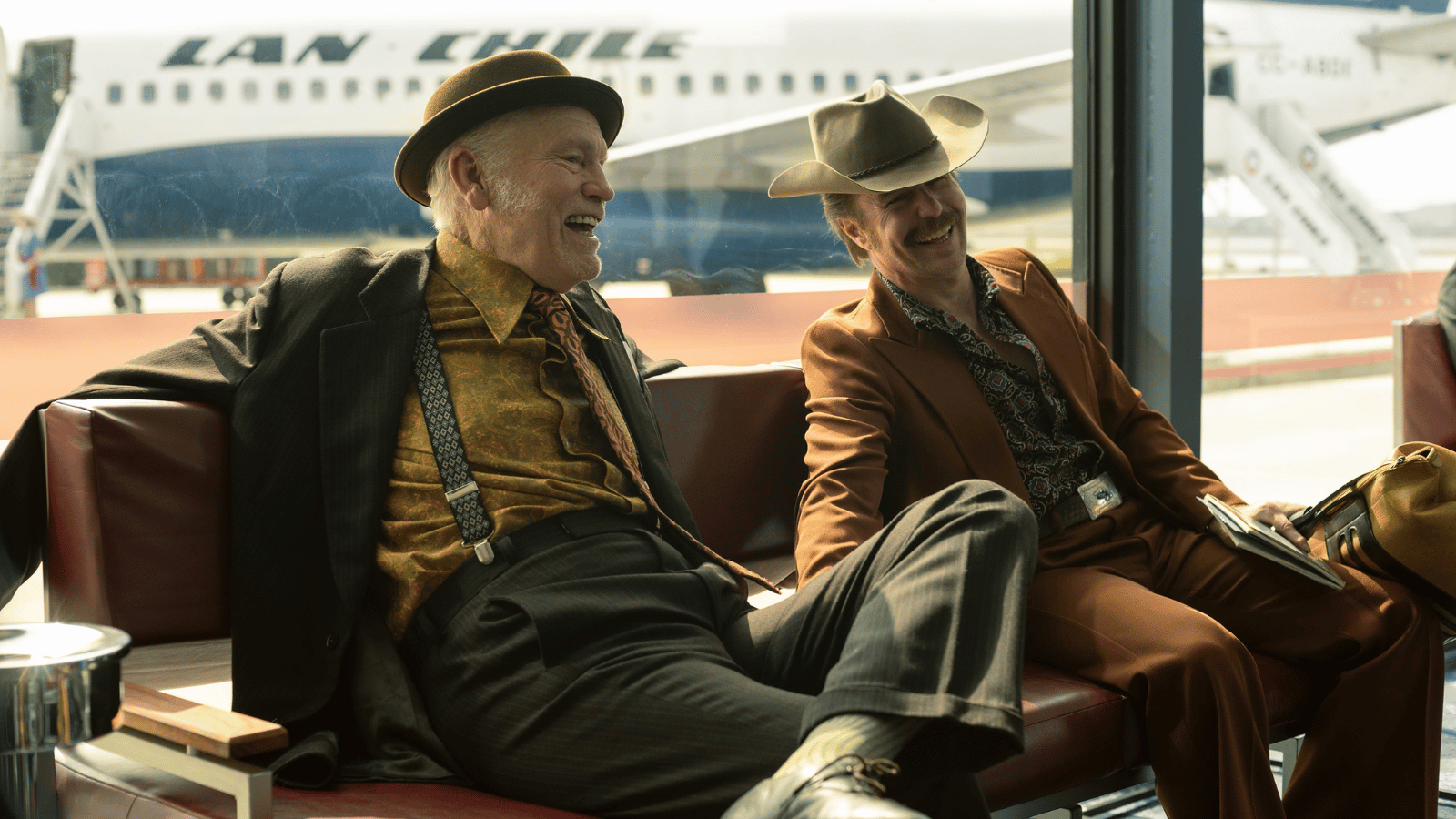
I just watched Wild Horse Nine and I loved it, and I also think the internet is having almost exactly the wrong conversation about it. Everybody wants to talk about the Of Mice and Men thing. Two guys, one of them slowly unraveling, wild horses running loose across this beautiful island instead of Lenny’s dream of tending rabbits on a little farm. Cute parallel. Easy to spot. Completely beside the point.
This is a Martin McDonagh movie, so you already know the tone going in if you’ve seen In Bruges or Three Billboards or Banshees of Inisherin. Pitch black comedy, big swings, actors having an absolute field day. John Malkovich won the Volpi Cup at Venice for this, and Sam Rockwell is right there with him. On the surface it’s a buddy movie about two old partners sent off on what looks like a working vacation. Underneath that surface is a movie about the actual, specific, named body count of American empire, and I don’t think it’s an accident that so much of the discourse around this movie is happy to stay up on the surface with the horses instead of going where McDonagh is actually pointing.
What Actually Happens
From here on out there will be so many spoilers – I almost am warning those of you who have already seen this film… to go, think about the movie again… reconsider your own thoughts and opinions about the film before you proceed any further. Alright? It’s going to be that kind of a spoiler filled discussion.
Chris Carlisle and Lee Chesterfield are longtime CIA partners, and when the movie picks them up they’re deep in the machinery of destabilizing Salvador Allende’s government in Chile, in the run up to the 1973 Pinochet coup. Chris is dying of cancer, and he’s also developed a habit of running his mouth about agency operations to people who have no business hearing it, so he and Lee head off to Easter Island on what everybody frames as a working vacation. But really it’s really a babysitting job.
The movie actually opens before any of that, back in Chris’s apartment in Santiago, where he’s got Lee filming him on a tripod for what he keeps calling his memoirs. He states his name, where he is, what he does, big shot in the CIA, and then rattles off his own résumé like he’s reading a job history out loud. Veteran of Guatemala, 1954, a success. The Congo, 1960, a success. The Bay of Pigs, 1961, less successful. When Lee asks where else, Chris just says Dallas, ’63, and tells him not to look too pleased about it on camera. In that same stretch, Chris mentions he’s taken up gently shooing moths out of his apartment instead of killing them, and admits, half joking and half not, that he thinks he cares more about the moths of Chile than he does about the people of Chile. Lee tells him he cares about the people. Chris says there’s not much people, right.
Prior to their leaving Santiago, Chris tells two young left wing Chilean students at the airport, straight to their faces, that the only reason he and Lee are in their country is to destabilize their democracy, and it’s going great. Lee spends the rest of the trip trying to walk that back. On the plane, Chris starts bragging that he’s killed people in countries Lee can’t even spell, dares him to name one, and when Lee says Czechoslovakia, Chris tells him he never killed anyone there, he just can’t spell it, and then adds, almost to himself, that they’ll never know now. Once they land, MJ, Lee’s bureau chief back home, calls to check in and warns Lee flat out that if Chris keeps going with this memoir idea, that would be a major mistake. That call is what actually sets up the rest of the movie. Lee is quietly put in the position of managing, and maybe reporting on, his own dying partner. And can I just say, that Easter Island gives the back half of the movie its whole visual register, the moai statues, the wild horses roaming free across green fields and white cliffs, and it’s gorgeous,
Even the small stuff keeps landing on the same nerve. At the hotel buffet, mid rant about the sad Kraft cheese slices they’ve been served, Chris says Chile had the potential for a nice cheese until he and Lee showed up and decided the country was going to have whatever fucking cheese they told it to have. It’s a throwaway joke. It’s also not really a throwaway joke.
The scene the whole movie is quietly building toward comes later, lying around on morphine one night, when Chris and Lee drift into one of those circular, stoned conversations about heaven, whether dinosaurs have souls, and whether any Nazis will be getting in. Lee flips it into comforting his dying friend, telling him this whole country is going to be free because of him, running through the list, Guatemala, Indonesia, that place in Africa he can never remember the name of. Sure, you killed some people, Lee tells him, they were so wild. And hey, if that Nazi handling guy had gotten to him first instead, well, Chris is way better than that guy. A hundred times better than the Nazi.
And you laugh, because it’s delivered as two old friends messing with each other while high out of their minds. And then you sit with it for a second, because the joke was never actually a joke.
Why the Rabbits Reading Misses It
Most of the interwebs drives the movie to a Of Mice and Men (Lennie sacrificial killing) reading and stops there. Sure, that’s a clever take for a ninth grader. Huzzah. But here’s my actual issue with the Of Mice and Men vantage on the film. It treats the horses as a symbol of something unreachable and sad in a purely personal, interpersonal way, two guys and a friendship that’s about to break. And sure, that’s in there. But Chris’s own résumé isn’t about his friendship with Lee. It’s about the ledger. Guatemala 1954. The Congo 1960. The Bay of Pigs 1961. And this movie is set in 1973 specifically because that’s the year the United States helped engineer a coup against an elected government in Chile, and that’s not some minor historical footnote, that’s the actual plot of the movie happening in the background the entire time these two guys are vacationing among wild horses.
Today, most of American society is willfully ignorant about what our country has actually done to other countries and their people over the last century and a half. Mass casualties. Mass graves. Economic intervention. Market manipulation. All of it, all over the world, wherever it served our interests. Take the Philippines. We killed something like 20,000 combatants and well over 200,000 civilians there just to keep the country from declaring its own independence, and American officials at the time actually argued, out loud, in public, that Filipinos were unfit for self rule. That’s not ancient history dressed up as a metaphor. That’s the same muscle memory this country has used over and over again.
Don’t believe me that that sort of manipulation and darkness is still in our DNA? Look at what just happened with Maduro in Venezuela. That’s not some distant historical parallel I’m reaching for, that happened basically yesterday. We are still very much in the business of pressure, manipulation, and force, whatever it takes to get what we want geopolitically, or more accurately, economically.
And then there’s Chile itself, the actual setting of this movie. After the American backed coup against Allende, the official confirmed number of people killed or disappeared is 3,216. But once you widen that out to everyone who was murdered, disappeared, or tortured over the seventeen years that followed, that number jumps past 40,000. More than 200,000 people fled the country into exile because of what American interventionism did there. That’s the real history sitting directly underneath the wild horses and the moai statues and the pretty cliffs these two guys are wandering around on their working vacation.
So yes, on one level this is a buddy movie about friendship, betrayal, trust, and belief. I’m not arguing with that reading, it’s clearly there and it clearly works. But the darker, truer current running through this film is American political bullying, and Lee’s stoned, half affectionate joke that Chris is a hundred times better than the Nazi is actually more insightful than we really want to admit. We laugh at the idea on instinct. Of course he’s better than the Nazis. But is he, really? The Nazis built their entire worldview on racial superiority, which is repugnant, full stop, no argument from me there. And no, we haven’t built concentration camps here, and no, we didn’t gas six million Jews and six million Romani people. But just the other day, our actively willful shutdown of USAID has been tied to hundreds of thousands of deaths around the world, people who needed that aid and didn’t get it. (Want to go deeper on the topic? Read the book, Into the Wood Chipper: A Whistleblower’s Account of How the Trump Administration Shredded USAID by Nicholas Enrich.) Add in everything this country has done through direct military engagement or quieter black ops control over the decades, and the question Chris asks with a smirk stops being rhetorical. It’s the actual thesis of the movie.
The wild horses aren’t Lenny’s rabbits. Lenny’s rabbits were a dream of something gentle and safe that he was never going to get to keep. The horses in this movie are just running loose across a island that the characters, and maybe the audience, get to enjoy as scenery for exactly as long as we’re willing not to ask what’s underneath it. That’s the real dream this movie is interested in. Not a farm with rabbits on it. America’s own dream of itself as the good guy, the one you get to keep telling yourself as long as you don’t look too closely at the ledger. That’s the real, honest question that this movie is actually asking its audience and that they are mission… Are we really the good guys? Were we ever the good guys?
Final Thoughts
I think what makes this movie work, and what makes it more than just a prestige drama with a political point to score, is that McDonagh never lets Chris off the hook for any of it, and he never lets the audience off the hook either. Chris isn’t a villain the movie is condemning from a safe distance. He’s funny, he’s likable, Malkovich plays him with real warmth, and that’s exactly why the confession hits like it does. You like this guy. You’re laughing with him. And then he hands you his own résumé and dares you to still feel good about where you landed.
This isn’t a movie about two friends drifting apart against a pretty backdrop. It’s a movie that uses that friendship as cover to walk you right up to a question most people spend their whole lives avoiding. Wild Horse Nine knows exactly what it’s doing with those horses, and it isn’t doing Steinbeck.