
Or: How Edgar Wright Made a Mediocre Movie That’s Still Better Than Arnold’s Fever Dream
If you’ve been paying attention to Stephen King adaptations over the last four decades, you’ll know that Hollywood has a nasty habit of taking King’s most biting social commentary and turning it into something that wouldn’t offend a PTA meeting. So when I walked out of Edgar Wright’s 2025 take on The Running Man, I found myself in a peculiar position: disappointed in the execution, but quietly grateful that someone—anyone—finally understood the assignment.
Let me be clear from the jump: Wright’s Running Man is a 2.5 out of 5 stars movie. Maybe 3 out of 5 if I’m feeling generous and the theater popcorn was particularly good. But as an adaptation of Richard Bachman’s (King’s) 1982 novel? It’s a solid 9 out of 10. Yes, even with the changed ending. Yes, even with the less dour tone. And to understand why that matters, we need to talk about what came before.
The 1987 Abomination: How Arnold Schwarzenegger Murdered Stephen King’s Vision
I need you to understand something: the 1987 Running Man is not an adaptation. It’s a hostile takeover. It’s what happens when you give a King novel to people who think subtlety is a town in Connecticut and social commentary is something communists do. Why am I up in arms? Well, my Guy Movie Night Group decided that it’d be fun to watch the classic Ahhnold original, and then go see the new one, and then discuss and debate their differences… and which one was better. But upon rewatching the original – I was just shocked by just how bad it was. It wasn’t a movie, it was a WWE wrassling special. It was horrifically bad.
Originally, you have a tight, claustrophobic novel about a desperate man in a collapsing economy who volunteers for a game show where the entire nation hunts him for sport. The book is about class warfare, media manipulation, and the insidious way entertainment numbs us to atrocity. It’s Bachman-era King at his most vicious—before he got famous enough that publishers stopped letting him write books this mean.
Now, what did Hollywood do with this material? They cast Arnold Schwarzenegger. Arnold Schwarzenegger. The man is wonderful—I’m not here to slag Arnie—but casting him as a desperate everyman is like casting The Rock as a shy librarian. The entire premise requires you to believe this person is vulnerable, hunted, and outmatched. Arnold looks like he could benchpress the entire Games Network building.
The 1987 film creates hunters who aren’t calculating professionals—they’re cartoon characters. There’s a guy named Buzzsaw who uses a chainsaw. There’s a hockey-themed killer because… ice? The film takes place in a contained game zone rather than the real world, stripping away the entire point about society’s complicity.
<spoiler>And what about the ending? In King’s book, Ben Richards flies a plane into the Games Network building, killing himself, Killian, and countless others in an act of pure, impotent rage.</spoiler> It’s not a victory. It’s a scream into the void. It’s the only power left to someone who’s lost everything. In the 1987 film? Richards wins. He beats all the hunters, exposes the corruption, kills the host, gets the girl, and presumably opens a successful chain of fitness centers. The crowd cheers. Roll credits. It’s the most offensively American ending imaginable—the idea that one good guy with enough muscles can fix a systemically corrupt society.
Stephen King himself compared it to Spinal Tap, saying it “goes to 11.” His wife watched it with her fingers in her ears. That should tell you everything. This isn’t an adaptation—it’s a corpse wearing the book’s nametag.
Edgar Wright’s 2025 Version: Getting an A for Homework, C- for the Essay
Now we arrive at 2025, and Edgar Wright—a director who’s proven he understands structure, theme, and visual storytelling—takes a crack at it. And here’s where things get complicated.
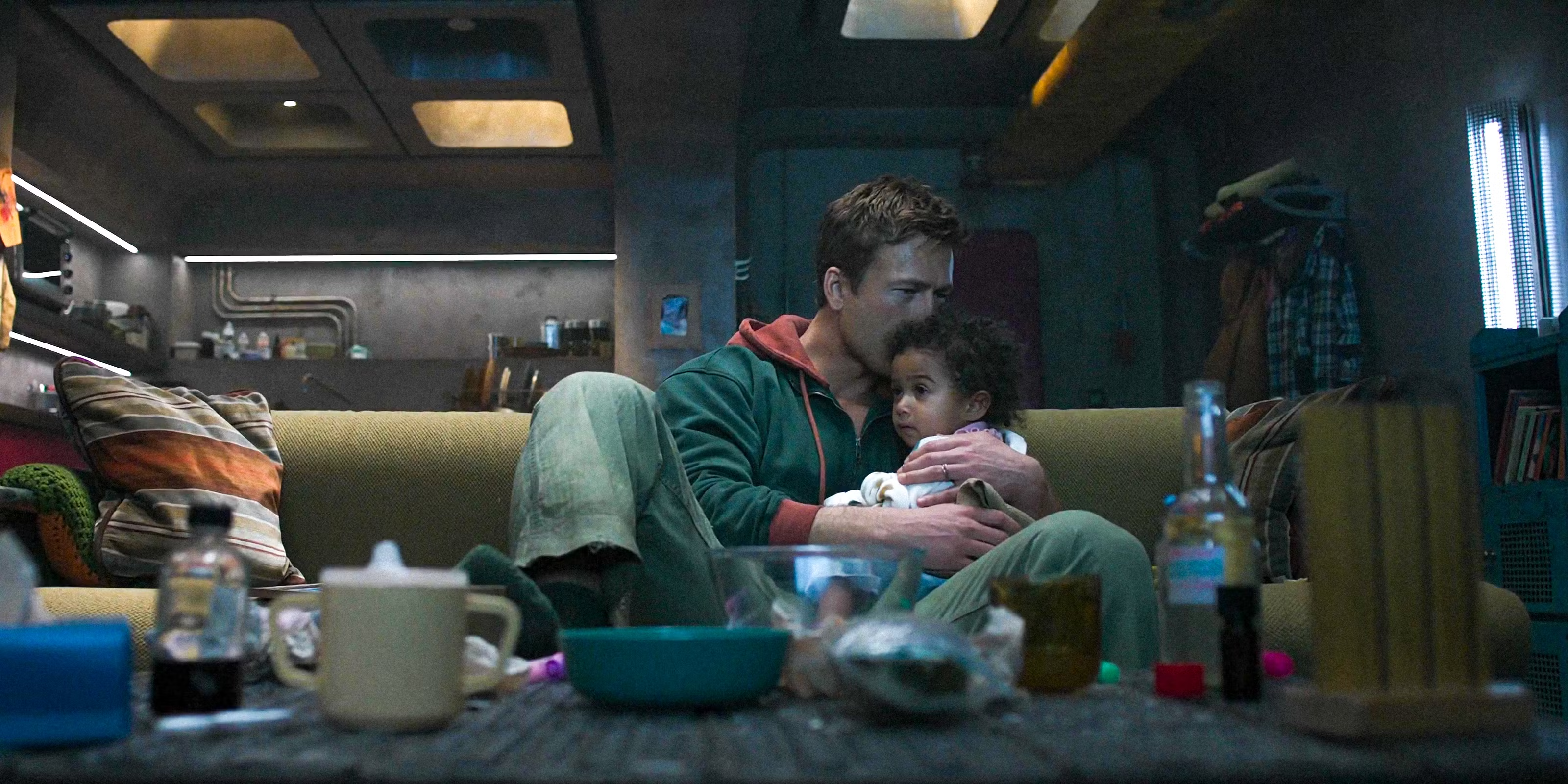
From a pure adaptation standpoint, Wright nails it. He understands the assignment in ways the ’87 version never even glanced at. The 2025 film follows the novel closely, with Ben Richards as a blue-collar worker who voluntarily enters the deadly game to pay for medicine for his desperately sick daughter. It’s about desperation, not heroism. It’s about a broken system, not individual villainy.
The worldbuilding is there. The film depicts a near-future America ruled by an authoritarian media Network, where most viewers live in poverty with little healthcare access. The class dynamics are present. The media manipulation is front and center, complete with deepfakes and manufactured narratives. The film includes satirical commentary on reality TV obsession and digital manipulation technologies. Wright even has Richards travel through Derry, Maine—a lovely nod to King’s interconnected universe that the ’87 version would never bother with.
Josh Brolin’s (Sicario anyone?) Dan Killian is perfectly cast—calculating, ratings-obsessed, the embodiment of entertainment capitalism. Colman Domingo brings genuine charisma to Bobby Thompson, making him disturbingly believable as a host who’d gladly watch contestants die for audience share. These aren’t mustache-twirling villains; they’re recognizable people working within a system that rewards atrocity.
So what’s the problem?
The movie is… fine. Just fine. And that’s the issue.
Critics noted the film lacks nearly all of Edgar Wright’s signature personality—the sharp editing, high-energy pacing, creative transitions, and playful visual flair are missing. This could have been directed by anyone. Where’s the Wright who gave us the breathless choreography of Baby Driver? It feels like he checked his style at the door in service of being “serious,” but forgot that style is substance when you’re making social commentary.
The pacing drags. Some scenes prolong when they should snap. Critics described it as a film that “doesn’t live up to the director’s high bar for inventive action extravaganzas but maintains a slick stride”. Glen Powell is fine—he’s charming when the script lets him be—but he doesn’t have the depth to carry the darker material. There are moments where you can see the good movie this could have been, but it never quite materializes.
And then there’s the ending.
The Ending Problem: Or, How to Dodge the Point Entirely
In King’s novel, Richards hijacks a plane. Killian informs him that his family is dead. Richards kills McCone (the lead hunter), the flight crew, and forces his hostage to parachute out. Then he flies the plane directly into the Games Network building. The last thing Killian sees is Richards in the cockpit, middle finger extended, before everything explodes. It’s nihilistic. It’s brutal. It’s earned.
Wright keeps most of this setup. In the 2025 version, Richards ends up on the plane just like in the book, but the Network manipulates the situation to vilify him. After Richards refuses Killian’s offer to become the next lead hunter, the Network airs a deepfake showing Richards threatening to crash into their building, then shoots the plane down with a missile.
And then—here’s the kicker—the film reveals Richards survived due to the plane’s auto-eject function, the uncensored recordings are leaked, and Richards becomes the face of a revolution. His family’s deaths were faked. There’s a revolt. Ben emerges from a crowd and shoots Killian. The system falls. Happy ending!
Stephen King himself approved the change, saying audiences “get to have it both ways”—the setup from the book with Richards on the plane, but a more hopeful conclusion.
Look, I understand why Wright did this. Wright explained they “were never going to do the ending in the book for reasons that I hope are obvious,” noting that “something quite as bleak and nihilistic as that isn’t the ending that feels right for today”. And yes, a scene of someone flying a plane into a building hits differently in 2025 than it did in 1982. I’m not a monster.
But here’s my problem: it’s a cop-out wrapped in good intentions.
The book’s ending is devastating because Richards loses. The system wins. His sacrifice is meaningless to everyone except him. That’s the point. King wasn’t writing a revolution manual; he was writing about how deeply we’re all complicit in our own oppression, how easily we’ll watch someone die for our entertainment, and how the individual is utterly powerless against machinery designed to grind him up.
Wright’s ending tries to have its cake and eat it too. Critics noted the film “arcs toward King’s ending because it’s the Network’s ending,” allowing the hero to subvert it, but ultimately “does too much”. The leaked footage, the happy reunion, the revolution—it’s all too neat. Too quick. The ending robs audiences of full satisfaction from both Richards seeing his family and getting revenge, leaving more questions than answers.
And tonally? It betrays everything that came before. You can’t spend two hours showing us how completely the system dominates, how thoroughly it manufactures reality, how powerless individuals are against it—and then go “but one leaked video and the people rise up!” That’s not how any of this works. That’s not how propaganda works. That’s not how authoritarian systems work. It’s the same fairy-tale thinking that ruined the ’87 version, just dressed in better clothes.
Francis Lawrence’s recent adaptation of King’s The Long Walk had the courage to go darker than the source material. Wright had a chance to trust his audience with bleakness and chose safety instead.
Source Material Fidelity: Or, Why I’m Still Giving This a 10/10 on the Adaptation Scale
But here’s the thing—and this is crucial to understand my seemingly contradictory position—I don’t actually hate this movie.
I’m disappointed. I wanted better. But disappointment isn’t hate.
Because for the first time in nearly 40 years, someone made a Running Man that understood what the book was about. Not perfectly. Not completely. But substantially more than anyone before.
Wright got the class dynamics. He got the media manipulation. He got the desperation of Richards, the calculation of Killian, the complicity of the audience. He got that this isn’t about individual heroism but about systemic rot. He got that the game show isn’t the villain—it’s a symptom.
The 2025 adaptation is described as “much more faithful to King’s original story, with the major exception being the ending”. And you know what? That’s something. That’s more than we’ve had before.
The ’87 version took King’s scalpel and turned it into a sledgehammer made of cotton candy. Wright took the scalpel and used it—he just flinched before the final cut. I’ll take a director who flinches over one who never understood the weapon in the first place.
Does the ending pull its punches? Absolutely. Does it undermine some of the film’s power? Without question. But the other 130 minutes show a genuine attempt to grapple with King’s themes rather than strip-mine them for action set pieces.
The Lesson: On Wanting To Be Fooled
We want to believe that corrupt systems can be defeated by one determined individual. We want to believe that exposing truth leads to justice. We want to believe in happy endings where the good guy wins and gets his family back. These are deeply American fantasies, and Hollywood sells them to us constantly.
King knew better. Bachman really knew better. The novel offers no such comfort. Richards’ death isn’t noble—it’s pathetic and pointless and terrifying. That’s why it mattered.
Wright’s film wants to honor the book while also selling tickets to people who need hope in 2025. The director argued that “by letting Richards live, the film rejects the idea that the only response to a broken system is to go down with it,” suggesting “survival can be its own act of defiance”. I understand that impulse.
The Verdict(s)
So here’s where we land:
The 1987 Running Man: 1 out of 5 stars as a film. 0 out of 10 as an adaptation. It’s not even playing the same sport as the book. It’s barely the same genre. It’s a loud, dumb, occasionally fun action movie that happens to share a title with a brilliant novel. If you want pure ’80s cheese with Schwarzenegger one-liners and zero substance, have at it. Just don’t pretend it has anything to do with Stephen King.
The 2025 Running Man: 2.5-3 out of 5 stars as a film. 9 out of 10 as an adaptation. It’s a mediocre movie that understands its source material in ways that matter. The technical execution disappoints. The ending cops out. But it gets what King was doing, and in the wasteland of Stephen King adaptations, that alone deserves recognition.
Is it the movie we deserved? No. Is it the movie we needed? Also no. But it’s the movie we got, and it’s leagues better than what came before.
Final Thoughts: Are You Watching Closely?
If you haven’t read the book, read it first. It’s short, nasty, and says more about American society in 1982 (and 2025) than either film manages. Then watch Wright’s version to see what a faithful adaptation looks like, for better and worse.
And if you’re tempted to watch the ’87 version for “fun nostalgia”? Go ahead. But know that you’re not watching The Running Man. You’re watching The Running Man’s louder, dumber cousin who didn’t understand the assignment but passed anyway because he’s friends with the teacher.
The question isn’t whether Edgar Wright made a great movie. He didn’t. The question is whether he made a movie that honors King’s vision while compromising just enough to exist in modern Hollywood.
And the answer is: almost.
Which, after 38 years of not even close, feels like progress.
Now if you’ll excuse me, I need to go read the book again to remember what good, uncompromising storytelling feels like. Even if—especially if—it doesn’t end well.