
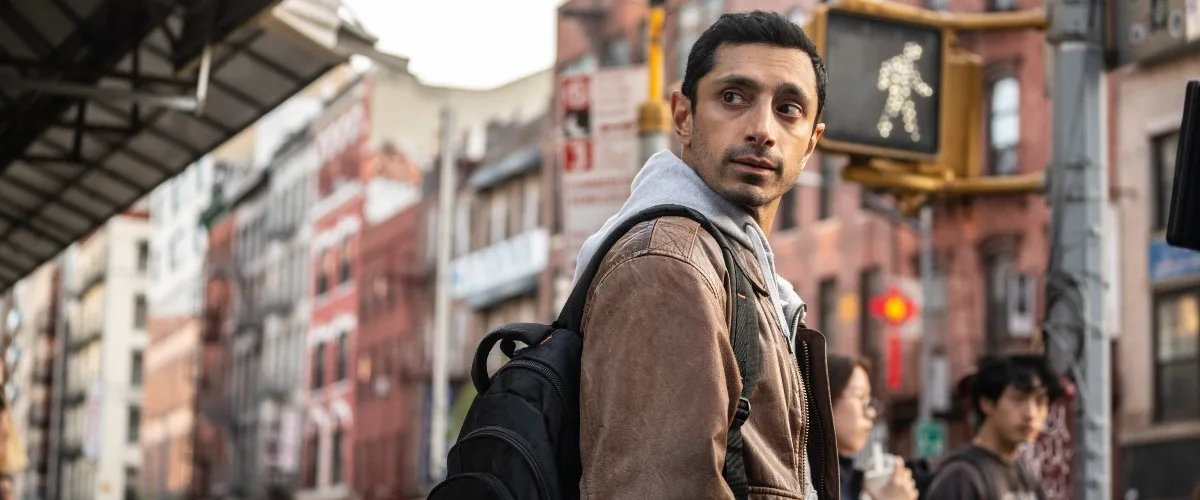
I gotta say, that it is pretty rare that I go into a movie and totally surprised by how smart it ends up being. But that is the case with David Mackenzie’s movie Relay. Relay is a taut, paranoid thriller that harkens back to the conspiracy films of the 1970s, wrapping its story in layers of surveillance, corporate corruption, and moral ambiguity. Starring Riz Ahmed as Ash, a mysterious fixer who brokers deals between whistleblowers and the corporations they threaten, the film builds tension through careful plotting and restrained performances before delivering a gut-punch twist that reframes everything we’ve watched. Let’s dive deep into the spoilers and unpack exactly what happens in this gripping thriller.

Apparently, Ash survives at the margins of society – providing a service that only a few need. His method is brilliant in its simplicity: he uses the Tri-State Relay Service, a legitimate telecommunications service for deaf and hard-of-hearing individuals, to maintain complete anonymity. By typing his messages through a telecommunications device for the deaf (TDD), Ash ensures that relay operators read his words aloud to clients and adversaries alike—meaning no one ever hears his actual voice, and the service keeps no records that could be traced.
The film opens with Ash successfully helping Hoffman, a former Optimo pharmaceutical employee, return incriminating documents about the company’s dangerous products. Hoffman receives his payoff, Ash ensures his safe departure, and everyone walks away clean. It’s a perfect example of how Ash’s system should work. From a movie making standpoint – it’s always brilliant to show the audience a standard exchange before it goes horribly pear-shaped and cockeyed. Which is obviously what happens when Sarah Grant (Lily James) enters the picture.
Sarah’s Story: The Perfect Client?
Sarah appears to be another corporate whistleblower in crisis following the same storyline as the Optimo experience. She used to work for Cybo Sementis Research Institutes and has stolen documents exposing dangerous side effects of their genetically modified wheat. Unlike traditional whistleblowers who want to go public, Sarah has changed her mind—she’s being surveilled, intimidated, and simply wants to return the documents in exchange for her safety.
Ash agrees to help, setting up an elaborate plan involving burner phones, coded language, package drops, and careful misdirection. Sarah travels to Pittsburgh under Ash’s watchful eye, mailing two packages: one headed to Oklahoma as a decoy, the other containing the actual documents and a cash deposit that makes its way to Ash. With the report in hand, Ash leverages it against the company, threatening to expose them unless they leave Sarah alone and pay up.
The corporation agrees, sending Ash a $500,000 payoff. However, they hide a tracking device in the money—a clever move that Ash outmaneuvers by forwarding the cash across the country until the tracker’s battery dies.
The Cracks Begin to Show
Things start to unravel when Sarah misses a scheduled check-in. Ash, concerned, calls her while impersonating the relay service, admitting that previous client situations have gone wrong. Meanwhile, voicemails from Hoffman reveal that he is being crushed by guilt after saving himself instead of hundreds of thousands of people around the world. Unable to bear the weight of his selfish decision, it’s pretty clear that Hoffman takes his own life.
This backstory becomes crucial to understanding Ash’s character. He’s a recovering alcoholic whose descent began after 9/11 and his own discovery of corporate misconduct. During an AA meeting with his sponsor Wash—an NYPD detective—Ash confesses his inner torment: he makes money keeping secrets buried rather than exposing wrongdoing. It’s a moral compromise that eats away at him, particularly after Hoffman’s suicide.
The Twist: Everything Was a Lie
Here’s where Relay pulls its biggest punch: Sarah was never a whistleblower at all.
In the film’s climactic sequence, Dawson and his corporate surveillance team corner both Ash and Sarah, holding them at gunpoint and demanding to be taken to Ash’s warehouse where he stores all his clients’ incriminating documents. During a violent confrontation—Ash throws one team member from a moving vehicle and fights desperately—Sarah subdues Ash, revealing herself as part of Dawson’s crew.
The truth crashes down: Sarah wasn’t originally working for Cybo Sementis Research Institutes. She’s actually working for Optimo Pharmaceutical. Oh, and by the way, Optimo really wants those “safety” documents back… and they’d like Ash dead to boot. Sarah was the bait, her entire story was manufactured to draw Ash out of the shadows. The surveillance team wasn’t protecting a corporation from a rogue whistleblower; they were hunting Ash himself.
This revelation spins the entire movie on its head. Every anxious moment where Sarah seemed vulnerable, every close call with the surveillance team, every development of trust between her and Ash—it was all performance art. The film had been showing us a woman in danger, when in reality we were watching a predator circle her prey.
The Showdown: Trust as the Ultimate Weapon
When the team takes Ash to his warehouse where he stores all his secret documents, Ash activates a failsafe distraction and escapes with a gun. A chaotic sequence follows where he’s struck by a car but manages to evade most of the team, only to be confronted by Sarah again.
But Ash had prepared for betrayal. Earlier in the film, we saw him connect with Wash, his AA sponsor and the only person he truly trusts. In a key moment, Ash had reached out to Wash about his moral struggles, building a bridge back to human connection in his otherwise isolated existence. This relationship becomes his salvation.
In the end, Wash arrives with police backup, summoned by Ash before the final confrontation. Sarah, Dawson, and team member Ryan are arrested on the spot. With law enforcement present, Ash offers to turn over all the incriminating documents he’s collected—not just from the Sarah case, but from all his clients—to Wash, the only person he trusts to do the right thing.
Why Did Ash Mail the Money?
In the film’s final scenes, Ash makes a choice that defines his character arc. After recovering from his injuries, he receives the $500,000 that was originally sent as part of the “deal” with Sarah. But by this point, news has broken about Optimo’s crimes—Wash has given the documents to the media, and the pharmaceutical company’s wrongdoing is finally public knowledge. Ash takes most of that money and mails it to the Tri-State Relay Service.
This decision is deeply symbolic and reveals Ash’s transformation. Throughout the film, he’s been profiting from keeping corporate secrets buried, accepting payoffs that essentially allow corrupt companies to continue harming people. Hoffman’s guilt-ridden voicemails and apparent suicide haunt him, forcing Ash to confront his own complicity in enabling corporate misconduct.
By sending the money to the relay service, Ash accomplishes several things:
1. Moral restitution: He rejects blood money earned through facilitating corporate cover-ups. The cash represents everything he’s grown to hate about his work.
2. Gratitude and protection: The relay service made his entire operation possible. Without their legal protections and lack of record-keeping, Ash couldn’t have maintained his anonymity. The donation honors the organization that unwittingly enabled his work.
3. Distance from his past: Keeping the money would mean continuing to profit from the system he’s now rejecting. By giving it away, Ash symbolically walks away from his life as a fixer.
4. A clean conscience: Unlike Hoffman, who couldn’t live with his compromise, Ash finds a way to make peace with his choices by changing course. The donation represents his attempt at redemption.
The relay service employees had no idea they were part of these dangerous machinations. Ash’s gift ensures that an organization serving a vulnerable community benefits from his morally complex work.
How Did Ash Escape?
Ash’s escape is less about physical evasion and more about strategic preparation and trust. His survival hinges on several key elements:
Preparation and redundancy: Throughout the film, Ash demonstrates meticulous planning. He maintains multiple disguises, uses misdirection constantly, and always has contingency plans. His warehouse failsafe bought him crucial seconds during the confrontation.
Reading people: Ash suspected something might be wrong when Sarah missed her check-in. His years of working with vulnerable people had taught him to recognize when situations felt off, even if he couldn’t pinpoint exactly what was wrong.
Reaching out: The most crucial element of Ash’s escape is his willingness to trust Wash. Throughout most of the film, Ash operates in complete isolation, trusting no one. But his AA meetings with Wash represent cracks in that armor—moments where Ash’s need for human connection breaks through his defensive walls. By confiding in Wash before the final confrontation and ensuring Wash knew to come to his aid, Ash essentially built an insurance policy based on human trust rather than technological tricks.
Turning state’s evidence: By offering all his documents to law enforcement, Ash transformed from criminal fixer to valuable witness. His cooperation likely granted him protection and explained why we see him traveling freely at the film’s end.
The Final Scene: Moving Forward
The movie ends with Ash boarding a train, traveling to a new life much like the clients he once helped relocate. As he settles into his seat, radio and television reports announce the revelations about Optimo’s misconduct. The documents Ash safeguarded have finally exposed the truth, and a corporate merger worth billions has collapsed under the weight of scandal.
This ending is deliberately ambiguous about Ash’s future. Is he truly free, or simply moving to another city to start over? Has he permanently left his life as a fixer, or will he resurface under a new identity? The film doesn’t answer these questions directly, but the symbolic elements suggest genuine transformation.
Ash is heading away from New York, away from his warehouse of secrets, away from his anonymous life. The news reports playing as he travels indicate that this time, the truth won out—corporate corruption was exposed rather than buried. And unlike Hoffman, who couldn’t live with his choices, Ash has found a path forward.
The Film’s Commentary on Modern Paranoia
Relay operates as both thriller and commentary. In an age of total surveillance, where privacy feels impossible and corporate power seems limitless, Ash represents an attempt to game the system—to find loopholes and blind spots that allow individuals to survive against overwhelming institutional power.
The relay service itself is a perfect metaphor: a system designed to help vulnerable people communicate becomes a tool for maintaining anonymity in a surveillance state. Ash doesn’t beat the corporations through heroic confrontation; he survives through cleverness, misdirection, and exploiting the gaps in their omniscient gaze.
But the film also questions whether such survival is enough. Ash lives in constant isolation, trusting no one, maintaining no genuine human connections. He’s winning small battles—extracting payoffs, protecting individual clients—but the system itself continues unchanged. Is that really victory, or just managed defeat?
Sarah’s betrayal hammers home the film’s paranoid worldview: even apparent allies might be enemies, even sympathetic victims might be predators. Trust is liability. Connection is weakness. The only safety is distance.
Yet the ending complicates this cynical perspective. Ash survives specifically because he chose to trust Wash. His redemption comes through rejecting isolation and reconnecting with the social world, even if only through one careful relationship. The film suggests that while paranoia might keep you alive, it’s human connection—risky as it is—that makes survival meaningful.
Final Thoughts
Relay works best as a character study wrapped in a procedural thriller. Riz Ahmed’s restrained performance captures a man trying to maintain control while everything slips away. The twist with Sarah might feel like a betrayal of audience trust, but it serves the film’s themes perfectly: in a world where everyone is potentially compromised, where surveillance is total and corporate power is absolute, paranoia isn’t pathology—it’s rational response.
The movie was at its weakest when it was looking like Sarah was falling for Ash. I was literally seconds from turning the film off when it played to this well-worn and over used trope. But when it turned out that Sarah was actually his hunter, and also his number one threat, the movie changed on a dime. Instead of being a damsel in distress, Sarah turned out to be his most lethal threat. And instead of a cringe-tastic love story, we got a much more cynical view of corporate greed. I really enjoyed the final twist, and really thought that it made the movie. I was already enjoying the clever ways in which Ash was balancing his tight rope of secrecy and clever subterfuge, but when the final twist came through, and we doubled back to it being all about Optimo, I was really invested. Hopefully you enjoyed it as well.