

I wanted to love Marty Supreme. It’s an A24 movie afterall, and I’ve yet to watch an A24 movie that I didn’t swoon over. And for about 90% of its runtime, I kind of did.
This is one of those movies you champion on craft alone. The kind you recommend to fellow film nerds with a breathless, “You have to see how well this thing is made,” even while quietly bracing yourself for the inevitable follow-up question: “Yeah, but did you like it?”
Because here’s the tension at the heart of Marty Supreme: it’s impeccably constructed… and emotionally hollow in exactly the one place it can’t afford to be.

A Period Piece That Knows What It’s Doing
First, let’s give credit where it’s due. This movie is gorgeous.
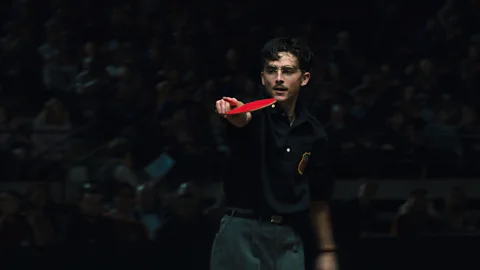
Every frame feels considered. The cinematography doesn’t just recreate the era—it luxuriates in it. Muted color palettes, textured shadows, natural light bleeding through dusty windows. The camera lingers just long enough to let you soak in the world without calling attention to itself. It’s confident filmmaking, the kind that trusts you to notice the details without waving at them.
The production design is doing serious heavy lifting here. Sets feel lived-in, not museum-polished. Furniture looks worn. Walls feel stained with history. Costumes don’t scream wardrobe department—they whisper character. You understand who these people are before they open their mouths, and that’s no small thing.
And yes, this is one of those films where you find yourself thinking, “This should absolutely be nominated for something.” Probably several somethings.
Performances Firing on All Cylinders
The acting across the board is excellent—often better than the script even requires.
The supporting cast, in particular, is doing quiet, restrained, deeply human work. Side characters feel fully realized in just a handful of scenes. There are moments where someone delivers a single line, or even just a look, that conveys more emotional complexity than entire subplots in lesser films.
Which makes it all the more frustrating that Marty himself—the center of the movie’s universe—never quite earns the attention lavished upon him.
The Problem Isn’t That Marty Is Unlikable
(It’s That the Movie Doesn’t Know What to Do With That)
Let’s get this out of the way: unlikable protagonists are not the problem. We all loved a million movies where the protagonist was a complete jerk. I’m thinking Social Network, Whiplash, Funny Games, Taxi Driver, Nightcrawler, There Will Be Blood… etc etc etc. There are plenty of movies that it is fantastic to love to hate, if you know what I mean. Some of the best films ever made revolve around deeply flawed, selfish, abrasive people. We’ve followed monsters, narcissists, criminals, and sociopaths for decades—when the movie understands why we’re watching them.
But Marty Supreme seems oddly confused about its own main character. Marty is a jerk. Not a complicated jerk. Not a charming jerk. Not a fascinating train-wreck jerk. Just… a selfish, self-serving, emotionally incurious guy who takes and takes and rarely reflects. He hurts people casually. He ignores consequences. He rarely grows.
And crucially: the film doesn’t interrogate this in any meaningful way.
It doesn’t frame Marty as a cautionary tale.
It doesn’t offer insight into why he’s like this.
It doesn’t evolve his selfishness into tragedy, irony, or reckoning.
The movie seems to admire Marty just enough to undermine itself.
Craft in Search of a Spine
This is where the film starts to wobble. Scene after scene is beautifully written. The dialogue snaps. The pacing is confident. Individual moments work. But as a whole, the movie never quite answers the question: Why am I spending this much time with this man?
There’s no emotional anchor—no counterweight to Marty’s behavior. The people around him suffer, drift away, or quietly endure, but the film doesn’t linger on their interior lives long enough to shift perspective. And because Marty never meaningfully confronts himself, the story starts to feel circular rather than purposeful.
It’s not that you want Marty redeemed.
It’s that you want the movie to take a position.
Instead, it sort of just shrugs off Marty’s asshole-ness.
A Film I’ll Still Recommend (With an Asterisk)
Here’s the thing: despite all of this, Marty Supreme is absolutely worth seeing.
If you love:
- finely tuned scripts
- meticulous period detail
- confident, adult filmmaking
- movies that look like they cost twice what they did
…this is your jam.
I’ll happily recommend it to people who appreciate cinema as craft. I’ll talk up the performances. I’ll rave about the design. I’ll point out specific scenes that are masterclasses in restraint. But I’ll also warn them: “Don’t expect to fall in love with the main character—or for the movie to care whether you do.”
Final Thoughts on Marty Supreme
Marty Supreme is a beautifully made film with a hollow center, just like those chocolate Easter Bunnies. It’s all chocolate outer shell and no heartbeat. A technical triumph that forgets to give its protagonist a reason to matter beyond his own ambition. Sometimes, a movie can survive an unlikable lead.
This one needed either more self-awareness… or less affection for its own creation.
Still—if you’re the kind of movie lover who roots for the under-seen, the finely crafted, the slightly misfiring but ambitious swing? You should absolutely put this on your list. Just don’t expect Marty to earn your loyalty.