

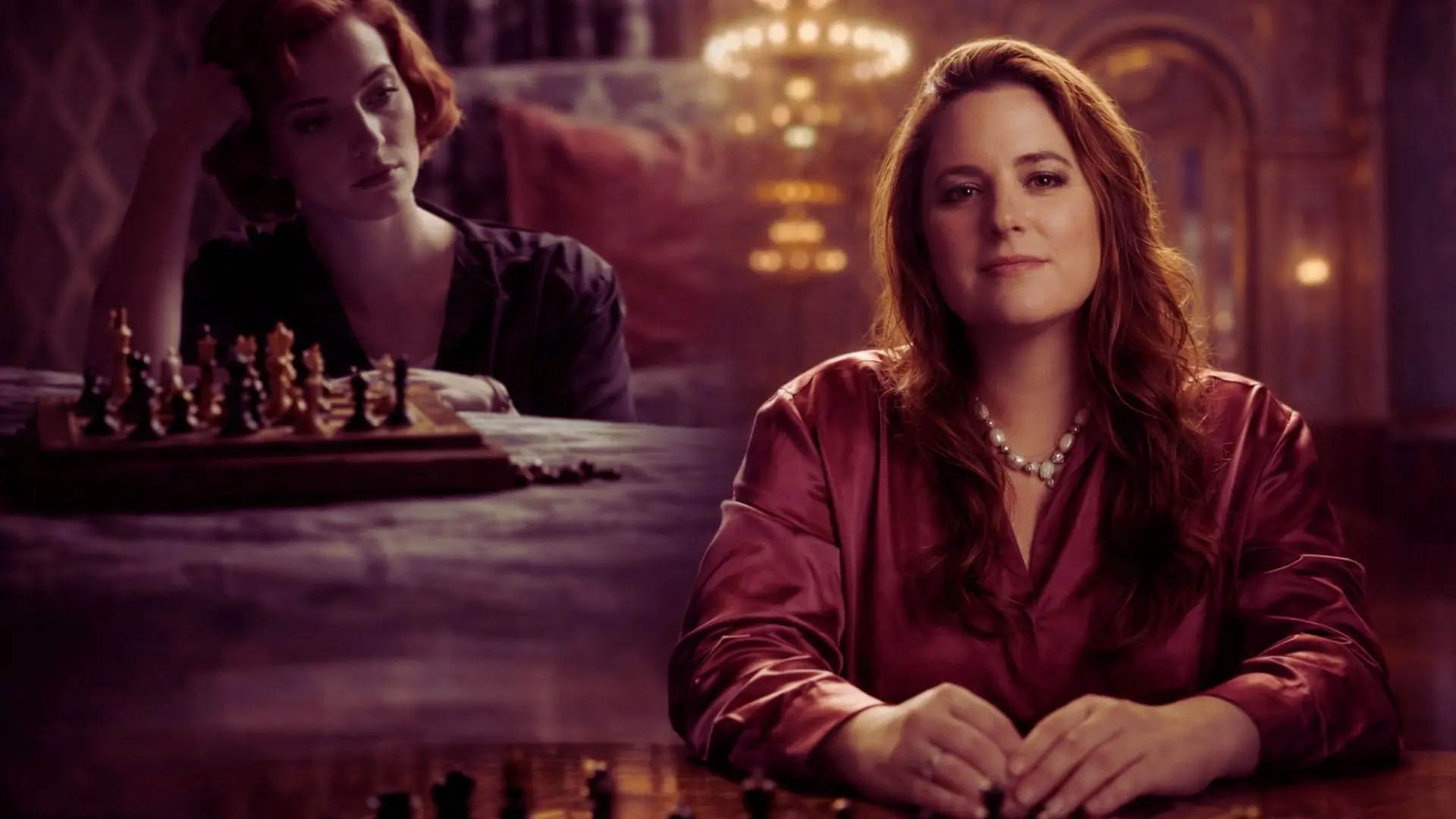
Look, I’ve been waiting for this documentary since The Queen’s Gambit dropped in 2020 and got everyone suddenly obsessed with chess. Back then, I wrote about how Beth Harmon’s fictional story was glorious, and I made sure to mention the real-life player who actually lived a version of that impossible dream: Judit Polgár.
Now Netflix has released Queen of Chess, directed by Rory Kennedy, and after watching all 94 minutes, I can tell you this: if you loved The Queen’s Gambit, you absolutely need to watch this documentary. Not next week. Not when you have time. Now.
Because Judit Polgár’s story is everything Beth Harmon’s was, except it actually happened. And unlike the fictional version, this one comes with all the complications, messiness, and moral ambiguity that real life inevitably provides.

The Impossible Achievement
Let’s start with the facts, because they’re genuinely staggering:
Judit Polgár became a Grandmaster at age 15 years and 4 months, shattering Bobby Fischer’s record. She’s the youngest person—male or female—to ever achieve that title. At age 12, she ranked 55th in the world. At her peak in 2005, she hit a rating of 2735 and became the first and only woman to break into the top 10 chess players in the world overall.
She defeated 11 current or former world champions. She beat Garry Kasparov—widely considered the greatest player in history—in rapid chess. She qualified for the World Championship tournament. She did all of this while being told repeatedly, by Kasparov himself among others, that women simply couldn’t compete with men at the highest levels of chess.
And then she retired in 2014, walked away from competitive play, and now runs an educational foundation teaching chess to children.
The documentary covers all of this with extensive archival footage from tournaments spanning decades, personal family videos, and modern interviews with Judit, her family, and key figures from the chess world. It’s accessible to non-chess players while still respecting the depth of what Polgár accomplished.
The Uncomfortable Question: What About the Experiment?
Here’s where things get complicated, and where I think the documentary’s critics have a legitimate point.
Judit and her two older sisters—Susan and Sofia—were raised by their father László in what was essentially a decades-long experiment to prove that geniuses could be made, not born. László was an educational theorist who believed that with the right training from early childhood, any child could become a genius in their chosen field.
So he chose chess. And he chose his three daughters as test subjects.
From age 5 onward, the Polgár sisters lived in a small Budapest apartment where chess consumed their lives. They were homeschooled so they could focus on chess. They studied positions for hours daily. They traveled to tournaments constantly. Their entire childhood was structured around proving their father’s theory correct.
And it worked. All three sisters became chess prodigies. But especially Judit—the youngest, the one who her sister Susan predicted would be “the strongest of the three of us” when Judit was still a child.
The documentary touches on this dynamic but doesn’t dig as deeply as some critics would like. There’s a brief moment where the interviewer asks Judit about being part of her father’s experiment, and Judit demurs. She doesn’t engage with the question in any substantial way.
And honestly? I get why the documentary doesn’t push harder on this point, and I also understand why some viewers find that frustrating.
Why Judit Doesn’t Owe Us That Conversation
Look, here’s my take: Judit Polgár is 49 years old. She’s been answering questions about her unusual upbringing for literally four decades. She’s been asked variations of “were you exploited by your father?” and “do you resent being used as an experiment?” probably thousands of times.
At what point does she get to just be celebrated for what she accomplished?
Because here’s the thing—every elite athlete, every chess grandmaster, every world-class musician had an unusual childhood. Their parents made choices about their education, their training, their social lives. Some of those choices look like dedication and support. Some look more questionable in hindsight. But we don’t usually frame those stories as “experiment” and “lab rat” unless there’s something that makes us uncomfortable about it.
With the Polgár sisters, I think what makes people uncomfortable is the deliberateness of it. László wasn’t just a proud father encouraging talented daughters. He had a thesis he wanted to prove. He wrote about it publicly. He used his daughters’ success as evidence for his educational theories.
That’s weird. I’ll admit that. It crosses some line between supportive parenting and something more clinical.
But it’s also true that:
- All three sisters, by their own accounts, loved chess
- They weren’t locked in a basement—they traveled the world, competed internationally, met fascinating people
- They all speak about their father with respect and affection
- They all went on to live full lives beyond chess (Susan is now a successful chess promoter and educator; Sofia stepped back from competitive chess to pursue other interests)
- Judit herself has been married for years, has children, runs a successful foundation, and seems by all accounts to be a well-adjusted, thoughtful person
So was it exploitation? Was it an unethical experiment? Or was it just an unconventional approach to education that happened to produce extraordinary results?
I genuinely don’t know. And more importantly: it’s Judit’s story to tell or not tell.
If she’s decided that she’d rather be known for beating Kasparov than for her complicated relationship with her father’s theories, that’s her choice. If she’d rather this documentary celebrate her achievements than psychoanalyze her childhood, I respect that.
She doesn’t owe us a confessional about whether she felt like a guinea pig. She’s already given us enough.
What the Documentary Does Brilliantly: The Kasparov Rivalry
Where Queen of Chess truly excels is in documenting Judit’s multi-decade rivalry with Garry Kasparov. This is the dramatic spine of the film, and it’s absolutely riveting.
Kasparov was notorious for his sexist comments about female chess players. He called Judit a “circus puppet.” He claimed women lacked the necessary aggression and killer instinct for top-level play. He said men and women shouldn’t even compete against each other.
And then this teenage girl from Hungary kept showing up at his tournaments.
Their first major encounter was at Linares 1994, when 17-year-old Judit played in the super-tournament for the first time. The documentary includes the infamous moment where Kasparov appears to violate the touch-move rule on camera—moving his knight, then switching it to a different square after his hand had left the piece. Judit called him on it. The arbiter ruled in Kasparov’s favor. Kasparov won the game.
The chess world argued about it for years. Was it a violation? Should Judit have been awarded the win? The footage is right there in the documentary, and you can decide for yourself.
But that moment crystallized everything about Judit’s position in the chess world: talented enough to compete at the highest levels, but still not given the same benefit of the doubt as her male opponents.
Years later, Judit finally beat Kasparov in a game. The documentary shows her doing it, and it’s genuinely thrilling. Not because Kasparov was wrong about women’s chess abilities (he clearly was), but because Judit proved it on the board, over and over, for 25 years.
And here’s what makes the story even better: Judit and Kasparov eventually reconciled. The documentary reveals that they’ve recently played recreational freestyle chess together at conferences. The man who once called her a circus puppet now apparently respects her as a peer.
That’s the arc the documentary is really interested in: not the exploitation angle, but the triumph. The breaking down of barriers. The changing of minds through sheer undeniable excellence.
Why You Should Watch
Queen of Chess is a documentary that knows what story it wants to tell. It wants to celebrate Judit Polgár as one of the greatest chess players who ever lived—full stop. Not “greatest female chess player” (though she is). Not “greatest player considering her unusual upbringing” (though that’s remarkable). Just one of the greats, period.
And it makes that case compellingly.
The archival footage is fantastic—you see young Judit dismantling opponents, you see the chess world slowly coming to terms with her, you see her peak years when she was in the top 10 in the world. The modern interviews are thoughtful without being overly analytical. The pacing is brisk (94 minutes flies by). And even if you know nothing about chess, you’ll understand what she accomplished and why it matters.
Is it a perfect documentary? No. If you want a deep psychological exploration of what it meant to be László Polgár’s daughter, you won’t fully get that here. If you want Judit to grapple with the ethics of her father’s experiment on camera, you’ll be disappointed.
But if you want to watch a documentary about an extraordinary person who broke through barriers that everyone said were unbreakable, who beat players who said she had no business being on the same board as them, and who did it all with grace and intelligence—then this is absolutely worth your time.
The Bigger Picture: What Judit Represents
At the end of the day, Queen of Chess is asking a question that goes way beyond chess: How do we celebrate pioneers without demanding they constantly re-litigate the complicated circumstances that made them pioneers in the first place?
Judit didn’t choose to be born into László’s experiment. But she did choose to be great at chess. She did choose to compete against men when she could have dominated women’s chess with far less resistance. She did choose to keep proving herself over and over when she could have given up and blamed sexism (which, to be clear, was absolutely real and documented throughout her career).
The documentary chooses to focus on those choices—the ones Judit made for herself—rather than the ones her father made for her. Some critics will say that’s a cop-out. I say it’s giving Judit the agency to define her own story.
She’s earned that right.
So watch Queen of Chess. Watch it because Judit Polgár’s story deserves to be told. Watch it because the chess is actually fascinating even if you’ve never touched a board. Watch it because Garry Kasparov eating crow is objectively satisfying. Watch it because sometimes it’s okay to just celebrate someone’s excellence without picking apart every complicated aspect of how they got there.
And then, if you’re like me, you’ll probably want to go back and watch The Queen’s Gambit again, except this time you’ll know that Beth Harmon’s impossible dream was actually possible all along.
Because Judit Polgár lived it.
Queen of Chess is streaming on Netflix now. It’s 94 minutes. You have no excuse.
Go watch it. Then come back and tell me I’m wrong about the László experiment thing. I’m ready for that debate.