
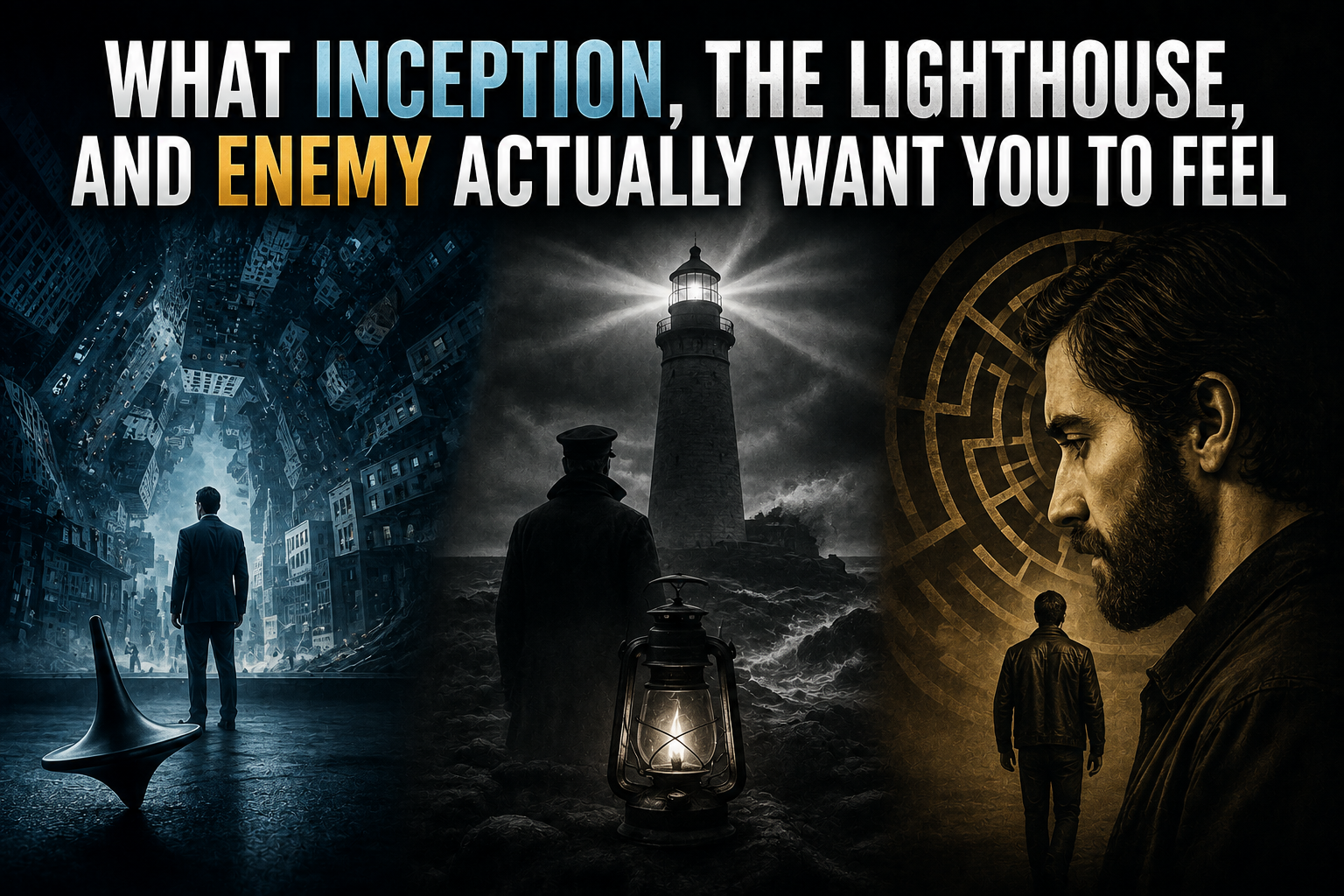
A lighthouse keeper laughs on the rocks as gulls tear at him. A spinning top wobbles. A man opens a bedroom door and sees a giant spider where his wife should be. Three movies, three closing shots, and decades of arguments about what any of it means. The trick with ambiguous endings is that most viewers ask the wrong question. They chase the plot answer when the director is aiming at a feeling.
The Wrong Question: What Happened?
Christopher Nolan, Robert Eggers, and Denis Villeneuve all know the audience wants a verdict. Is Cobb dreaming? Did Thomas Wake really guard some Promethean secret? Is Adam or Anthony the real man? Give the answer, and the film becomes a puzzle box you close and shelve. Withhold it, and the film keeps working on you for weeks. That withholding is not laziness. It is the point.
You can see the same design philosophy across other slow-burn favourites and even in unrelated entertainment formats—the way a hand of poker leaves the last card face down, or the way Pragmatic Play slots lean on suspended near-misses to keep the reels psychologically alive between spins. Different medium, same lever: uncertainty as an emotional state, not a bug to fix.
Inception: The Feeling Is Acceptance
Nolan has said in interviews that the more interesting shot in the finale is not the top—it is Cobb walking away from it. He no longer needs to check. Whether the world is real or a projection, he has chosen it. The ending is engineered so that you, the viewer, feel that same private surrender. Debating totems misses what the last two minutes are doing to your chest.
The finale works because each visual detail represents a different stage of Cobb’s decision to stop searching for certainty:
- The top spinning = the mystery you cling to.
- Cobb turning away = the peace he grants himself.
- The cut to black = your turn to decide what peace costs.
That is why the unresolved top matters less than Cobb’s reaction to it. For most of the film, he treats certainty as something he must obtain before he can move forward, but the final scene reverses that pattern.
The Lighthouse: The Feeling Is Punishment You Half-Wanted
Eggers shoots the final image like a Gustave Doré engraving of Prometheus, and that reference is not decorative. Thomas Howard climbed toward a forbidden light, knowing what it would do to him. The gulls, the laughter, the exposed body on the black rocks—Eggers is not asking whether the light was magical. He is asking whether you understand the pull of ruin.
The ambiguity is moral, not literal. You are supposed to leave the theatre unsure whether you pity Howard or envy him. That discomfort is the ending.
Enemy: The Feeling Is Recognition
Villeneuve’s Enemy ends with the loudest quiet scream in modern cinema. Adam finds a spider the size of a room, and he sighs. Not screams. Sighs. Every reading—the spider as fear of commitment, as totalitarian surveillance, as the maternal shadow, as the doubled self—points to the same emotional target: the exhausted acknowledgment that the pattern is going to repeat. He has seen this before. He will see it again.
Three Endings, One Common Design
Line them up, and a shared blueprint appears. Each film ends on an image that is legible as a symbol before it is legible as a plot point. Each denies closure. Each asks the viewer to name a feeling they usually avoid.
| Film | Final Image | Intended Feeling |
|---|---|---|
| Inception | Spinning top, Cobb walking away | Chosen acceptance |
| The Lighthouse | Howard on the rocks, gulls circling | Fascinated dread |
| Enemy | Adam facing the giant spider | Weary recognition |
How to Watch an Ambiguous Ending On Purpose
If you want to get more out of these final scenes, stop treating them as riddles with a hidden answer key. Try this instead:
- Name the feeling in the last shot before you name the theory.
- Ask why the protagonist stopped fighting.
- Notice what the camera lingers on one beat longer than expected.
- Write down your first read before reading anyone else’s.
Cognitive researchers who study narrative transportation have shown that unresolved endings deepen emotional processing precisely because the brain keeps rehearsing them. That is why these three films outlast their think pieces.
Why This Matters for the Rest of Your Watchlist
Once you start reading endings for feelings first, the whole shelf of ambiguous cinema opens up: Michael Haneke’s Caché, Lynch’s Mulholland Drive, and Kaufman’s I’m Thinking of Ending Things.
If you want to explore more films that reward close attention, the top 100 Netflix documentaries offer plenty of thought-provoking stories built around perspective, uncertainty, and interpretation.
The next time a film ends and the theatre goes quiet, resist the urge to Google the explanation. Sit in the discomfort. That silence is the movie finishing its last and most honest sentence.