
Sports movies rarely stay on the field, court, track, or boxing ring. The most enduring examples use competition as a framework for stories about ambition, identity, friendship, pressure, failure, and belonging. That is one reason American cinema has returned to athletics so often: sports already come with built-in conflict, recognizable rules, dramatic stakes, and characters whose progress can be measured in very visible ways.
The result is a remarkably diverse collection of films. Some draw on the lives of real athletes and teams, while others build entirely fictional worlds around competition. Their approaches are just as varied: certain movies examine sport with the detail of a documentary, while others use locker rooms, bowling alleys, racetracks, and baseball diamonds as backdrops for comedy, personal drama, and stories about American sporting culture. That same connection between sports and everyday life can be seen beyond the screen, including in the way fans follow professional leagues and engage with platforms covering arizona sports betting.
There is no single definition of the greatest sports movies. A film can matter because of its performances, direction, cultural influence, technical achievement, historical setting, or simply the way it captures the particular experience of watching and playing a sport. The American Film Institute has included films such as Raging Bull and Rocky among its major selections, while Rocky and Field of Dreams have also received recognition through the Library of Congress’s National Film Registry.
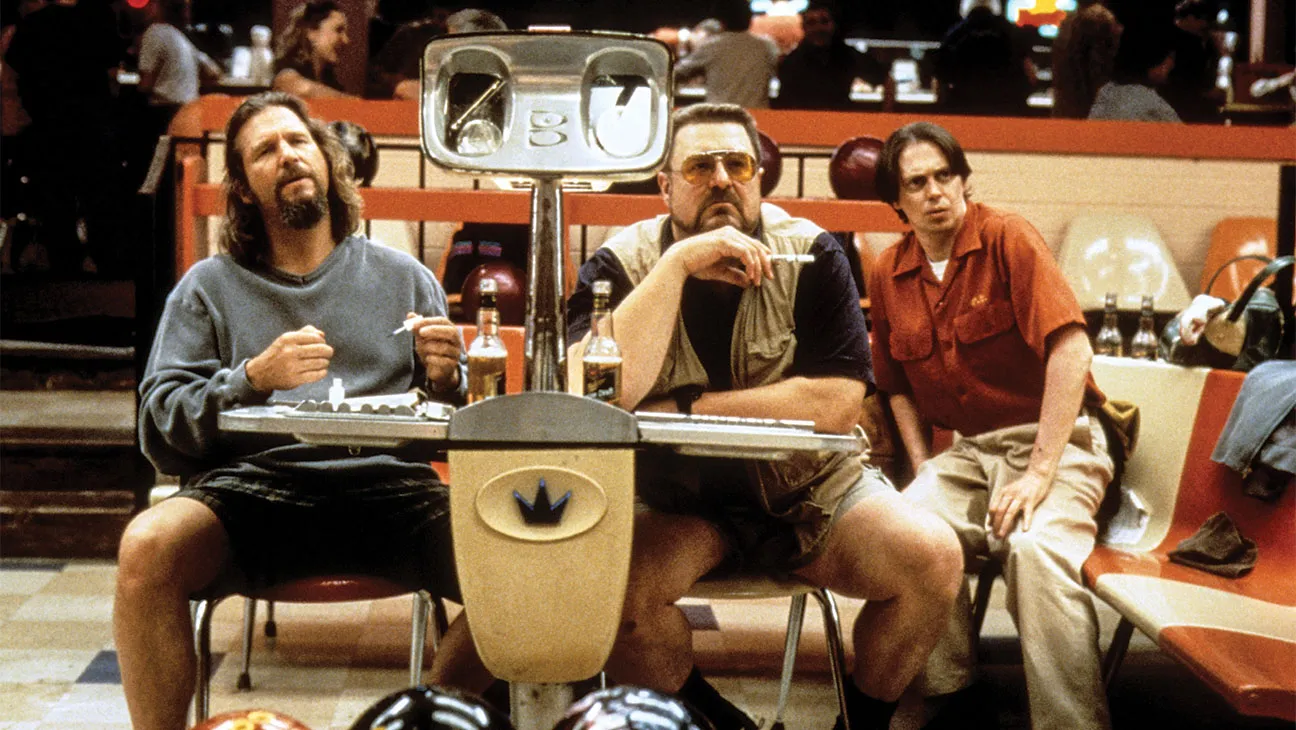
15. The Big Lebowski (1998)
The Coen brothers’ The Big Lebowski is not a conventional sports movie, which is precisely why it belongs in the conversation. Bowling is not the central conflict in the traditional dramatic sense, but it provides the film with its social world, rhythm, and recurring vocabulary.
Jeff Bridges’ Jeffrey “The Dude” Lebowski spends much of the film moving between bowling sessions and an increasingly complicated series of misunderstandings. John Goodman and Steve Buscemi complete one of cinema’s most recognizable amateur bowling teams.
The film treats bowling as a ritual rather than a championship pursuit. The characters care about their games, but the lanes also function as a place where friendships, arguments, rivalries, and absurd conversations unfold.
That makes The Big Lebowski an unusual entry among sports films. It is less interested in who wins than in what people reveal about themselves while playing.
14. Ford v Ferrari (2019)
Ford v Ferrari takes a famous episode in motorsport history and builds a character drama around it. The story centers on automotive designer Carroll Shelby and driver Ken Miles as Ford attempts to challenge Ferrari at the 24 Hours of Le Mans.
Matt Damon and Christian Bale anchor the film as Shelby and Miles, respectively. Their relationship gives the racing sequences a human dimension: technical decisions, corporate politics, personal pride, and questions of control all become part of the competition.
The film is also a reminder that sports movies do not have to be about traditional team sports. Motorsport combines athletic skill with engineering, endurance, machinery, and strategy.
Its racing sequences provide the spectacle, but the conflict between Miles, Shelby, and the corporate structure surrounding them provides the dramatic engine.
13. A League of Their Own (1992)
Penny Marshall’s A League of Their Own uses baseball to tell a larger story about American society during World War II.
The film fictionalizes the formation of the All-American Girls Professional Baseball League, which gave women an opportunity to play professional baseball while many male players were serving overseas. Geena Davis, Tom Hanks, Lori Petty, Rosie O’Donnell, and Madonna appear in the ensemble.
The movie moves between comedy, competition, workplace drama, and questions about gender expectations. Its baseball scenes matter because the players are trying to establish themselves as serious athletes in a culture that does not automatically treat them that way.
Rather than presenting the sport as an isolated world, A League of Their Own places baseball within a specific period of American history.
12. The Wrestler (2008)
Darren Aronofsky’s The Wrestler approaches professional wrestling from a very different direction.
Mickey Rourke plays Randy “The Ram” Robinson, a former wrestling star whose public career has declined while his attachment to the ring remains strong. Wrestling here is both performance and physical labor. The audience knows the matches are choreographed, but the injuries, exhaustion, and consequences experienced by the performers are tangible.
That tension gives the film its distinctive character. Randy’s identity is inseparable from the persona he created in the ring, making retirement more complicated than simply leaving a job.
The film is not interested in the glamorous side of sports entertainment. It focuses instead on aging, loneliness, work, and the difficulty of separating a performer from the role that made him recognizable.
11. Miracle (2004)
Miracle dramatizes the United States men’s ice hockey team’s victory over the Soviet Union at the 1980 Winter Olympics.
Kurt Russell plays coach Herb Brooks, whose approach to building the American team emphasizes conditioning, discipline, and a collective identity. The story is one of the best-known examples of sports movies based on true stories, although, like other historical dramas, it condenses events and characters for dramatic purposes.
The hockey itself provides the film’s structure. Players who begin as individual talents have to become a functioning unit.
The historical context is equally important. The Cold War shaped how the 1980 Olympic hockey game was remembered in the United States, turning an athletic contest into a cultural event that extended far beyond the rink.
10. Friday Night Lights (2004)
Peter Berg’s Friday Night Lights follows a high school football team in Odessa, Texas, where the sport occupies an unusually prominent place in community life.
The film is based on H. G. Bissinger’s nonfiction book about Permian High School football. Billy Bob Thornton plays coach Gary Gaines, while the young players face pressure that extends well beyond the scoreboard.
What separates Friday Night Lights from simpler underdog stories is its attention to consequences. Winning can affect a player’s status, future opportunities, family expectations, and sense of identity.
Football becomes a way to examine a community and its values. The players are teenagers, but the expectations surrounding them can be adult-sized.
9. Bull Durham (1988)
Bull Durham combines baseball with romantic comedy and workplace storytelling.
Kevin Costner plays Crash Davis, an experienced minor-league catcher assigned to mentor promising young pitcher Ebby Calvin “Nuke” LaLoosh, played by Tim Robbins. Susan Sarandon plays Annie Savoy, a baseball fan who develops her own philosophy about players, performance, and relationships.
The film understands minor-league baseball as a profession rather than simply a glamorous version of the major leagues. Players travel, struggle for contracts, develop routines, and try to determine whether their careers will move forward.
That practical setting gives Bull Durham its distinctive voice. It is one of the funnier sports movies in the American tradition, but its comedy comes from character and workplace dynamics rather than from treating the sport itself as a joke.
8. The Natural (1984)
Barry Levinson’s The Natural presents baseball through the language of myth.
Robert Redford plays Roy Hobbs, a gifted baseball player whose career is interrupted by a violent incident before he can reach the major leagues. Years later, he returns to professional baseball and becomes the center of an increasingly symbolic story.
The movie is adapted from Bernard Malamud’s novel, and its visual style embraces the idea of baseball as American mythology. Stadium lights, uniforms, bats, gloves, and carefully staged moments become part of a world that feels larger than ordinary sporting competition.
The film is less concerned with statistical realism than with the emotional symbolism of the game. Baseball becomes a setting for lost opportunities, second chances, and the possibility of constructing a new version of one’s life.
7. Creed (2015)
Creed could easily have become a simple continuation of the Rocky franchise. Instead, director Ryan Coogler uses the existing mythology to introduce a different protagonist.
Michael B. Jordan plays Adonis Johnson, the son of former heavyweight champion Apollo Creed. Sylvester Stallone returns as Rocky Balboa, now occupying the role of mentor rather than young contender.
The film connects two generations of boxing without making the younger character entirely dependent on the older one. Adonis has to establish his own identity, while Rocky faces a different stage of his life.
The boxing sequences are therefore connected to questions of inheritance and self-definition. The film’s relationship with the earlier Rocky movies is important, but Creed has its own dramatic focus.
6. Moneyball (2011)
Moneyball is a sports movie in which the most important action often happens away from the playing field.
Brad Pitt plays Billy Beane, the general manager of the Oakland Athletics, while Jonah Hill plays Peter Brand, a fictionalized version of an analyst associated with the team’s statistical approach. The screenplay is based on Michael Lewis’s nonfiction book.
The film centers on the attempt to use statistical analysis to construct a competitive baseball roster under financial constraints. That makes it particularly different from traditional sports dramas: the central problem is not how to train harder or overcome an injury, but how to think differently about player value.
Its baseball games are important, but the movie’s real conflict is between established baseball traditions and a data-driven approach to evaluating performance.
5. Hoosiers (1986)
Hoosiers is set in small-town Indiana and follows a high school basketball team attempting to make a run through the state tournament.
Gene Hackman plays coach Norman Dale, an outsider with a complicated past who takes over a team facing skepticism from its community.
The film works because basketball is presented as both a sport and a social institution. In a small Indiana town, the high school team represents something larger than the players on the court.
The movie also captures a particular American sporting tradition: the belief that a local gymnasium can become the center of a community’s attention. The basketball itself remains central, but the emotional stakes come from the relationship between players, coach, families, and spectators.
4. Field of Dreams (1989)
Field of Dreams begins with one of the strangest premises in American sports cinema: an Iowa farmer hears a mysterious voice telling him to build a baseball field.
Kevin Costner plays Ray Kinsella, who follows the instruction despite having no conventional reason to believe it will lead anywhere. The story gradually connects baseball with memory, family, regret, and reconciliation.
The film was nominated for three Academy Awards, including Best Picture, and was added to the National Film Registry in 2017.
Baseball is important because of what it represents. The sport connects generations and memories, particularly through the history of the Chicago White Sox and the players associated with the 1919 Black Sox scandal.
Field of Dreams is therefore less a movie about winning a game than about why particular games and players remain meaningful long after the final score has disappeared from the headlines.
3. Raging Bull (1980)
Martin Scorsese’s Raging Bull is one of the most demanding films in the sports genre.
Robert De Niro portrays Jake LaMotta, the middleweight boxer whose professional success existed alongside a volatile personal life. The film is based on LaMotta’s memoir and examines his career through a stark, psychologically intense style.
Boxing becomes an extension of the protagonist’s personality. Violence inside the ring is only one part of a broader pattern of conflict.
The film received eight Academy Award nominations and won Oscars for Best Actor and Film Editing. AFI also placed Raging Bull at No. 24 on its 100 Years…100 Movies list.
Unlike many sports movies, Raging Bull does not build toward a conventional inspirational conclusion. It is interested in what happens when professional achievement fails to resolve personal problems.
2. Rocky (1976)
Rocky follows a small-time Philadelphia boxer who receives an unexpected opportunity to fight heavyweight champion Apollo Creed.
Sylvester Stallone wrote the screenplay and stars as Rocky Balboa, while John G. Avildsen directs. The film was made on a relatively modest budget and used Philadelphia locations extensively, helping make the city part of its visual identity. The Library of Congress has described the film as a story that extends beyond boxing into friendship, love, dignity, and self-respect.
At the 1977 Academy Awards, Rocky won Best Picture, Best Director, and Best Film Editing, while also receiving several other nominations.
Its central competition is straightforward, but the film’s real subject is the value Rocky places on going the distance. The championship fight matters because of what the opportunity means to him, not simply because of its result.
That distinction helped turn Rocky into one of the defining American sports films.
1. The Wrestler? Or Rocky? Why the “Greatest” Sports Movie Question Is Complicated
Calling one film the definitive sports movie inevitably depends on what is being measured.
If the standard is historical recognition, Rocky has an unusually strong case: it won Best Picture and remains part of the National Film Registry. If the focus is cinematic experimentation, Raging Bull occupies a very different position. If the criterion is the relationship between sport and American culture, Field of Dreams, Hoosiers, and A League of Their Own offer entirely different perspectives.
That is why a list of the best sports films works better as a map of the genre than as a definitive hierarchy.
Sports cinema has room for the statistical arguments of Moneyball, the historical drama of Miracle, the humor of Bull Durham, the mythology of The Natural, the community focus of Friday Night Lights, and the personal conflicts of The Wrestler.
It also continues to change. New sports movies increasingly move beyond the traditional formula of the underdog who trains, competes, and wins. Recent films have explored professional racing, tennis, wrestling, basketball, soccer, and other sports through stories that can be as much about business, identity, relationships, or institutions as competition itself.
The enduring sports movie, however, usually comes back to the same basic question: what does competition reveal about the people involved?
Sometimes the answer is ambition. Sometimes it is pride, fear, loyalty, loneliness, or the desire to belong. The scoreboard is often only the most visible part of the story.

Why Sports Movies Keep Finding New Audiences
The interesting thing about sports cinema is that the final score is rarely the part people remember.
Years after a game, race, or fight has ended, what tends to remain are the circumstances around it: the player who was given one last opportunity, the team that had to redefine itself, the coach who could not separate winning from his own identity, or the family history hiding behind a seemingly ordinary baseball field. Sport provides the clock, the rules, and the possibility of a clear result. Movies use those boundaries to tell stories that are much less tidy.
That helps explain the variety of the films on this list. Rocky and Hoosiers approach competition through personal and community stakes. Moneyball questions how success should be measured. Raging Bull looks at what happens when achievement and personal life move in opposite directions. A League of Their Own places a sporting story inside a specific moment in American history, while The Big Lebowski barely cares about winning at all.
The genre has also proved remarkably adaptable. Some of the most memorable sports films are based on true stories, while others invent athletes and competitions entirely. Some are dramas; others are comedies, biographical films, crime stories, or character studies that happen to take place around a sport.
For that reason, the list of great sports films will never be completely settled. New sports movies will inevitably reinterpret familiar ideas, introduce different sporting cultures, and find drama in places earlier generations of filmmakers overlooked.
The strongest examples do not require the audience to care about the final result. They make the competition meaningful because of everything surrounding it—and sometimes, because of everything that happens after the game is over.