
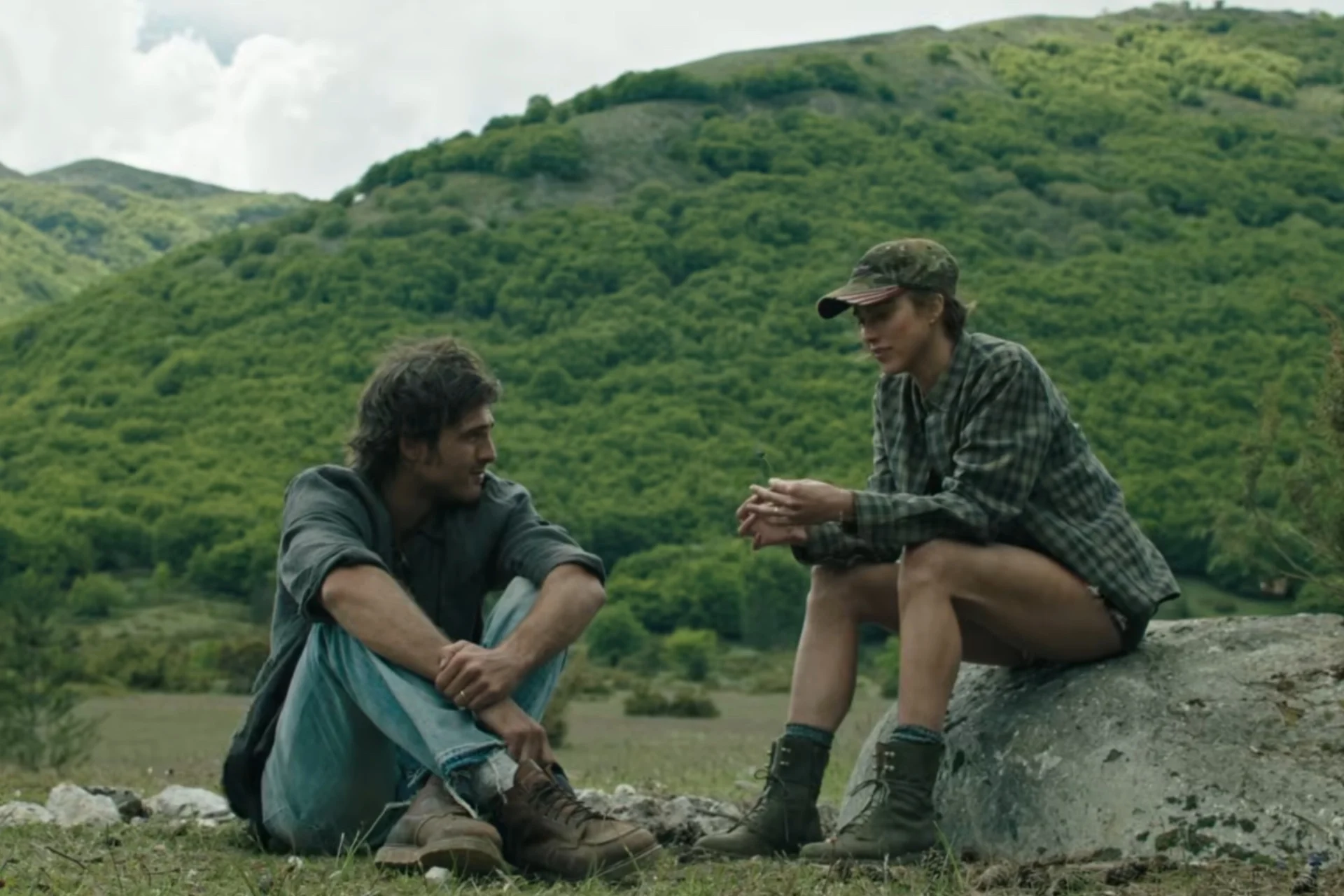
Okay so I need to talk about The Dog Stars… Ridley Scott’s new one with Jacob Elordi and Josh Brolin… because I watched it expecting a fairly standard post apocalyptic survival thing and walked away just completely charmed in a way I did not see coming.
Here’s my spoiler free pitch. It’s 2035, a flu pandemic wiped out most of the world, and Jacob Elordi’s character Hig is living out at an abandoned airfield in Erie, Colorado with his dog Jasper and a hardened survivalist named Bangley, played by Josh Brolin. That’s really all you need going in. What you actually get is less “action packed thriller” and more of a slow, melancholy wander through a dead Colorado… and I loved every second of it. I know these places. I know Denver, I know these little front range towns, I know what these archetypal Colorado landscapes look like when they’re full of people, and getting to see them reclaimed by weeds and wildlife and silence just hit something in me I wasn’t expecting. Broken down planes sitting on a hand mowed airstrip… abandoned skyscrapers just standing there doing nothing… it’s gorgeous in this quiet, sad way, and I’m still thinking about it.
I’ll be straight with you, the actual plot and character motivations are kind of thin. I don’t think that’s a hot take, critics have said as much (it’s sitting around 40% on Rotten Tomatoes, “derivative and drowsy” is a phrase getting thrown around). But honestly… I’d have been completely fine if they’d just planted the camera in a field somewhere in Denver and let me watch jackals and deer slowly move into the empty office buildings for two hours. That’s the vibe. It’s less a movie and more a mood, and the mood is so specifically, weirdly my thing that I don’t even care that the throughline is wobbly.
Here’s the trailer if you haven’t seen it yet:

Okay. From here on out I am going scene by scene through the entire movie, including the ending, so if you have not watched it yet and want to go in fresh, this is your exit. Go watch it, come back, we’ll talk.
SPOILERS START HERE. SERIOUSLY. LAST CHANCE.
Alright. Let’s walk through this thing.
We open nine years after the flu (and the follow up blood disease that came with it) wiped out most of the population. Hig is a mechanic and pilot living at an abandoned airfield in Erie with Jasper, his aging dog, and Bangley, a former Marine who has basically turned the airfield into a fortress. Hig lost his wife Melissa to the flu while she was pregnant, and that grief is sitting under every single thing he does for the rest of the movie, even when nobody says it out loud.
Hig flies patrols in his old Cessna, which he’s nicknamed the Beast, and he’s also been secretly running supplies out to a nearby Mennonite community, which Bangley absolutely does not approve of, because Bangley’s entire philosophy is trust nobody, stay armed, stay behind the fence. We get scavenger attacks, we get a warning about a much scarier group called the Reapers roaming out there, and then the gut punch, raiders hit the airfield and Jasper is fatally wounded. Hig buries him. And that loss is really the hinge the whole movie turns on, because with Jasper gone, Hig finally decides to chase something he’s been sitting on for years, a faint radio signal he picked up from Grand Junction a while back that he never had the fuel or the nerve to go check out.
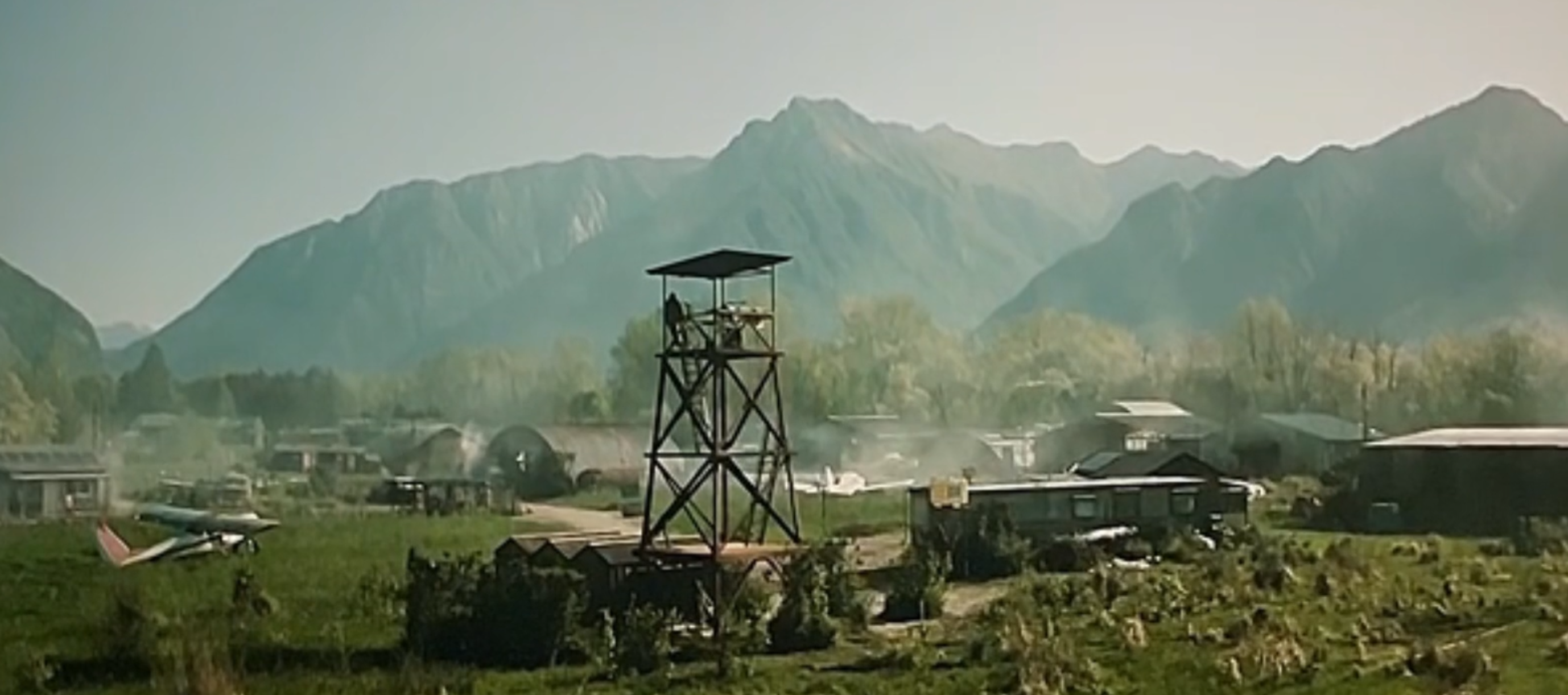
So he flies west. His plane has engine trouble and he’s forced down near a farm, where he meets Cima, a physician, and her father Pops, a former Navy SEAL. This is where the movie slows all the way down into its romance, Cima and Hig, and it’s genuinely tender, there’s this lovely little beat where she hears recorded music for what feels like the first time in years and it’s just a nice, human, unguarded moment in a movie that’s otherwise mostly about people getting shot at. Raiders hit their farm too, though, and the group decides to band together and keep heading toward Grand Junction, because at this point Hig isn’t the only one hoping there’s something real waiting there.
And then the movie does this hard swerve I genuinely did not see coming (seriously thought we were heading towards Infinity Pool or some craziness, it was that weird). Grand Junction is not a refuge. It’s run by a woman named Darlene, played by Allison Janney (WEST WING FAME, 10 THINGS I HATE ABOUT YOU!!! You know her well.), who is dressed the entire time like a vintage 1970s flight attendant, like she has simply refused to update her personality since the world ended, and she runs what looks at first like a functioning little community and turns out to be something much darker. She tries to force Cima into marriage with one of her men, purely because Cima’s medical skills are valuable, and when the group starts fleeing for their lives they find bags of dismembered bodies and rows of Polaroids on the wall of past victims. It’s a full on cannibal compound wearing the costume of civilization, essentially, and it’s a genuinely jarring tonal left turn from the quiet folk music romance stuff that came right before it. Hig sets a fire, Darlene gets caught in it, and the group fights their way out with grenades while the whole place goes up. (My number one complaint of this entire movie? That 4 or 5 hand grenades would incinerate that entire airport complex. Yeah, no.)
They fly back to Erie to check on Bangley, who took multiple hits defending the airfield while they were gone but survived and “killed over 50 raiders”… “funny, because I only counted 31 bodies.”) And instead of everyone just hunkering back down behind Bangley’s fences the way things were at the start of the movie, the group makes the choice to relocate together to that Mennonite settlement Hig had quietly been helping the whole time, the actual functioning community that was there all along, just waiting for people to trust it. The movie ends on Hig and Cima together, looking up at the stars, and Hig points out one he’s decided to name after Jasper. Small, quiet, a little corny honestly, and I did not care, I was fully on board.
So What’s This Actually About? A Few Theories
Theory one: it’s a grief movie wearing a post apocalypse costume. Every big decision Hig makes traces back to loss, his wife, and then Jasper. The entire trip to Grand Junction only happens because Jasper dying finally breaks him loose from Bangley’s fortress mentality. Naming a star after his dog at the very end isn’t just a sweet button on the romance, it’s Hig finally finding a way to carry grief forward instead of getting frozen by it, which is sort of the whole emotional arc in miniature.
Theory two: Bangley and Hig are the actual thesis of the movie, and Grand Junction is the cautionary tale. Bangley represents pure fortress survivalism, trust nobody, stay armed, don’t extend a hand to anyone outside the fence. Hig represents the opposite instinct, that connection and risk are worth it even now. Grand Junction, then, is what happens when “community” curdles into something monstrous, Darlene hasn’t actually built a society, she’s built a nostalgia act, still playing flight attendant while running an abattoir behind it, and I think that’s the film’s warning shot about mistaking the performance of civilization for the real thing. The Mennonites, quietly doing the actual work of rebuilding this whole time, are the answer to both Bangley’s paranoia and Darlene’s grotesque cosplay.
Theory three, and this is my own read on it… I think the thinness people are dinging it for might actually be the point, or at least I choose to receive it that way. This movie is far more interested in what abandoned Colorado looks and feels like than it is in delivering a tightly plotted survival thriller, and I don’t think that’s a flaw so much as a different kind of movie hiding inside a genre shell. It wants you sitting in the silence of an overgrown airstrip, it wants you looking at a dead skyscraper and feeling something, and the plot mechanics are almost just an excuse to keep moving the camera through that world. Which, again, worked completely on me, so.
Theory four: the ending is a deliberate rejection of nihilism. Worth knowing, this is actually a changed ending from Peter Heller’s original novel, which leaves things much more ambiguous, our characters staying put at Erie while mysterious jets fly overhead, no real resolution on whether the wider world survived. The movie instead sends everyone off to join an actual community and closes on stargazing and a named star. …and I think it’s the film picking a side in its own internal debate, arguing that after everything, connection and hope win out over isolation and hardened self reliance. It’s a softer landing than the book gives you, and depending on your mood that’s either exactly what you needed or a little too neat. For me, given how much dread I walked in with, I was grateful for the soft landing.
I was so pleasantly surprised by this one… could be that I was in a forgiving mood. But I loved the vibe, the aesthetic. I liked the Dad protecting his daughter. I liked the MAGA-nut protecting his friend. I absolutely adored the freakazoid Grand Junction crew! I mean what? And I just loved that the screenplay chose to give us what we wanted, which was a breath of fresh air, and the beginnings of some semblance of community again.
If you are looking for other movies like this one? I got you covered… an almost perfect replica but more tension, Z for Zachariah. That and The Book of Eli… others? It Comes at Night is alot more intense than this one… don’t think it’s cut from the same cloth. Oh, or what about Into the Forest? Or Cargo? Oh, but the best movie cut from this same philosophical cloth, definitely is Starfish. You are welcome for those outstanding movie recommendations.