
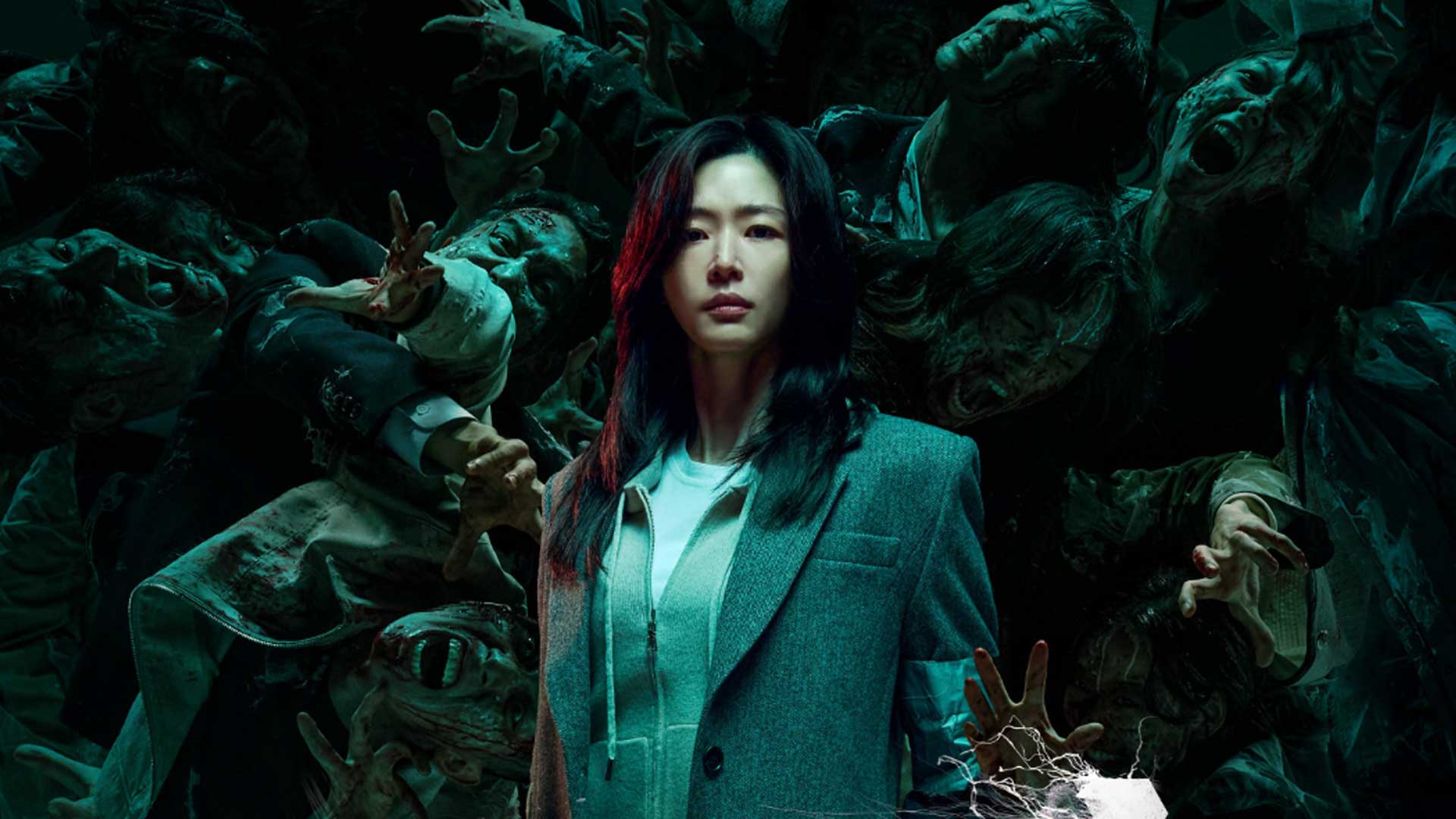
I want to start by saying something that I think gets lost in a lot of the discourse around Colony: this is not Train to Busan. I know Yeon Sang-ho directed Train to Busan. I know you know that. But Colony is doing something fundamentally different from that film, and if you walk in expecting the same emotional architecture you are going to spend two hours being quietly confused about why this does not feel like that. Train to Busan was about love and sacrifice and the specific ways that people reveal who they are when civilization collapses around them. Colony is about something colder and stranger and considerably more disturbing: what happens when the thing replacing civilization is not chaos but order. A different kind of order. One that does not have room for you as an individual.
That distinction matters for everything that follows. So let us get into it.
What is Colony actually about underneath the zombie movie
Colony, which is known in Korean as Gunche, premiered at Cannes 2026 and is directed by Yeon Sang-ho, whose last zombie film was Train to Busan back in 2016. The film stars Jun Ji-hyun as biotechnology professor Kwon Se-jeong, Koo Kyo-hwan as the villain Seo Yeong-cheol, Ji Chang-wook as security guard Choi Hyeon-seok, Kim Shin-rok as his wheelchair-using sister Choi Hyeon-hui, and Shin Hyun-been as outside biotech expert Gong Seol-hui.
The setting is the Doonguri Building, a massive commercial structure hosting a biotech conference on telepathy and shared consciousness. Se-jeong has been invited to the conference by her ex-husband Han Gyu-seong, who wants her to network before he moves to the United States. She arrives professionally isolated, personally exhausted, and carrying the specific weight of a woman who spoke up about corruption in her field and paid for it with her career.
Within minutes of the conference beginning, Seo Yeong-cheol releases a rapidly mutating virus and announces openly that this is a terrorist experiment designed to create a new humanity. Victims vomit white liquid and transform. The building is immediately sealed. What follows is roughly two hours of survival horror that gradually reveals itself to be something closer to a philosophical argument dressed in zombie film clothing.
The infection and what makes it different from every other zombie virus
This is the part that confuses most viewers and it is worth spending time on because the rules of the infection are actually internally consistent once you understand them, even if the film does not always explain them as clearly as it should.
The virus does not just transform people. It connects them. The infected share a neurological network, a genuine hive mind, and this has specific mechanical consequences that the film builds on throughout.
First, the infected adapt and learn collectively. When one infected creature encounters an obstacle, that knowledge propagates instantly through the entire network. This is why the survivors find the infected getting progressively smarter as the film goes on. They are not individual monsters learning from experience. They are nodes in a network that is accumulating knowledge from every encounter across all of its members simultaneously.
Second, and this is the part that trips people up in the ending, the network has a vulnerability. When the infected overload their shared neural connection, they enter what the film calls a death spiral. The system crashes. The infected shed their outer coating of white material and when they reawaken they have been reset. All the accumulated knowledge is gone. They start from zero again.
Third, the infected are not mindless. This is Yeon Sang-ho’s most interesting formal decision in the film. The infected study human behavior through observation and begin to imitate it. The most unsettling sequence in the film involves infected creatures silently mirroring the exact posture and movement of Hyeon-seok as he carries his sister through a corridor. For a split second it reads as almost darkly funny. Then you understand what you are looking at. They are not mocking him. They are learning him. Studying how a human moves through space so they can replicate it. The imitation is not communication or empathy. It is data collection for the collective.
Who is Seo Yeong-cheol and why did he actually do this
Yeong-cheol is played by Koo Kyo-hwan with a stillness that is considerably more disturbing than any amount of scenery-chewing would have been. He never raises his voice much. He never loses control. He is the calmest person in the building throughout an event he intentionally caused, and that calm is the horror.
His motive is ideological rather than personal. He is not seeking revenge on any specific person or institution, though the film hints at professional grievances that pushed him toward this philosophy. What he genuinely believes is that human individuality is a design flaw. That loneliness, conflict, miscommunication, tribalism, and all the other structures through which humans cause each other damage are not aberrations from some ideal version of humanity but fundamental features of what individual consciousness produces when left to operate in isolation from other individual consciousnesses.
The infected, in his view, are not monsters. They are an improvement. They do not experience the loneliness and division that Yeong-cheol sees as humanity’s defining tragedy. They act with unity and purpose. They do not hurt each other through miscommunication or selfishness because there is no space in the network for the self that miscommunicates or acts selfishly. He has looked at the hive and decided it is better than what we have.
This is a villain ideology that the film takes seriously enough to give it real screen time, which is both what makes Colony interesting and what makes some viewers uncomfortable. Yeong-cheol is not simply wrong about everything. Human civilization does produce exactly the problems he identifies. The film is honest enough not to dismiss his diagnosis even while rejecting his solution, and the reason it rejects his solution is carried entirely by Se-jeong as a character.
What Se-jeong represents and why her specific personality matters
Se-jeong is not a conventional action hero and the film is not interested in making her one. She is exhausted. She is socially isolated. She is professionally damaged from having told the truth about something when the professional cost of telling that truth was very high. She moves through the film looking overwhelmed in a way that Jun Ji-hyun makes completely believable.
What she represents in opposition to Yeong-cheol’s ideology is specifically individuality as a survival mechanism rather than a flaw. Her willingness to maintain her own position against institutional pressure is the reason she still has the scientific knowledge and the independent judgment to actually stop the infection. The film is making an argument that the same traits that make human individuals difficult, stubborn, and prone to conflict are also what make humans capable of the kind of adaptive problem-solving that a hive mind cannot do. A hive mind cannot have a dissident. Cannot have someone who holds a position against the consensus. And it turns out that this is a significant vulnerability.
The building as a character and what Yeon Sang-ho does with the architecture
Colony is fundamentally a closed-box film and it earns that structure completely. The Doonguri Building is sealed immediately after the outbreak begins and the entire film takes place within it, which creates a compression of tension that Yeon Sang-ho uses well. The survivors climb upward through the building trying to reach the rooftop where rescue helicopters may arrive, which gives the film a vertical momentum that substitutes for the horizontal forward momentum of a film like Train to Busan.
The building also allows the director to use architecture as horror in ways that open locations do not permit. Ventilation shafts, escalators, underground shopping corridors, lift shafts and maintenance corridors all become differently threatening as the infected adapt to each space and the film uses the building’s enclosed geometry to choreograph encounters in ways that feel genuinely novel for the genre. The sound design is particularly effective in the sequences where infected creatures detect human presence through vibrations in metallic surfaces rather than sight, which creates a specific kind of tension different from anything in Train to Busan.
The lifting sequence and what the infected are actually doing
The scene in the lift that the trailer teased is worth spending time on because a lot of viewers missed what was actually happening.
Hyeon-seok is carrying his sister Hyeon-hui through a corridor when they realize infected creatures are moving alongside them in almost perfect synchronization, adopting the same posture, the same pace, the same physical orientation. It is disorienting and strange and the film holds on it longer than feels comfortable.
What the infected are doing is mimicry as intelligence gathering. The hive has encountered humans who move this way and is cataloguing the behavior in real time to share across the network. The imitation is so precise because the hive mind does not miss details. Every infected member observing the same thing sees the same thing with total fidelity and contributes that observation to the collective instantly.
This scene also establishes the film’s most interesting formal question: at what point does an entity that can perfectly imitate human behavior become indistinguishable from a human? The infected are not there yet in Colony. Their imitation is close but wrong in ways that register on an instinctual level before the rational brain can articulate exactly what is off. But the film is clearly asking how long before that gap closes.
The outside investigation and what Gong Seol-hui discovers
Running parallel to the survival plot inside the building is Shin Hyun-been’s Gong Seol-hui working outside with government officials and military forces to understand and contain what is happening. These external scenes function as a different register within the film, colder and more procedural, and they serve two purposes.
First they provide exposition about the virus’s mechanics that the characters inside the building cannot access because they are too busy surviving to stop and analyze. Seol-hui is the scientist who puts together the pieces of what Yeong-cheol actually built and how it works. She is the one who identifies the death spiral mechanism and understands what triggering a network overload might do.
Second they provide political context for the disaster. The government’s response to the outbreak is characterized by precisely the kind of fragmented, self-interested decision-making that Yeong-cheol would point to as evidence that individual human consciousness produces dysfunction. Nobody agrees on what to do. Every official is protecting their own position. The response is too slow and too bureaucratic for the scale of what is happening. The film is not subtle about this irony: the humans arguing about how to respond to the hive mind are demonstrating the exact failures of individual consciousness that the hive mind was supposedly designed to correct.
The third act, the rooftop, and how Se-jeong actually stops it
The convergence at the rooftop is where Colony becomes genuinely impressive as an action sequence and also where it becomes somewhat messy as a narrative. The survivors have reached the extraction point. Military helicopters are present. And Yeong-cheol arrives with a massive infected swarm moving as a single coordinated organism, no longer chaotic at all, and the scale of what the hive has become is made visually explicit for the first time.
Se-jeong’s solution to stopping the swarm comes from the understanding that Yeong-cheol’s own altered biology is the key. He deliberately infected himself with a modified version of the virus that made him both infected and a kind of control node for the network. He is not quite the hive mind’s brain but he functions as a connection point that the network recognizes and routes through.
Se-jeong, working with Seol-hui’s outside knowledge, synthesizes a counteragent using information derived from Yeong-cheol’s biology that is designed not to kill the infected but to overload the network and trigger the death spiral reset mechanism. She is essentially sending a crash signal to the collective.
Hyeon-seok dies protecting his sister during the final confrontation. This is the film’s most overtly emotional moment and Ji Chang-wook and Kim Shin-rok earn every second of it because their sibling relationship has been the film’s warm center throughout the surrounding brutality. Several viewers online noted that this moment hit harder than anything else in the film, and they are right. The film earns their relationship in the way Train to Busan earned its central father-daughter relationship, by showing the texture of it rather than just asserting it.
Yeong-cheol dies in the chaos. His final moments are described as strangely peaceful, almost satisfied, as though he believes the transformation he started is already beyond stopping regardless of what happens to him personally. He is not wrong.
The reset and why the victory feels incomplete
When Se-jeong’s counteragent triggers the death spiral, the infected collapse and reawaken having lost all accumulated network knowledge. They are reset to a kind of zero state. The military forces move in. Several survivors escape. The building is contained at enormous cost.
But the film does not give Se-jeong or the audience a clean victory and this is the correct choice. The reset does not kill the infected. It does not eliminate the virus. It returns the infected to an earlier point on their evolutionary curve, which means the network could theoretically rebuild its accumulated knowledge given time. Some infected are continuing to move independently after the reset, which suggests the virus has already produced variations that do not depend entirely on the central hive network for their functionality. Evolution has been happening faster than containment.
The film is honest that what Se-jeong has accomplished is not a cure. It is a delay. A very expensive, very painful delay that cost Hyeon-seok his life and left an entire building full of dead and transformed people and an unresolved virus still present in whatever carriers survived the reset.
That final shot and what it actually means
The final image of Colony is the one that the film’s entire argument has been building toward, and it is easy to miss if you are not watching carefully.
As Se-jeong exits quarantine, one of the human survivors nearby briefly mimics another person’s movement in the same unnatural, slightly-off-in-the-timing way that the infected did inside the building. The film cuts. Credits roll.
The reading that Yeon Sang-ho is going for has two possible layers and I think both are intentional simultaneously.
The first layer is the literal horror implication: the virus has not been fully contained. Something is still in this survivor. The hive behavior has persisted at a level subtle enough to pass quarantine screening, which means the infection is already outside and the death spiral reset bought a few weeks or months of calm before the next phase begins. This is the sequel hook reading and it is clearly there.
The second layer is the thematic reading: the film has spent two hours arguing that human society is already exhibiting the early signatures of hive behavior through algorithm culture, social media conformity, collective trending, and the way people unconsciously mirror each other’s opinions and behaviors within social networks. The survivor’s movement may be nothing. May be tired body language. May be the kind of coincidental mirroring that people do all the time without being infected by anything. And the film is asking you to sit with the fact that you cannot tell the difference. That the gap between organic human mimicry and virus-induced hive behavior may already be smaller than you assumed.
Colony earns this ending because it has done the work to make it mean something. Yeong-cheol was wrong that the solution is to eliminate individual consciousness. But he was not wrong that there is something in individual consciousness that is already trending in the direction of his new humanity, and the film does not let you look away from that.
Whether a sequel comes or not, that final shot is what Colony is actually about. Not the zombies. Not the building. Not even the outbreak. The question of what humanity is already becoming, voluntarily, before anyone unleashes a virus at a biotech conference.