
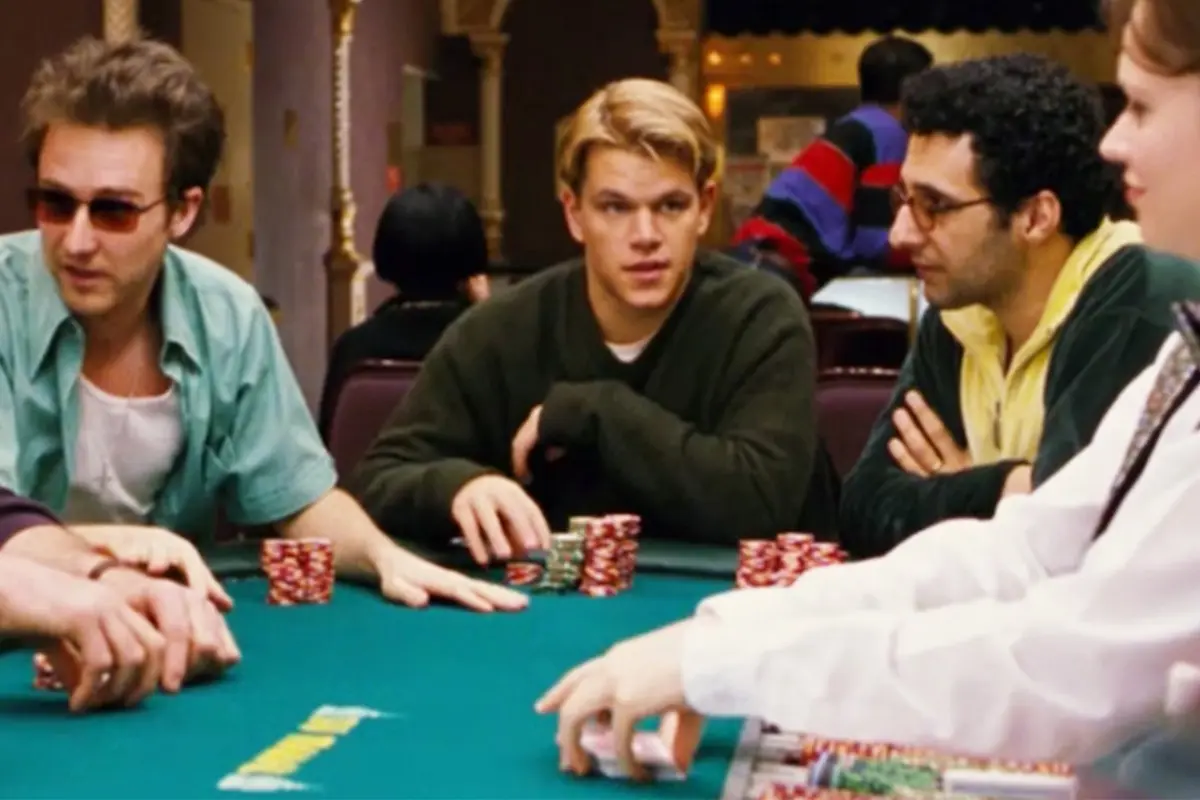
Here’s my problem with most “best gambling movies” lists: they tell you WHAT to watch and never WHY it hits so hard. And the why, in this genre, is almost always the same answer — because it actually happened. Or close enough to actually that the real people involved spent years denying it.
I went down this rabbit hole properly a couple of winters ago, the kind of rainy Dunedin fortnight where you watch a film a night and start taking notes like a lunatic. What I found: the best gambling films aren’t really about gambling. They’re about information — who has it, who’s hiding it, and what it costs to find out you never had it at all.
Let’s unpack the big ones. Spoilers everywhere, obviously. You’ve been warned.
Rounders (1998) — the one that built modern poker
Mike McDermott (Matt Damon) loses his entire bankroll to Teddy KGB (John Malkovich, eating Oreos like a Bond villain) in the opening ten minutes. The rest of the film is him clawing back — law school abandoned, girlfriend gone, best mate Worm dragging him into debt — until the final rematch.
What the ending actually says: the famous Oreo tell isn’t the point. Watch again — Mike doesn’t beat KGB because of the cookie. He beats him because he finally plays HIS game instead of surviving someone else’s. The last shot, Mike in a cab to Vegas, isn’t a happy ending. It’s a man choosing variance over safety, and the film refuses to tell you if that’s brave or doomed.
The real-story layer: Rounders bombed in cinemas, then became scripture when Chris Moneymaker — an actual accountant — won the 2003 World Series of Poker after qualifying through an $86 online satellite. Poker pros to this day cite the film as recruitment propaganda. Damon and Edward Norton trained with real pros like Johnny Chan, who cameos as himself.
Casino (1995) — the ending everyone misreads
Scorsese’s three-hour epic about Sam “Ace” Rothstein running the Tangiers for the Chicago mob. People remember the violence (the cornfield scene, the vice, poor Nicky). But the ending’s real gut-punch is quieter: Ace survives everything and ends up… exactly where he started. A handicapper, picking winners, alone. “And that’s that,” he shrugs.
The decode: the film’s final montage shows the old casinos being demolished for family-friendly corporate Vegas. Scorsese isn’t mourning the mob — he’s saying the house changed owners, not nature. The new house just has better lawyers.
True story underneath: Ace is Frank “Lefty” Rosenthal, who really did run four Vegas casinos for the Chicago Outfit without a licence, really did host a TV show from the casino floor, and really did survive a 1982 car bomb thanks to a metal plate under the driver’s seat. Nicky is Tony Spilotro, whose actual fate was grimmer than the film’s version. Barely.
Uncut Gems (2019) — anxiety, explained
Howard Ratner, Manhattan jeweller, serial degenerate, playing every debt against every bet. The Safdie brothers shot it like a panic attack and Adam Sandler should’ve had an Oscar nomination, I will die on this hill.
The ending explained, since this is the one people google at 1am: Howard wins. That’s the trick. His insane six-way parlay on Kevin Garnett and the 2012 Celtics — it HITS. Over a million dollars. And he’s shot dead in the moment of victory by the loan shark’s muscle he locked in his security vestibule, grinning, because for Howard the win was never the money. It was being right when everyone said he was crazy. The camera literally travels into the bullet wound and out through the cosmos, mirroring the opening journey into the opal. The gem and the gambler: both beautiful, both flawed, both valued wrong.
The rest of the essential list, rapid-fire
- The Cincinnati Kid (1965) — Steve McQueen loses the final hand to a 220-to-1 miracle, on purpose, script-wise: the film’s whole thesis is that being the best doesn’t beat being the luckiest, “that’s what it’s all about, isn’t it?”
- California Split (1974) — Altman’s shaggy masterpiece. The ending, where Elliott Gould’s character wins huge and feels nothing, says more about gambling psychology in ninety seconds than most documentaries manage in ninety minutes.
- 21 (2008) — the MIT blackjack team story, heavily Hollywood-ed from Ben Mezrich’s book. Card counting is legal maths, by the way; casinos just reserve the right to show you the door.
- Molly’s Game (2017) — Sorkin’s take on Molly Bloom, who really ran poker nights for A-listers and Russian mobsters. The real “Player X” identity remains one of Hollywood’s worst-kept secrets.
- Croupier (1998) — Clive Owen, cold and perfect. The dealer’s-eye view nobody else bothered to film.
- Mississippi Grind (2015) — criminally underseen. Ryan Reynolds before everything was a joke.
Why these films work on us
There’s a line from Roger Ebert’s review of Casino that I think explains the entire genre:
“Movies like this are the reason I go to the movies: to see lives I could not live, in places I would not dare to go.”
That’s the deal, right? We watch Howard Ratner so we don’t have to BE Howard Ratner. The genre lets you feel the variance without paying for it. Every one of these films — even the triumphant ones — is secretly a film about reading the fine print of a situation too late.
The fine-print lesson, applied
And look, that’s genuinely the transferable skill, especially for anyone in NZ who plays online now and then. Every film above turns on someone misunderstanding the terms of their own bet — Worm’s debt maths, Howard’s collateral chain, Molly’s rake question that turned a legal game illegal.
The modern everyday version of that fine print is bonus terms. A promo page looks simple; the obligations underneath are where people get surprised. Before claiming something like a levelup casino no deposit bonus, read it the way Mike McDermott reads a table: what’s the wagering requirement (that 30x–50x multiplier decides everything), which games count toward it, what’s the maximum cashout, and how many days you get. Kiwi players on offshore platforms — LevelUp included — are covered by the operator’s T&Cs rather than NZ consumer law, so the document IS the deal. Five minutes of reading beats Howard Ratner energy every single time. And the boring rule stands no matter how good the promo looks: it’s entertainment spend, decided in advance, never rent. LevelUp’s own responsible-play settings (deposit limits, cool-offs) exist for exactly the Worm-shaped moments.
Okay. Back to the couch.
Where to start tonight
If you’ve seen none of them: Rounders first — it’s the warmest and the most quotable. If you want the masterpiece: Casino, with snacks and an intermission. If you want to feel genuinely unwell for 135 minutes, in the best way: Uncut Gems, lights off, phone away.
And if after all that you still think you’d have folded where they didn’t, held where they chased, walked away at the top — well. That feeling, right there? That’s the exact feeling every one of these characters had too.
This is how they win.