

I love the starkness and moral simplicity of horror. Not originally a horror fan, but over time, having familiarized myself with the themes, intricacies, and nuances of horror, I’ve come to really enjoy it. (Just as long as you keep midsommar far far away from me.) But normally, I’m a huge time travel guy. A closed box, indie film guy. And buzzword bingo? Exit 8 hits so many of my sweet spots perfectly that its mindblowing I didn’t short circuit while watching this film. I mean, a looping subway corridor? Closed box CHECK! A puzzle box framework that requires study and intricate details to solve? CHECK. Psychological dread seeping from every flourescent subway light? CHECK! I definitely had to bring this one to you guys. Because wow. WOW. This one got me.
For the uninitiated: Exit 8 started life as a tiny indie video game from Japanese developer Kotake Create, released in 2023. You walk down a subway corridor. You spot anomalies. You turn around when you see one. You keep walking when you don’t. Eight correct calls in a row and you’re out. Miss one and you’re back to zero. That’s the whole game. It can be speedrun in five minutes. Director Genki Kawamura somehow turned that into a 95-minute psychological thriller that premiered at Cannes! and received an eight-minute standing ovation. An eight-minute standing ovation for a movie based on a game with no story, no characters, and two NPCs. Oh how I love real cinema, let me count the ways.

With that said, please… STOP READING RIGHT NOW IF YOU HAVEN’T SEEN IT. Go watch it. Come back. I’ll wait. It’s worth every second. Alright. Buckle up. Here’s Exit 8, explained.
The Setup: The Test
The film opens on a Tokyo subway train. Our protagonist — he is never named, and the film literally titles him “The Lost Man” — is standing by the door, earbuds in, minding his own business. A mother boards with a crying baby. A man begins loudly berating her. The Lost Man watches. Takes out his earbuds. Listens. And then… puts his earbuds back in. He literally does nothing. This moment is the entire movie, so please stash this memory somewhere safe. We’ll get back to it.
Leaving the train, he gets a call from his girlfriend. Apparently she is pregnant. And this is what she needs to know — should the two of them keep the child or not? He’s rattled, indecisive, and promises to come to the hospital soon. As The Lost Man heads further into the subterranean subway bowels, the call drops. He passes through the turnstile toward Exit 8 and, even though he doesn’t know it yet, he’s in the loop.
The word “Test” briefly appears on screen. Then it fades to “The Lost Man.” You’ve been warned.

EExit 8 – The Rules of the Game
The corridor is sterile, fluorescent, endlessly repeating. One other figure appears over the course of every loop — “the Walking Man.” He passes again and again, expressionless. Save for when he’s not… and that’s some scary stuff right there. After a couple disorienting loops, our Lost Man discovers a sign on the wall that spells out the rules:
- Do not overlook any anomaly.
- If you find an anomaly, turn back immediately.
- If you find no anomaly, do not turn back.
- Exit through Exit 8.
Simple! Except that the anomalies range from “a doorknob appearing where there was none” to “blood raining from the ceiling” to “the Walking Man grinning directly at your face.” The counter on the exit sign — Exit 0, Exit 1, etc. — tells you how many you’ve successfully navigated. Get to Exit 8 without a mistake? You’re free. Miss one? Back to zero.
Exit 8 – The Anomalies
The early rounds are almost playful. The Walking Man’s behavior is the most reliable tell — when he smiles, when he follows, when he freezes, something is wrong. The Lost Man starts photographing everything obsessively: the subway manners poster, the dentist ad, the fire hydrants, the lockers. He builds himself a mental checklist. You as a viewer start doing the same thing, scanning every frame. The film has you playing along whether you signed up for it or not. Devilishly clever filmmaking.
Then around round six, something unprecedented happens. His phone rings. It’s his girlfriend again. He takes the call and tells her he didn’t defend that mother on the train, tells her he doesn’t know what kind of father he could possibly be — and when he turns the corner, the sign reads: Exit 0.
The phone call was the anomaly. DAGGONIT!
I literally caught my breath when I saw the sign. The film has just told you that his emotional avoidance, his inability to confront the question his girlfriend is asking, is itself the wrong move. The loop keeps resetting not just when he misreads the corridor. It resets when he misreads himself.
Exit 8 – The Boy
This is where Exit 8 goes from clever to genuinely moving.
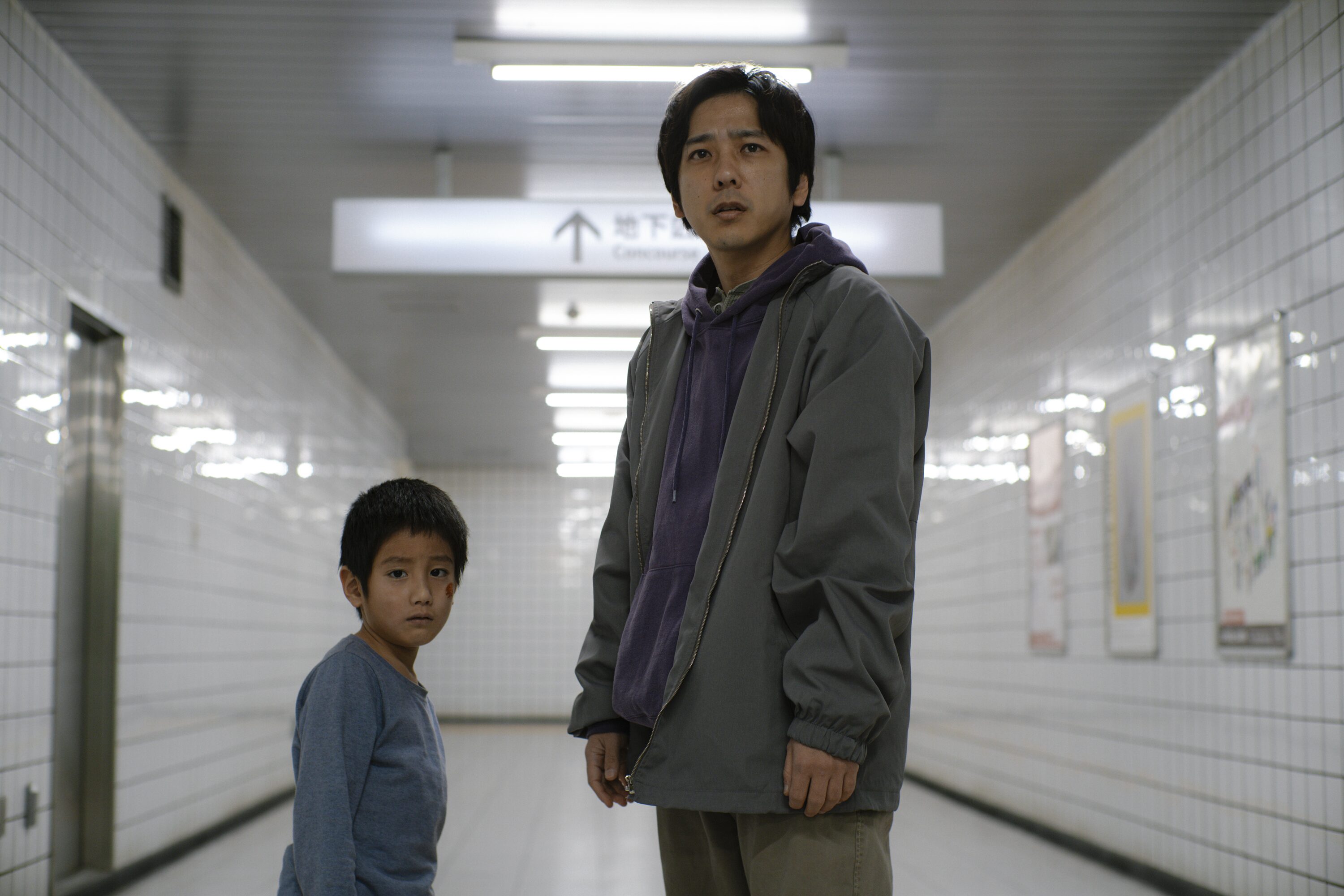
In a later round, a young boy appears in the middle of the corridor — small, calm, and completely out of place. The Lost Man’s instinct is to treat him as an anomaly. He tries to drag the boy back with him. But the boy doesn’t behave like the other anomalies. He talks. He has his own history. He tells our man, quietly, that he separated from his mother on purpose — hoping she would come looking for him. That he has never met his father. And there it is.
The two of them — the Lost Man with no name and the boy with no father — form a team. The boy starts spotting anomalies the Lost Man keeps missing. They check each other’s work. An upside-down ceiling sign. A door that opens onto a reflection of the subway bystander moment — the exact second our man chose not to act. Exit 5. Exit 6. The counter climbs.
The rats — oh, the rats, these horrible little mutant pig-rat creatures with baby-cry mouths, nightmare fuel of the highest order — are an anomaly the two of them brave together, white-knuckling through until the lights come back on. And then: a flood. A catastrophic wave of water tears through the corridor. In the chaos, the Lost Man grabs the boy and hoists him up to the ceiling sign — Exit 7 — keeping him out of the water. The flood sweeps the Lost Man away. He sacrifices his own safety for the child without thinking about it.
When the water recedes, the boy wakes up alone at Exit 7. He looks down the corridor. No anomalies. He walks forward.
Exit 8 – The Ending — What Actually Happens
The Lost Man makes it out separately. He reappears in the corridor alone, finds no anomalies, and walks forward. The Exit 8 sign is right there. He takes it.
He surfaces back in the real world — the crowded, fluorescent, ordinary subway station. He walks to a vending machine, buys a water bottle, and drains the whole thing in one long pull like a man who has been somewhere for a very long time. Then he calls his girlfriend. He tells her he’s coming to the hospital. He means it this time — you can hear the difference.
He boards a train.
And then the film does the thing.
The same mother is there. Same crying baby. Same man, launching into the exact same berating tirade that opened this entire film. Beat for beat, the scene that started everything is playing again. The Lost Man stands there. He listens. He tears up.
And then he turns toward them.
The film cuts before we see exactly what he says or does. It doesn’t need to show us. We know. The screen goes dark.
But What Does It MEAN?!
Here’s the thing about Exit 8 that makes it genuinely great and not just a gimmick: the anomaly The Lost Man keeps failing to identify isn’t blood on the walls or a reversed poster. It’s his own evasion. Every time the loop resets, it’s because he looked away from something real — the woman being berated, his girlfriend’s question, his guilt about who he is versus who a father needs to be. The corridor doesn’t care about your intentions. It cares about what you actually do. Notice or miss. Act or don’t.
The boy is almost certainly not a real boy. Or, he’s both. He’s real within the logic of the film and simultaneously a vision of the child his girlfriend is carrying. The metaphors are too precise to be accidental: both have absent fathers, both separated from their mothers, both are waiting for someone to choose them. When The Lost Man hoists the boy above the flood, he’s making the choice he couldn’t make on the train platform. He just didn’t know it yet.
And then the film brings you back to the train. Same scenario. Same test. The corridor’s rules, it turns out, weren’t confined to the corridor. The loop is life. The anomaly is you, failing to show up. Exit 8 is the moment you stop. You turn toward the thing instead of away from it. You step in. The film ends the second he makes that turn — because that’s all it was ever about. Everything else was just practice.
One note on the Walking Man — his arc is interesting but slightly underbaked. What the film does reveal is significant: he wasn’t always the expressionless figure haunting the loop. He was once a regular person trapped in that corridor, just like The Lost Man. He tried to find his way out. He failed — fell for a false exit — and got absorbed into the system, essentially becoming part of the loop itself. The same fate befell the High School Girl. It gives the whole thing a darker dimension: the corridor isn’t just a puzzle. It’s a presence. And it keeps people who don’t make it.
His arc doesn’t land with the same emotional weight as The Lost Man’s because we haven’t been given enough of him to care the way we care about our guy. And some of the CGI — particularly those mutant rats — looks like it came from a limited budget. Neither of these things ruin it.
Exit 8 is the rare video game adaptation that works because it completely lets go of the game. It keeps only the rules and the atmosphere and uses them to tell a human story about fatherhood, guilt, attention, and the ordinary heroism of just showing up for people. It premiered at Cannes for a reason.
If you’re looking for more films that scratch this itch… you know the kind that lock you in a box and use genre mechanics to excavate something human — here’s where I’d point you next: Coherence. Time Crimes. ARQ. The One I Love. Vivarium. And obviously, if you haven’t seen The Infinite Man, another closed-box film about a man who cannot stop trying to control everything, go fix that immediately.