Backrooms Youtube eps 1 – 10 explanation post
Backrooms Youtube eps 11 – 17 explanation post
Backrooms Youtube eps 18 – 22 explanation post
Backrooms Movie explanation walkthrough
Backrooms Movie Theories Explanation
Backrooms Definitive Timeline
Let me tell you about the war happening in the internet comment sections of the Backrooms movie right now.
On one side, you’ve got the self-appointed “true horror fans” absolutely torching this thing. Worst film of the year. Boring. Pretentious. A slow-motion nothing. They walked out. They want their money back. And their core complaint, once you strip away the venom, is actually kind of revealing: there’s nothing to grab onto. No clean scares. No monster rulebook. No reliable cause-and-effect. It’s too slippery. It refuses to behave like a horror movie is supposed to behave.
On the other side, you’ve got the people who understood the assignment.
Because here’s what Kane Parsons actually did with The Backrooms. He took the most meme-able internet horror concept of the last decade, the one everyone assumed would become a jump-scare delivery machine, and he made a psychologically mature character study instead. Deliberately threw out the standard horror toolkit. No telegraphed scares. No safe ground. He went further in that direction than even Obsession did this year, and Obsession was operating at a high level (just a completely different one… that movie was a loud, unhinged opera; this one is a quiet, dissociative ache).
What Kane gave us instead of tropes is two of the most fully-formed, broken, desperate characters in recent horror. And the entire film, the entire impossible, melting, looping geography of the backrooms, is filtered through their damage. That’s the key to the whole thing. We are not watching an objective place. We are watching two wounded people, and the backrooms is what their wounds look like from the inside. So before we get into what happens, you have to understand who these people are. Because in this movie, the who IS the what.
Backrooms Full Spoiler Warning
Complete walkthrough, plot, characters, ending, the whole thing. If you haven’t seen it, bookmark this and come back. From here on, everything is on the table.

The Two Broken Lenses
The Two Broken Lenses – Clark (Chiwetel Ejiofor)
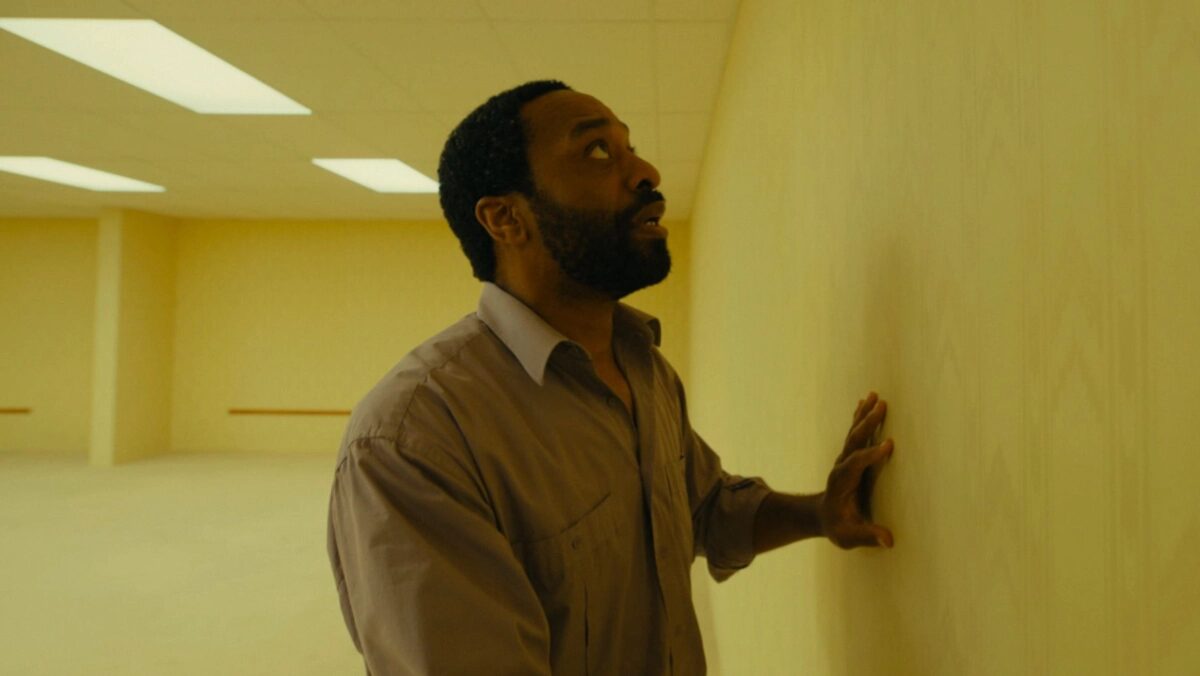
THiNC. readers will know Chiwetel Ejiofor from Z for Zachariah primarily (such a fantastic movie). But also from a number of other huge box office draws like The Martian and The Old Guard. Clark is the owner of Captain Clark’s Ottoman Empire, a dying furniture store he dresses up in a sultan-pirate costume to advertise. And he is, to put it gently, a mess.
He wanted to be an architect. Never became one. That single failure has metastasized into everything else: a marriage that collapsed, a wife (Barbara) who kicked him out, a drinking problem he won’t name, and a low constant hum of rage that he points in every direction except inward. Angry at Barbara. Angry at his therapist. Angry at a society he’s decided conspired to make him fail. The one explanation he will not entertain is the correct one… that this is all on him.
Chiwetel plays him as exactly the kind of guy you’d feel sorry for if you met him for ten minutes and exactly the kind of guy you’d flee if you knew him for ten years. “I hurt people. I don’t want to. It’s just the way I’m wired. Maybe I deserve to be alone.” That’s Clark’s entire thesis about himself, and the tragedy is he’s using it as an excuse rather than a diagnosis. He’s living inside his failing store. Sleeping on a display bed in the middle of an empty warehouse, drinking whiskey, watching old movies. Before he ever finds the backrooms, he’s already living in a liminal space. He’s already there.
Mary (Renate Reinsve)
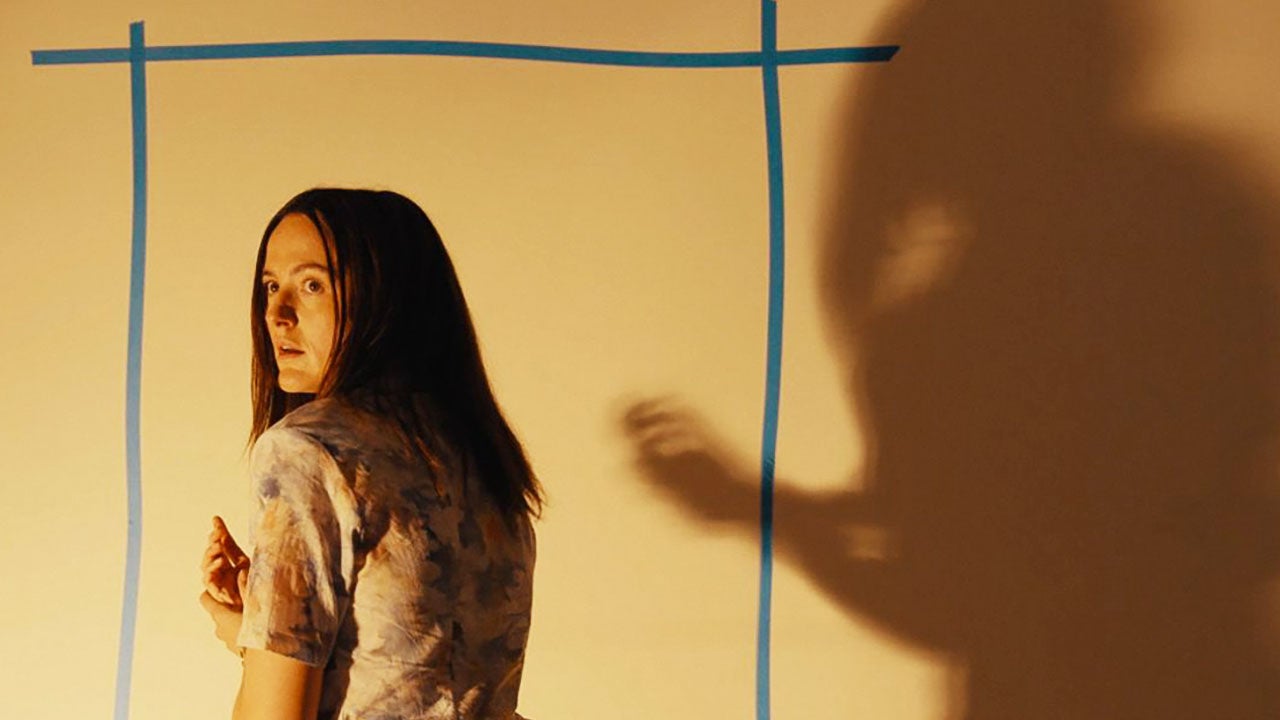
THiNC. readers will know Renate from The Worst Person in the World… which was a fantastic ride… and is still a movie review in draft form. Sorry world for failing you on that front. I also had her movie Sentimental Value as deserving to win best picture last year and stood my ground even when it lost. Mary is Clark’s therapist, and on paper she’s the success story, composed, grounded, author of a self-help book and audio series called The Window Within. “Open the window. Be the author of your own design.” She projects total control.
And, ironically, hilariously, she is not in control at all. Not even a little bit. Just better at hiding it than Clark is.
Mary’s childhood was a slow-motion horror of its own. Her mother was severely mentally unwell, terrified of the outside world and the “demons” she believed were coming for them. Papered over the windows. Never let Mary go outside. The home was a sealed, chaotic, pill-strewn box, and the one thing little Mary wanted was to look out a window or open a door. Her mother stopped her every time: “I never said you could go outside. It’s no good. They’re all over the place.” Eventually the mother was institutionalized, wheeled away while Mary watched.
So Mary grew up and did the thing wounded kids often do: she became the person who could have saved her. A therapist. Someone who fixes broken people, because she could never fix the broken person who raised her. She carries a literal piece of her childhood with her at all times, a chunk of concrete with her handprint pressed into it, from the day she and her mother left their marks in wet cement outside the home that’s now being demolished. It sits by her dinner plate. By her bed. In her pocket. She medicates. She’s still, decades later, attached to and haunted by a mother who was fundamentally broken.
This is the whole trick of the movie. Clark is rage that won’t look in the mirror. Mary is trauma that can’t stop looking backward. Both of them are inside the backrooms before the backrooms even shows up. Which, sort of feels kind of an important vantage point for considering the Backrooms, and what it might possibly mean.
The Rest of the Cast
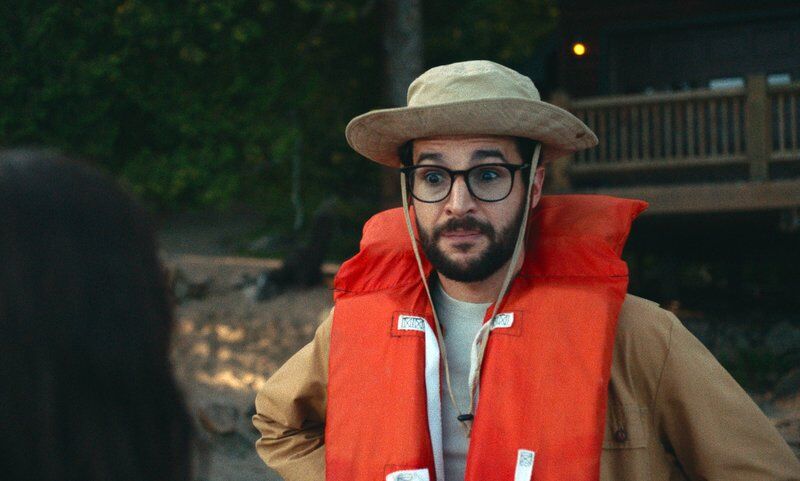
I have to take a quick moment and round out the rest of this extremely talented cast. You’ve got Bobby (Finn Bennett, True Detective, Warfare) and Cat (Lukita Maxwell, who I loved in Shrinking), Clark’s two employees, and Phil (Mark Duplass, who from a THiNC. standpoint is basically a demigod here, The One I Love helped build this website, Safety Not Guaranteed, Creep 1, Creep 2, Language Lessons, etc etc etc), a scientist with the Async Research Institute who’s been watching all of this on CCTV.
What Actually Happens
The Cold Open
The movie opens as found footage captured by Async (which you’d be well versed with if you read through my Backrooms Youtube video explainers). Recovered tape, dated June 19, 1990. A man with a camera is lost somewhere in the backrooms, radioing that he’s been separated from his group and that there’s something else down here with him. A seagull flies into the room. He follows the direction it came from, maybe hoping it’s a way out. He passes half-formed shop signs and furniture clipping through the walls. A door creaks open behind him (horror fans, that’s a sound effect pulled straight from the Portal games, possibly the greatest games of all time, one of Kane’s stated influences). A giant figure emerges and chases him to a dead end. It catches him. The tape distorts and dies. In the reflection of the TV screen, we see people in white coats watching the footage. Cue the title card.
So before we meet a single living character, we already know: there’s a place, there’s a monster, and there’s an organization studying both.
The Therapy Session
Cut to a little girl and her mother pressing their handprints into wet cement. A construction vehicle dumps a demolished house on top of the image. We pull back to find adult Mary watching her childhood home get torn down for a development tower, her voiceover talking about the loops and habits that keep us walking in circles.
Then we learn the voiceover is a therapy session. Mary is treating Clark. We watch them run a roleplay exercise. Mary plays Barbara, reenacting the night Clark came home drunk, broke a glass, and got into the argument that ended his marriage. Clark gets genuinely, frighteningly angry even in the pretend version. This is how Kane feeds us the entire backstory without a single clumsy info-dump: the failed architecture dream, the drinking, the bitterness, the provider complex, the collapse. Note to up and coming movie creators, THIS is how you flesh out a character. Show don’t tell.
Clark Finds the Backrooms
Clark’s living in the store. One night the TV cuts to a CCTV feed of the backrooms, the power dies, and he spots a crack of light coming through a wall, like the edge of an open door where no door should be. He leans in to listen, and falls straight through. A null zone. He’s in.
Yellow walls. Buzzing lights. A pile of furniture in the center of the room. He picks up a chair and realizes it’s two chairs melded into one, not furniture taken from his store, but furniture the backrooms grew. He begins exploring and discovers a Voyager-golden-record standee greeting him in fifty languages. He finds a CCTV room with the camera on the wall. Discovers a hidden bag of tapes and floppy disks and an ID badge (the dead(?) researcher from the cold open, his name is Naren Warne if you were curious, I’m guessing he’s going to come back at some point in the Youtube series or movie sequels), shoes half-clipped through the floor, a hole stuffed with discarded chairs. He hears something, sees a shadow drag the standee past an opening, and runs. On the way out he grabs a chair. Proof, and a memory.
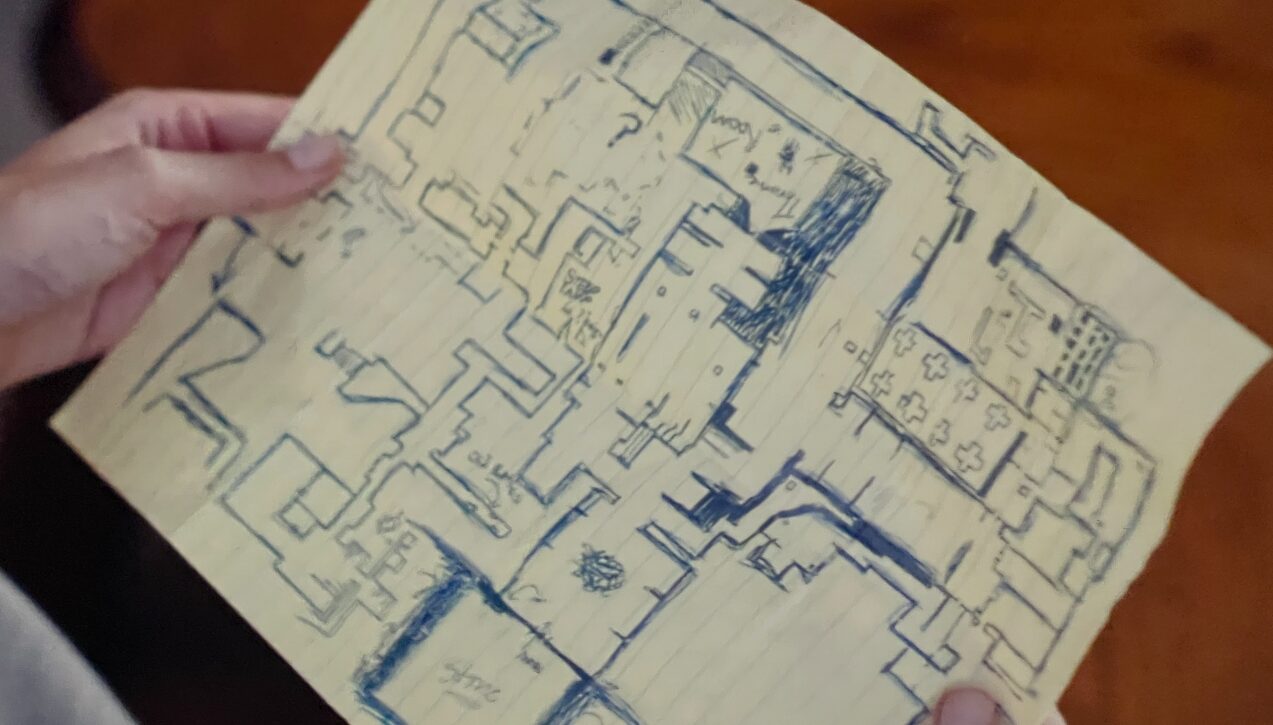
Crucially, when Clark goes back to therapy and tells Mary about it, he lets slip “I haven’t had a drink in three days.” Translation: that wasn’t one night. He’s been going back. Mapping it. He produces a hand-drawn map. The failed architect, finally with a structure worth drawing. He tries to explain the place: “Imagine describing a dog to someone who’s never seen one, then asking them to draw it. They’d get some things right, but you’d know it wasn’t a dog.” Best line in the movie about what the backrooms even is. Mary doesn’t believe him. He promises proof. And that he will expect an apology.
The Expedition
Clark recruits Bobby and Cat, and the film snaps back into handheld found footage for the descent. He ropes Bobby down a steep opening, and notably never warns either of them that something deadly lives down here. That omission tells you everything about Clark. Bobby finds a pile of clothes (including a copy of Clark’s own shirt), spots the creature moving in the dark, scrambles back up, and gets yanked back down. The rope, tied to a bed, drags Clark and Cat down too. Bobby is pulled into a compartment trailing blood. Gone. Cat chases after him, screaming. Clark runs.
The chase carries Clark through a Christmas-tree room with a half-formed woman who zombie-walks at him, through the infamous pool rooms, until he hears Cat shouting from behind a wall. She can see him, but he only sees wall. He sets the camera down to go help. Something very tall picks it up. Cat screams “look behind you.” Cut to black.
That’s the last we see of Clark as Clark.
Mary Goes Looking
Mary gets an answering-machine message: “I opened the window. I won’t be coming back.” Her own book’s language, turned into a suicide note that isn’t quite a suicide note. She finds the shop open, mail piling up, Clark long gone. She finds his whiteboard map, a door he drew on an actual wall, and watches a fly pass through the drawn doorway. She finds a mural, a giant on a throne, the phrase “tables don’t bleed,” a figure being lifted toward a window, and a scrawled note: “The floor plan changed again. I don’t know who signed the plans, but the handwriting looks like mine.”
Then Clark steps out from behind a corner. “This is every place that ever was.” He tells her to stay calm, that she knows him, and then grabs her from behind and chokes her unconscious. “It’s for her own good.”
The Dinner
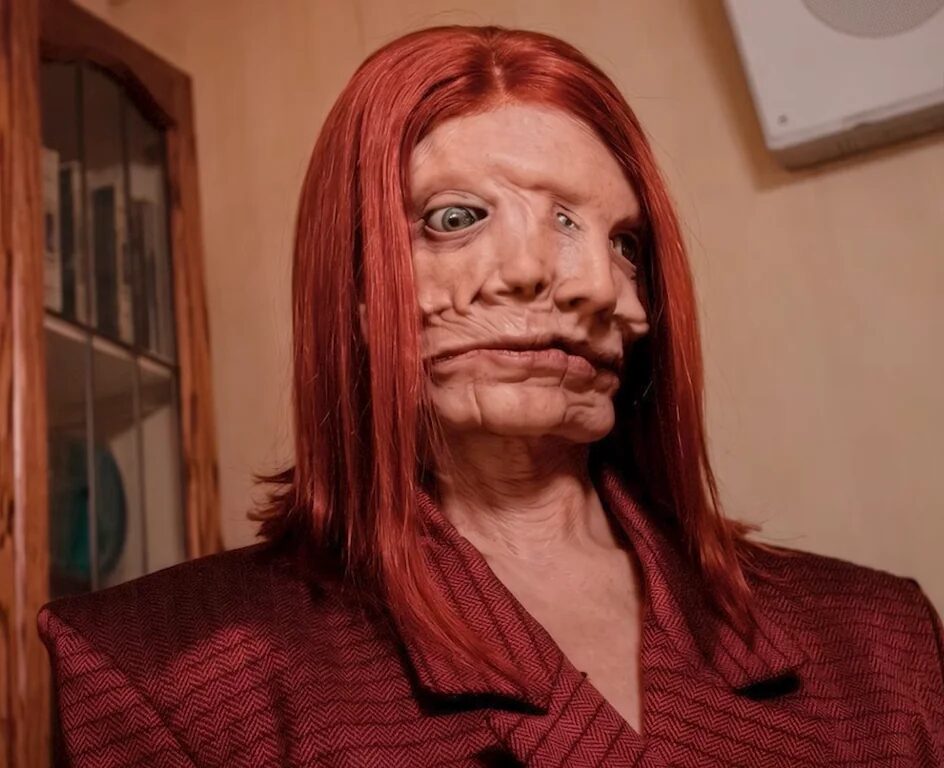
Mary wakes tied to a chair at a kitchen table, Clark across from her, three of the “still life” entities seated around them like a family. It’s the Texas Chainsaw dinner scene by way of a fever dream. Clark explains the imitation people: “This place builds them. Actually, more like it remembers them. And the more times it remembers something, the less it does.” He demonstrates they feel nothing by stabbing one. It doesn’t react. “They’re like furniture.” (Tables don’t bleed.) Then: “The best part is you can eat them,” and he carves a white, fatty substance out of the seated man’s belly onto their plates. When he opens the fridge for a drink, Cat’s severed head is inside. “I tried to help her,” he says, and trails off. Did the monster kill her, or did Clark? The movie refuses to tell you.
Then comes the moment Kane built the whole film toward. Clark wants his apology. And he wants it nice and slow, in roleplay form. He scalps the red-haired still life (a degraded copy of Barbara, his wife) and puts the hair on Mary’s head so she can play the part. And via their roleplaying from earlier in the film, he starts screaming at her the way he screamed at Barbara.
And Mary breaks.
Not down. Through. She shakes the wig off and for the first time stops being his therapist. Up to this point Mary has held what therapists call unconditional positive regard, that baseline of total, nonjudgmental acceptance you extend to a client no matter what. Right here she drops it. Just lets him have it: “Your wife didn’t leave because of the drinking or the rage. It was the whining. Nothing is ever your fault. You blame your brain. You ARE your brain.” The truest thing anyone says in this entire movie, and it’s the therapist abandoning the one professional principle that was keeping the lie alive.
Clark’s answer is to confirm the diagnosis. He doesn’t want to change. He likes it here. He’s right where he’s supposed to be. Mary, exhausted, finally says it: “Then don’t. Just stay, and let me go.” She can’t help him. She knows it now.
Captain Clark
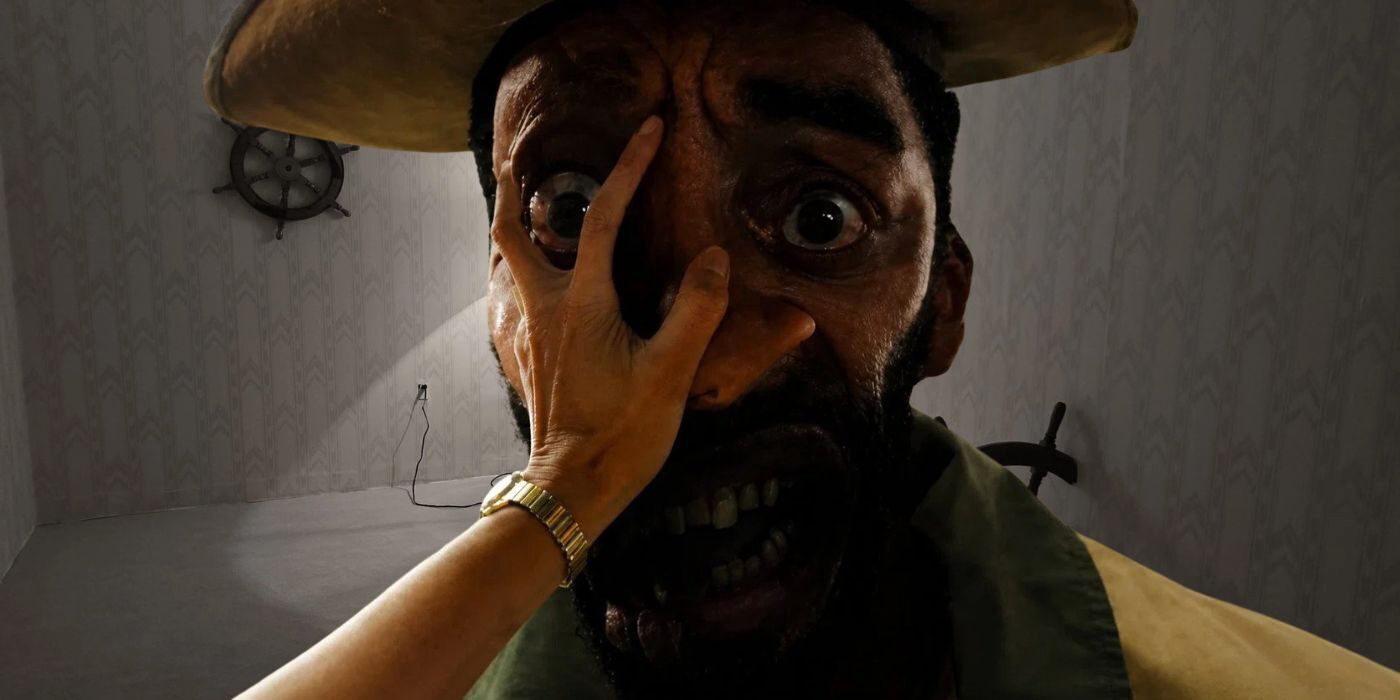
The red-haired wife-copy suddenly panics and flees, and out of the dark comes the giant. Massive, deformed version of Clark in his Captain Clark pirate-sultan costume. The monster from the cold open. It was him the whole time. Clark introduces Mary to it almost tenderly, “This is our therapist. Don’t worry. We don’t have to change,” and the giant lifts Clark up under the arms like an infant. Clark’s last words: “It’s just the way we’re wired.” And Captain Clark bites into him and kills him.
Mary runs.
The Escape and Async
The chase sends Mary up through a vertigo-inducing tower of wall-less rooms and into the backrooms’ copy of Clark’s own store, where she trips a trap. Those greeter standees were set up by Async not to welcome entities but to capture them. Gas floods the room, dropping both Mary and the monster. As Captain Clark pins her, she pulls the concrete handprint from her pocket and beats him in the face with it, over and over, until the handprint, the last physical piece of her childhood, shatters. She crawls into a gap too narrow for the giant, looks back at it with something almost like pity (she couldn’t save Clark; she couldn’t save her mother), and is promptly gassed and captured by Async’s hazmat team.
She’s brought through the threshold. Out of the backrooms and to an Async facility, brain scanned, walked past the captured Captain Clark, and seated in an interview room with Phil. He asks how she got in. “Through the wall of a furniture store.” He shows her CCTV of Clark, confirms the location, and then drops the institutional reveal: “My company. We used to make MRI machines. Not anymore.” Async opened the backrooms and now studies it. Phil admits he goes in himself. “I’m convinced that nothing in our lifetime, or in all of recorded history, means more than this.” Mary asks what’s going to happen to her. Phil: “That’s not up to me.” And right there we know she’s cooked.
The Ending Explained
Two images close the film and you need both.
First: as Phil rambles on about doors opening all over and nobody knowing why, the conversation fades out and Mary sits there with a small, knowing smile. Watch how the shot is framed. The bottom half of the wall is backrooms-yellow, the top half white, leading up to a skylight and the real world above. Early in the scene her head sits above the yellow line. By the end, the framing has shifted so the yellow has risen up behind her, almost submerging her. Visually, the backrooms is swallowing her even as she sits in what’s supposed to be the safe room. She’s smiling because she already knows she isn’t getting out. “That’s not up to me” is a death sentence dressed as a non-answer.
Second, and worse: the final montage shows backrooms copies of everything. Cat and Bobby’s missing posters, their home, Clark’s store, Mary’s demolished childhood house with the handprints eerily back in place. And then a room identical to the interview room she’s sitting in, with a figure in the chair. A still-life Mary. Misshapen. Misremembered. The backrooms has already copied her. So even if the real Mary somehow walks out of that facility alive, it doesn’t matter. A degrading echo of her is now trapped in there forever, doomed to sit alone in a sealed room exactly like the child who was never allowed outside. Her oldest loop, made eternal.
For the record: Kane Parsons has said the only interpretation he wanted to rule out is “it was all a dream.” Everything else he’s left deliberately open. Mary might have died in there. She might have escaped. The ambiguity is the point. The man built a movie designed to start arguments.
So What Does It Actually MEAN?
That, my friends, is where this all starts to get really good and where arguments should get started! I mean conversations! hahah. Because depending on who you ask, the backrooms is a literal anomalous dimension that a greedy corporation cracked open and now wants to monetize. Or it’s the physical manifestation of two people’s untreated trauma. Or it’s both at once, shaped by the very minds trapped inside it. Or the whole descent is one person’s psychotic break, and we never left the ward at all.
I’ve got five major theories to walk through, and I think the movie genuinely supports more than one of them at the same time, which is exactly why it’s going to be argued about for years. I’m breaking each one down in its own deep dive, with an overview post tying them all together and, eventually, my own verdict on which one holds up best. If you’d like to dive into my Backrooms Theories post, join us here!