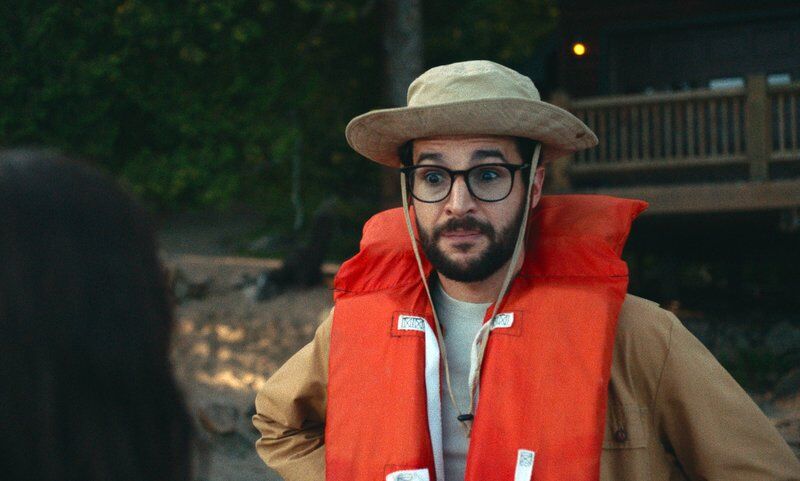
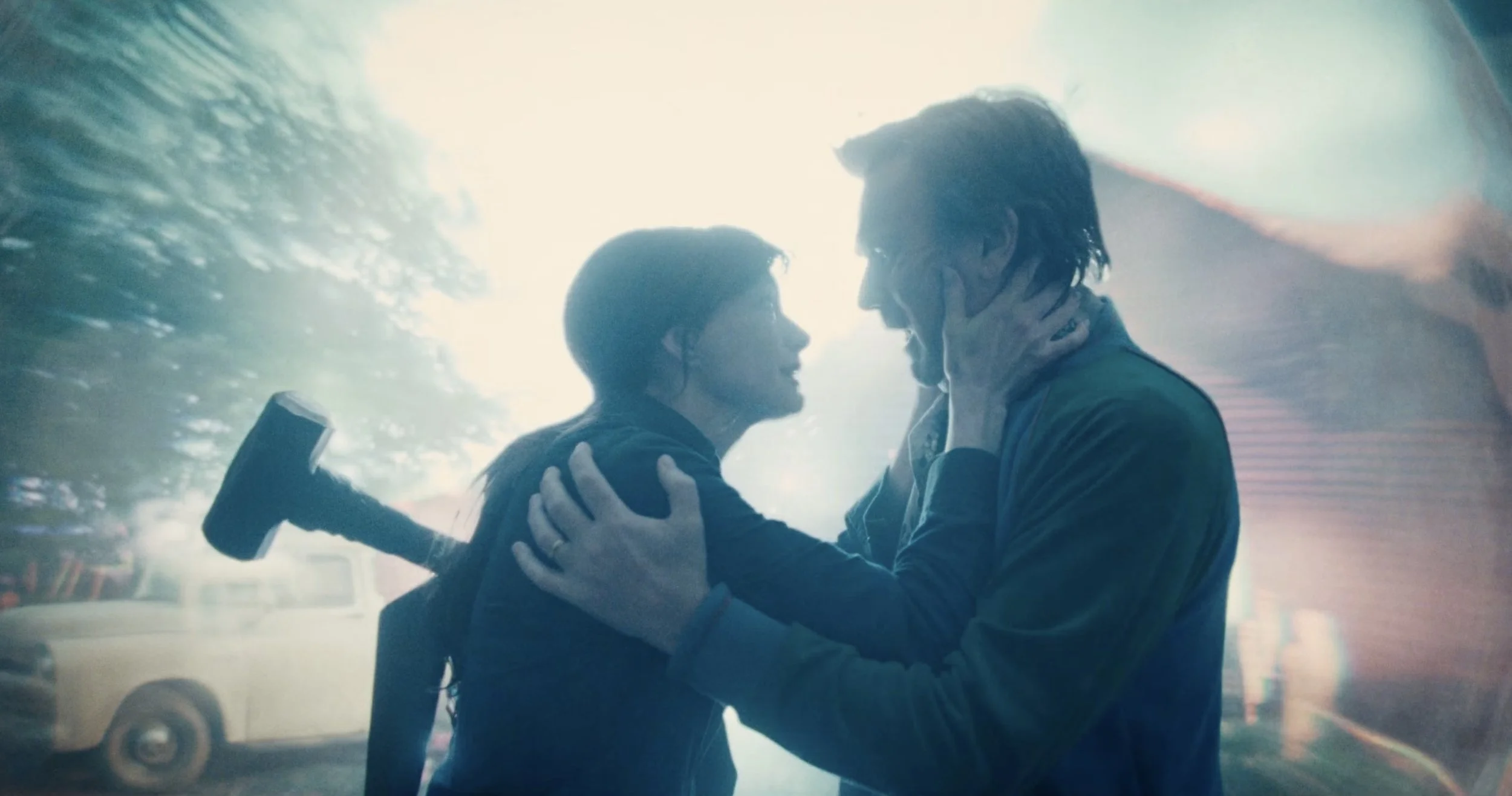
I’m in desperate need of talking about the movie The End of Oak Street – because, HOLY COW, what just happened here? My Guy Movie Night group went and saw this together, and everyone was saying, this is a great movie to watch in a crowded theater – Frights, Fun, Jump Scares! “It’s like a more mature Spielberg influenced Jurassic Park” I kept hearing before I walked into the theater. Oh? Okay. I’m here for that movie! Let’s Gooooo! But wait, there’s more.
So, if you weren’t aware, David Robert Mitchell (yes, the It Follows guy – Under the Silver Lake, etc) and JJ Abrams (Lost, Cloverfield, etc) put out a dinosaur-apocalypse-slash-suburban-melodrama called The End of Oak Street this month. They gave us Anne Hathaway and Ewan McGregor as a fraying married couple whose entire 1982 cul-de-sac gets yanked back to the Mesozoic in the middle of a rainstorm, and the ending is doing exactly what I want an ending to do, which is make me immediately need to talk to another human about it. But that doesn’t mean it worked. We need to spelunk this movie’s ending and see if we can make any semblance of sense out of it. So I went and read basically every ending-explained piece that’s been published since it dropped August 14th, and I want to walk through what the critics landed on before I give you my own read, because I think there’s a piece nobody’s quite saying out loud yet. Massive spoilers from here down, obviously. This is a spoiler-forward blog, you know the drill.
The setup, quickly
It’s the Platt family (Denise, played by Hathaway, Greg, played by McGregor, and their kids Audrey and Brian) living on Oak Street in a neighborhood some outlets are calling Flowervale. There’s been strange stuff building for a few nights, weird lights, something odd growing in a neighbor’s yard, a Carl Sagan reference or two dropped in dialogue so you know the movie wants you thinking cosmic rather than supernatural. Then during a storm the lights hit critical mass and the whole block gets thrown backward, not into the Old West, not into the future, but millions of years into the past, dinosaurs and all. From there it’s survival horror with an Allosaurus that everybody keeps mistaking for a T-Rex (a detail I love because it’s exactly what a scared suburban dad would get wrong).
How the movie explains the mechanism (which is to say, it mostly doesn’t)
Every single writeup I read agrees on this part: the film is deliberately cagey about the actual physics. There are “offhand allusions to solar anomalies,” the Sagan namedrop, and characters describing the lights as something like portals or wormholes smoothing space between different points in time, but nobody in the movie sits down and explains it, and the critics seem to think that’s on purpose. The Playlist’s review specifically calls out that the family briefly discusses the physics and then just drops it, and In Review Online says flat out that the characters barely care beyond the immediate moment “and frankly, neither should the viewer.” So if you left the theater annoyed that nobody drew you a diagram, that’s apparently the point, this is a movie about a family surviving a thing, not a hard sci-fi explainer. But does the movie actually land that ending? Let’s figure that out together.
What actually happens at the end
Greg dies violently partway through the chaos of their time traveling chaos. It is the best moment of the entire movie… wait, WHAT? You are killing the dad?!? And its horrific too – Greg is literally dismantled by an Allosaurus which takes him apart in front of the whole family. First a leg. Then he’s gobbled completely up… torso and all. It’s a move that the Jurassic Park movies never pulled that’s for sure. And then the survivors, Denise, Audrey, and Brian, have to fight their way to another one of these light portals and jump through it. That’s the solve for Greg’s death… it’s what let them get away with that maneuver. So here’s the twist: it doesn’t just dump them back in 1982 in general, it drops them back a short window before the original event ever happened. Something like 20 minutes prior their neighborhood teleporting, they arrive back. Just enough time some serious hero-mechanics to happen.
And with that 20 minute head start Denise now has enough time to save the day. But how? What is going on? Basically she runs to the nearest pay phone, and makes collect calls to get Greg2 to deliver them a pizza. Remember? He’s been out of work, and delivering pizza as his primary job. Not only does she save her husband with a pizza order, she also warns her neighbor Mel and other key people we watched die as the movie progressed. So the ending you’re watching, the reunited family in the backyard, Greg alive and grilling, is technically a second timeline that only exists because past-Denise intervened.
The part that’s messing with everyone: the doubled timeline
This is where it gets genuinely unsettling and it’s the detail that every single explainer piece flags as the thing you’re not supposed to think about too hard. If Denise’s warning stopped this Greg2, this Mel2, this version of everyone2 from ever getting sucked into the portal in the first place, what happened to the versions of them who did get sucked in? This particular movie doesn’t want you actually thinking much about this time-record-skip problem. Why? Because it means there are still dozens and dozens of people trapped and hunted by dinosaurs. Hundreds even. But if you watched the ending closely, the movie told us more than most film goers even realized… if you noticed that two versions of Audrey’s girlfriend Jeanette show up in the final scene, one who lived through the dinosaurs and one who never did, which is about as literal a confirmation of a doubled timeline as a movie can give you without saying it out loud. It’s pretty clear that the honest unraveling of this movie is that Denise didn’t undo the tragedy, she just relocated it: somewhere out there, a version of her family is still in the Cretaceous, permanently, because the version we’re watching got saved instead.
The scrapped ending was much darker
I’ve read that the original ending of The End of Oak Street was actually WAY WAY darker. The original planned ending sent the surviving Platts (sans Greg) through the wormhole at the end, and it did not put them back in 1982. Instead, it stranded them in a different point in history entirely, the Old West, settler times, Greg already dead and gone, no rescue, nothing. Straight Twilight Zone cruelty. WHICH WOULD HAVE BEEN THE ONLY ENDING THAT ACTUALLY WORKS! They chickened out on the real ending they needed to have.
But who could have POSSIBLY convinced JJ Abrams and Mitchell (two of the most vaunted indie/Hollywood movie makers in the world right now) to walk away from that perfect ending? Who? You have the answer in front of you… just think for a minute.
It was Anne Hathaway apparently. She pushed back on the original ending… and in her own words, she told the story that someone who had watched the movie in a test screening burst into tears. Just literally fell apart that Anne Hathaway’s character, and the children, were all abandoned in the old west. So instead of abandoning them to the tumbleweeds and gunfights… they had their bubble bounce them back 20 minutes prior to the dinosaur apocalypse… allowing Denise the opportunity to save the day. So yes, if you felt like the ending was a Hollywood capitulation, it was, of the worst sort. Anne Hathaway, an actor, not a writer, not an editor, not a director… arbitrarily changed the ending of this one in order to give the world the “happy” ending they were looking for. Which, once you know that, recontextualizes the whole doubled-timeline problem: the ending isn’t ambiguous by accident, it’s a happier ending grafted onto a story that was built for a right hook ending, and the seams (two Jeanettes, a Greg who both did and didn’t die) are what’s left showing.
The thematic reading nobody’s fully agreeing on
Now, if you want to do some real work with this movie, and think about this a little harder… there are more than a few interesting details here. If you think about it for a moment, you can see that the dinosaurs in The End of Oak Street actually function as a metaphor for the actual ugliness hiding beneath the over-idealized 1980’s suburbia. You could see the time travel as a distraction, the movie is actually about a family dropping their performative machinations. Denise admits she’s been writing a novel and she publishes the story of the dinosaurs. Greg admits he’s out of work, and grills out in the open… not drinking and hiding his unemployment. It’s a story about how “the perfect family” is hiding things and covering up their chaos with a smile and a laugh.
Personally, I grew up in Los Angeles (literally Los Angeles county, not Orange… locals will understand why I’m pointing this out) in the eighties and today we love to over-idealize this particular past as perfect. And it wasn’t. I was abandoned to my own devices. I have mapped out my wandering circumferences and I would go miles and miles and miles on my bike on my own. I took myself to my T-ball games. I went to school on my own. Latch-keyed myself back into the house. It was less than the ideal reality that Spielberg would have you believe it to be. My kids, when they were growing up, couldn’t go to the end of the block by themselves. Are you kidding me? No, absolutely not. And this movie is sort of calling out the ugliness inherent within the real 80’s that we are all overlooking. And I buy that hot take on this movie.
If you want to hot take that particular hot take – you could talk about this as an ecological destruction, “the vengeance of the past,” even a Reagan-era political reading. Which, sort of makes sense, and I don’t have a defense for actually.
Is The End of Oak Street Connected to Cloverfield?
One last bit of trivia before I get into my own take: despite the JJ Abrams involvement fueling Cloverfield-connected-universe theories all over social media, Abrams shot that down directly, saying the only actual overlap is that McGregor’s real-life partner Mary Elizabeth Winstead starred in 10 Cloverfield Lane, and that’s it, pure coincidence, people pattern-matching where there’s nothing there.
A Single Coherent Walkthrough for The End of Oak Street
Okay, here’s how I’d lay the whole thing out start to finish, reconciling everything above into one throughline arc to make sense of it all.
The lights aren’t random, they’re localized, some kind of bubble of temporal displacement that only grabs whatever’s inside its radius. But it grabs the future and the past… AND IT SWAPS THEM. Which is why we were seeing plants from Mesozoic appearing in people’s yards randomly. And these bubbles are contained, smallish circles that swap forwards and backwards in time all at once. Which is why it’s specifically this block and not the whole town. That bubble does two things over the course of the movie: it drags the neighborhood back to the Cretaceous, and it’s also the mechanism the family eventually uses to get back out, meaning the “portal” everyone keeps describing isn’t a separate escape hatch, it’s the same phenomenon working in reverse. That’s tidy, and it’s why nobody in the movie can fully explain it in physics terms, because it’s not really physics, it’s more like the event has a beginning and an end and stepping through it at the right moment lands you on the other side of that window.
But to be genuine and honest to its own premise, you sort of need to keep the timelines moving together – forward. Aka, you can’t save Greg. Greg is Dead. Unless its arbitrary… and then an Old West play actually makes more sense! Having Denise get back, exactly 20 minutes prior to the ensuing chaos is much too convenient a screenplay intervention. Aka, an Anne Hathaway sized intervention.
Now, I will give you this – the pizza call is clever. It’s not a gimmick, its the point and the heart of the movie. By having Denise call her husband for a pizza, we are seeing that she is accepting the reality of the truth of her out of work husband. We are seeing that she is doing absolutely anything to save her dead husband. But let’s be honest, the only person she would be able to save would be her husband because that is his job… to deliver pizzas. She disguises her voice. He brings the pizza… the neighborhood disappears. The rest of the people wouldn’t leave just on the proclamtion of a freaked out neighbor on the phone. You don’t leave, you hold up in the basement instead. It wouldn’t work.
Regardless, I had fun with this movie. Loved the dinosaurs. Loved the throwback 80’s world. Loved the way Greg died violently. But the only move to save this horrible ending? Is to drop them in the Old West. And that’s a Twilight Zone ending that actually makes it all make sense.