
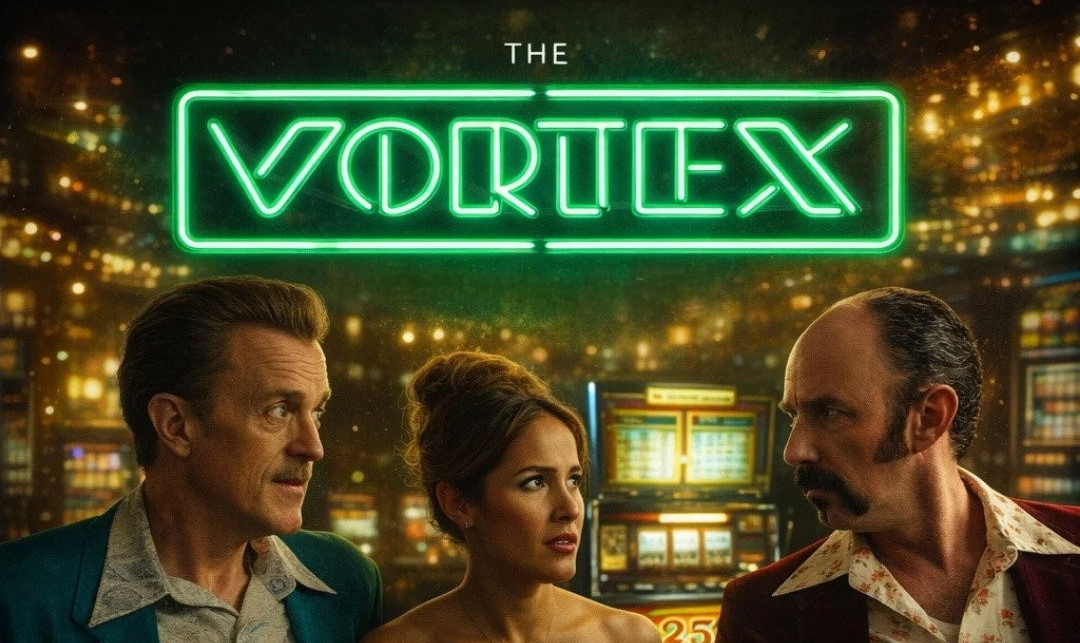
Written and directed by Richard Zelniker, The Vortex places its protagonist at the very epicenter of self-destruction. Pete Finnegan, a stand-up comedian played by Billy Gardell, is drowning in debt and sees no way out other than feeding coins into a slot machine again and again. His life has collapsed down to the flickering screen of a slot machine and a desperate belief that the next spin will be the one that saves him.
The MGM Grand Fire as Backdrop and Premonition
The opening titles confront the viewer with a fact impossible to brush aside: in 1980, a fire at the MGM Grand Casino in Las Vegas claimed 87 lives. The camera shows the slot floor filling with smoke before cutting to Pete’s performance. This historical context immediately colors everything with dread and creates a sense of a countdown — inaudible to the characters, yet deafening to the audience.
This review introduces the film’s premise, evaluates the performances, the score, and the overall atmosphere of the picture, without revealing its ending.
Debts, Stakes, and the Mechanics of Self-Deception
Pete Finnegan plays two roles: on stage he makes people laugh, while backstage he gambles away every last cent. He owes large sums of money, and the most dangerous of his creditors is not a patient man. Each of Pete’s days narrows to a simple loop: approach the slot machine, put in money, lose, suppress the panic, and repeat. The hope of “one big win” becomes his only currency, even as experience proves him wrong time and again.
Pete serves as a vivid lesson in what happens when a person substitutes blind faith in luck — luck that has never once arrived — for genuine calculation.
Around Pete: Threat, Comfort, and the People in His Orbit
The film’s characters gather around the protagonist like planets orbiting a star on the verge of burning out:
- Jimmy (Christopher Titus) — a mobster and loan shark whose presence carries the threat of physical violence and constantly tightens the pressure on Pete.
- Jackie (Emily Alabi) — a Native American housekeeper who is almost Pete’s constant companion; she hums prayers, promises him the protection of a great spirit, and believes in his luck more than he does himself.
- Shirin B. (Azita Ghanizada) — a show dancer whose connection with Pete hovers on the border between friendship and something more.
- Johnny (Jeremy Luke) — Shirin’s husband, a lounge singer who widens the social circle around Pete.
They all drift in and out of the slot floor, some playing the role of angels, others demons. Pete watches as other players hit jackpots while his machine silently swallows coins and shows no sign of life.
We Know More Than the Characters Do
Zelniker’s structural device is both cruel and effective. The viewer carries the knowledge of the approaching fire, while the characters feel only a nameless existential chill. They cannot identify where this sense of dread comes from and attribute it to exhaustion, alcohol, or losses. The gap between the audience’s knowledge and the characters’ blindness generates a mounting tension that never lets up for a moment.
Billy Gardell in an Unfamiliar Register
Gardell, widely known to audiences from the sitcoms Mike and Molly and Bob Hearts Abishola, works here in a noticeably darker mode. He plays a man who conceals escalating panic behind jokes, stubbornness, and the rituals of addiction. The actor’s comedic experience does not disappear — it transforms: the viewer watches humor become a defense mechanism, a thin crust stretched over an abyss.
Jazz, Tobacco, and Synthetic Hope
Asdru Sierra’s score — smoky jazz built on double bass rhythms and muted brass — turns the casino into an acoustic trap. Alcohol, cigarettes, artificial light, and unrealistic expectations define the boundaries of a sealed world with no obvious exit.
The Casino as an Allegory for Life on the Edge
The Vortex transforms the slot floor into a micro-model of a space where ordinary people’s dreams come to die. Pete Finnegan pursues his own quest, and his true ordeal would have been not a loss, but a win.
Why Pete’s Story Feels Relevant Today
The film is set in 1980, yet its theme feels sharper now than it did then. Pete had to walk into the casino, stand at a slot machine, and drop a coin. A modern gambler needs nothing more than a smartphone. Online casinos continue to multiply, and competition for new audiences pushes operators to seek out the softest points of entry. One of the most effective methods has long been established: free spins and no-deposit bonus money simply for signing up. The scale of this approach is well understood around the world. Australian casinos with no deposit bonuses enjoy wide popularity, as do similar offers from the US, Brazil, and Europe.
This format removes the primary psychological barrier: to try for the first time, there is no need to risk one’s own money. As a result, the number of players grows, and with them grows the number of those who, like Pete, eventually stop distinguishing entertainment from a trap. That is why Finnegan’s story reads not as a period drama but as a warning addressed to today’s viewer.
The film draws the viewer in with a sense of inevitability: the tension never eases, the hopelessness deepens, and the ending remains unpredictable. The story holds until the final frame, leaving one to wonder what Pete’s endless wait for “that one winning spin” will ultimately cost him — against the backdrop of a catastrophe already knocking at the door.