
by Taylor Holmes | July 3rd 2026 | Horror, Mind-Benders, Explainers
Kane Parsons dropped 15 new minutes of The Backrooms into theaters today. Not a re-release. Not a director’s cut with a few extra beats sprinkled through. Fifteen minutes added on to the end of the film… post-credits… that Kane built himself, in Blender, in the exact aesthetic of the original YouTube series. I’ve been able to confirm that it was in fact Kane, solo, just like how he created the YouTube series itself, created this new 15 minute segment.
The vibe online is mixed, and honestly? Fair. Charging theatergoers a second ticket to watch what is functionally a 15-minute YouTube video does feel like Kane pushing his luck a little. So I went and saw it for you. If you don’t want to shell out again, or if you already have and want to sit with what you just watched — this post is for you.
What I can tell you before the spoiler line: these 15 minutes are the single biggest lore drop in the Async universe since the movie itself. They rewire our understanding of the entire timeline. Async didn’t stumble into Clark’s world in 1991. Clark stumbled into theirs — a year late. If that sentence hurt your brain, good. Let’s spoil the hell out of this together.
Where the Movie Left Off (Quick Refresher)
The Backrooms (2026) ends with Mary — Clark’s therapist and the film’s other protagonist — pulled from the Backrooms after her ordeal and processed at an Async containment facility. She sits across from Async researcher Phil (Mark Duplass), the interview room slowly flooding with yellow light, until the film’s final shot reveals a static, doubled version of her already existing inside the Complex. Ambiguous. Devastating. Credits roll.
(For the full plot walkthrough, ending explanation, and the closing-shot analysis, see my original Backrooms Movie explainer. And if you want my YouTube Backroom episode deep dive – checkout post #1, post #2, or post#3. And if you’d like my now historical, pre-‘everything must go’ timeline, you can find that here as well. And finally, if you are looking for my full Backrooms theory breakdown, I’ve got you covered.)
FULL BACKROOMS SPOILER WARNING
Everything past this point spoils the movie, the entire YouTube series, and every frame of the new 15 minutes. I’m going to walk through the new footage beat by beat, name every reveal, and connect it to everything Kane has ever made. If you haven’t seen the Everything Must Go cut yet and you’d rather experience it cold, bail out here. If you’re staying — buckle up. This is a big one.
What Kane Actually Made – In Those Extra 15 Minutes
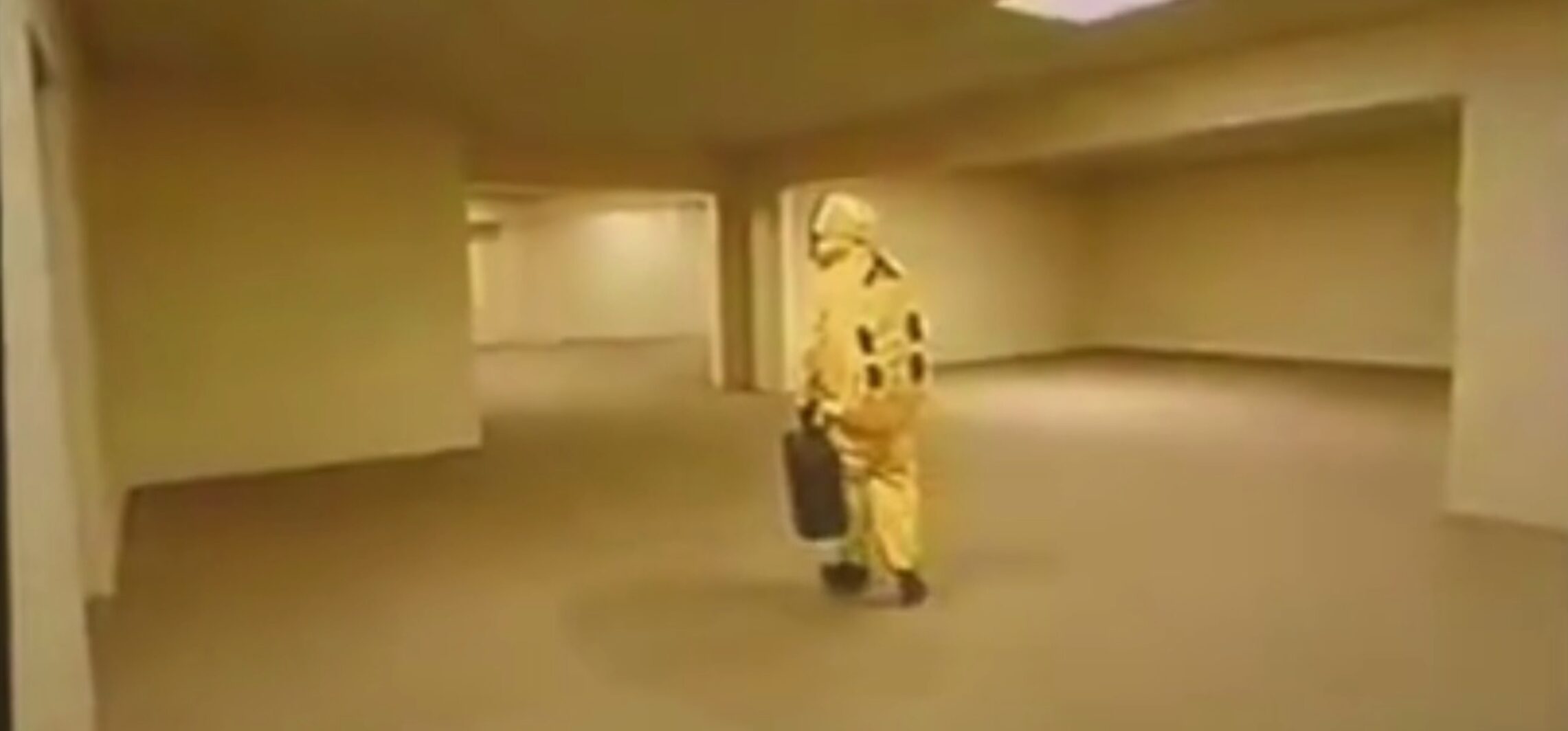
Before the beat-by-beat, one aesthetic note: the new 15 minutes look, feel, and sound identical to the original Kane Pixels YouTube series. Same grain. Same tape hiss. Same slow, dread-forward pacing. Same deliberate 1990s Async surveillance aesthetic — timestamped monitor overlays, hazard-yellow chemical suits, degraded video mixed with clicking slide-projected photographs. If you dropped this footage into the Kane Pixels channel between two of the existing episodes, it would slot in seamlessly.
Which is either a beautiful gift to the fanbase — Kane refusing to modernize or polish for the theatrical audience — or exactly why the “pay again for a YouTube video” crowd is annoyed. Both reads are correct. Now. Into the footage.
The 15 Minutes, Beat by Beat
The Timestamp
Black screen. A single timestamp: June 18, 1990. You need to clock that date, and put it into perspective in the entirety of the timeline. Otherwise, nothing else matters here.
Read that date. Bookmark it. It’s the day before the “Recovered Tape” event that opens the movie. If you’ve been paying attention to my timeline work, you already know June 19, 1990 is where Kane placed the film’s cold open — that horrific sequence of an Async researcher being hunted and killed by the entity. So we’re starting the day before that. Ok? Great.
The File Header
Next screen, in that clinical Async monospace font we’ve been staring at for years now:
Preliminary Layout Survey via “Kelowna Branch” — #7F* Footage relevant to [redacted] — analysis Video Media Operator: Naren Warne
Stop. Read that name again. Naren Warne is the researcher who dies in the movie’s cold open.
The “Recovered Tape” the film opens with — the one that establishes Async is losing people down there, the one that plants the sick feeling in your stomach that carries through the entire feature — is Naren Warne’s footage. And now Kane is showing us the 24 hours leading up to Naren’s death. From Naren’s own camera. We are watching a dead man do his job.
That’s not a small thing. Kane is doing exactly what he did in the YouTube series with the Peter Tench arc: taking a name we processed as anonymous corporate casualty and giving him a face, a voice, a badge, a routine. It hurts. It’s meant to hurt.
Into the Backroom Hallways
The footage fades in on a group of Async researchers in the full hazmat rigs — Taylor’s own note called them “yellow bunny suits” and honestly nothing captures the specific cursed innocence of the aesthetic better than that. Naren is behind the camera. His colleagues are in front. They’re preparing to enter a sector of the Complex neither we nor they have documented before.
A voice says, uncertain: “I think so I think so, I’m not sure.”
Another responds: “It took us a few hours to figure it out. But it seems to take the same form and shape, so it might actually be.”
It might actually be — what? The footage doesn’t tell us. Yet. But Async knew, going in, that they were about to encounter something that looked like something else. Something familiar. They just didn’t know what yet. The camera moves through hallways. Yellow. Empty. Kane’s greatest hits.
The Slide Projector
Cuts, deliberately, to click-clicking slide-projected still photographs — dozens of them — of corridors, doorways, wall junctions, empty rooms. The archival texture of the entire Kane Pixels aesthetic distilled into 45 seconds of clinical documentation. Async isn’t just filming this space. They’re cataloguing it, room by room, image by image, in a way that suggests preparation for something bigger.
“Are you seeing any switches, or…”
“No, not that I’ve seen.”
More photographs. More corridors. Then Naren’s video kicks back in as the team rounds a corner and someone off-camera stops dead.
“What the Fuck?!”
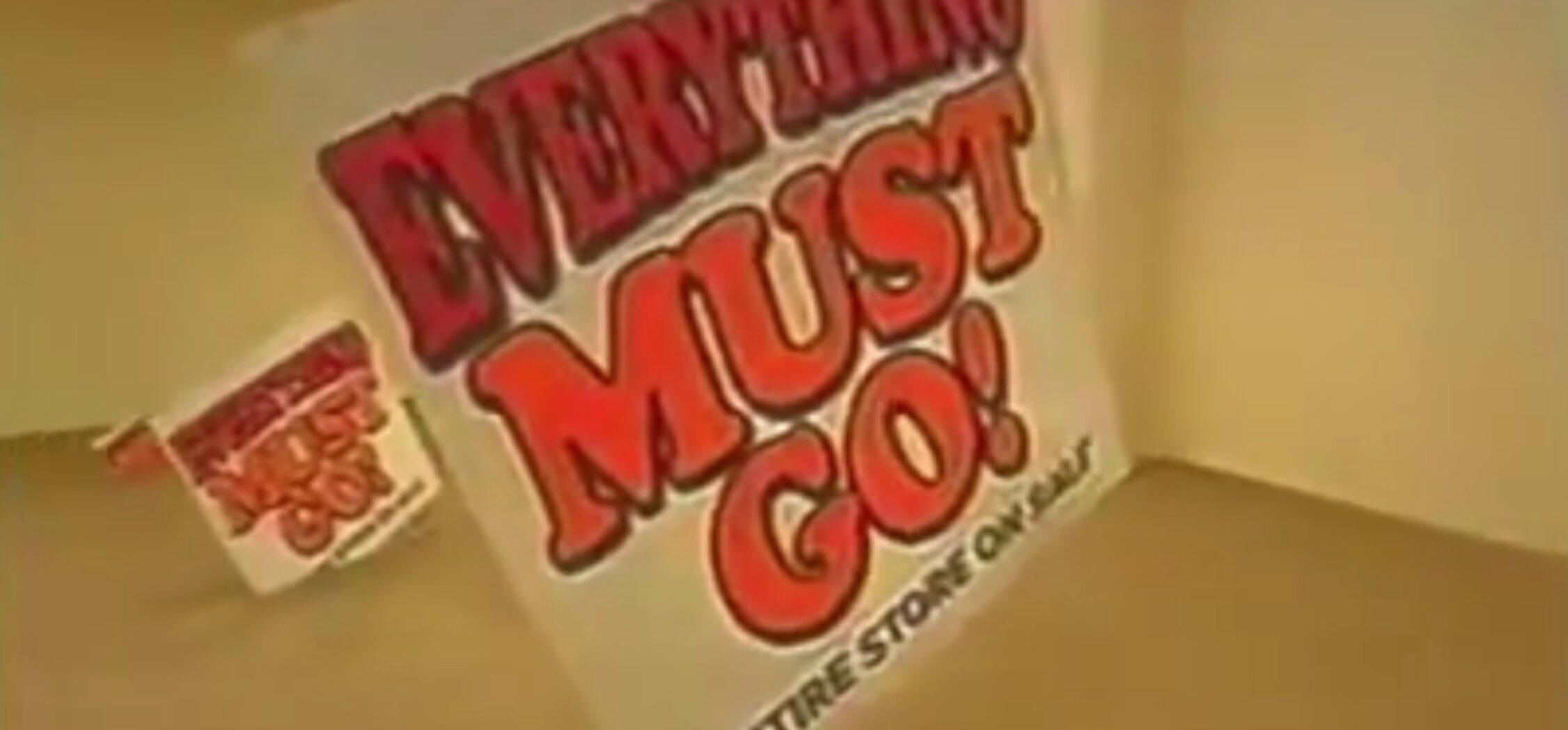
The camera swings. Something the team documented on the way in has changed. The Backrooms is rearranging itself behind them. And then they see the banners. You know the ones, the banners, “The Everything Must Go” signs from Clark’s furniture fire sale. There are three of them. They are all Identical. Screen-printed. Hung with steel cords. Each one reads, in the same bold font we’ve stared at on Clark’s dying furniture store for the entire second act of the film:
EVERYTHING MUST GO — ENTIRE STORE ON SALE
One is embedded in the floor. One is hanging in mid-air with no visible support beyond the steel cords. Someone off-camera says, quietly: “This is a new structure. This wasn’t here before.”
You have to pay attention here – because this is the thing that is entirely new … and has never happened before. So, please, if nothing else in this post lands, let this land. Async is looking at Clark’s furniture store signage… the exact banners we watched Clark dress up as a sea captain to promote… one full year before Clark starts entering the Backrooms. The film had Clark discover the null zone in his own store in June 1991. This footage is dated June 18, 1990. The Backrooms already had his signs. A year before he did.
The Slide Freezes
Kane cuts to more of the slide-projector photographs — this time of the banners themselves, held in frozen still-frame. Documenting them. Cataloguing them. Getting them into the file so Dr. McCarthy — a name we haven’t heard before, but who is apparently senior enough to be told about anomalies of this magnitude — can review them personally.
The voice-over log confirms: Dr. McCarthy is “eager” to see the signs. The team ends the day’s expedition.
June 19, 1990
The timestamp changes. New footage begins with the counter now reading 6/19/1990 — the same day, we now know, that the Recovered Tape footage was captured. We are inside the timeline we’ve been staring at for a year, on the day Naren dies.
We see Async’s computer terminals. The team is prepping to go back in. They have new instructions from up the chain.
The Return, and the Fourth Sign
The team returns to the space with the banners. And they have apparently spent the night analyzing the signs. Their theory: the three banners are hung in a descending order. And if the pattern continues — if these banners are duplicating themselves according to some rule — then a fourth banner should exist just beyond the wall. Behind the wood panelling.
Naren’s camera watches as one of the researchers pulls out a cutting tool and begins to cut into the wood. They breach the wall.
The Hand in the Beam
Behind the panelling they discover a hand. A human hand. Embedded in the structural wood beam. Sticking out. Impossible. The narrator on the log panics. Off-camera voices talk over each other. Someone higher up — through a radio, we assume — gives the order. Regardless of the hand. Regardless of what it means. ‘Go in anyway’. And so of course, they go in.
The Room Beyond
The hand turns out to belong to a mannequin. The mannequin is standing next to a ship’s steering wheel. Read that again. A ship’s steering wheel. In the Backrooms. One year before Clark, in his failing furniture store on the other side of the world, will put on a ship captain’s costume and turn his entire “Captain Clark’s Ottoman Empire” branding into a nautical desperation-play.
The room contains more: additional banners. Coat racks. Lawn furniture. A second steering wheel — half-submerged in the floor, as if it’s being swallowed. And a TV in the corner, flashing between a blue screen and bursts of degraded footage we can’t quite identify.
The Backrooms isn’t just producing Clark’s signage. It’s producing Clark’s entire aesthetic universe. The captain persona. The furniture. The nautical decor of a middle-aged man’s midlife crisis fever dream. All of it. A year before he thinks of any of it.
The Clanging
The team hears a sound in the distance. Something metallic. Rhythmic. Approaching. It gets louder.
Someone says: “We have to go.” They begin to withdraw. The camera turns back toward the way they came in.
And a figure appears. Directly in front of them. Abruptly.
The narrator yells: “WHAT THE FUCK—” And the camera hits the floor.
Cut to black.
Recovered Tape
You know what happens next. You saw it in the film’s cold open. Naren Warne, separated from his team after this exact moment, is hunted through the Complex and killed by the entity. His tape is later recovered, reviewed, and becomes the footage we open the entire feature with.
The Recovered Tape isn’t a random expedition gone wrong. It’s the second half of the Everything Must Go survey. The Async team wasn’t just exploring — they were investigating the impossible appearance of Clark’s future belongings, and the Backrooms killed them for looking.
Where Everything Must Go Lands on the Timeline
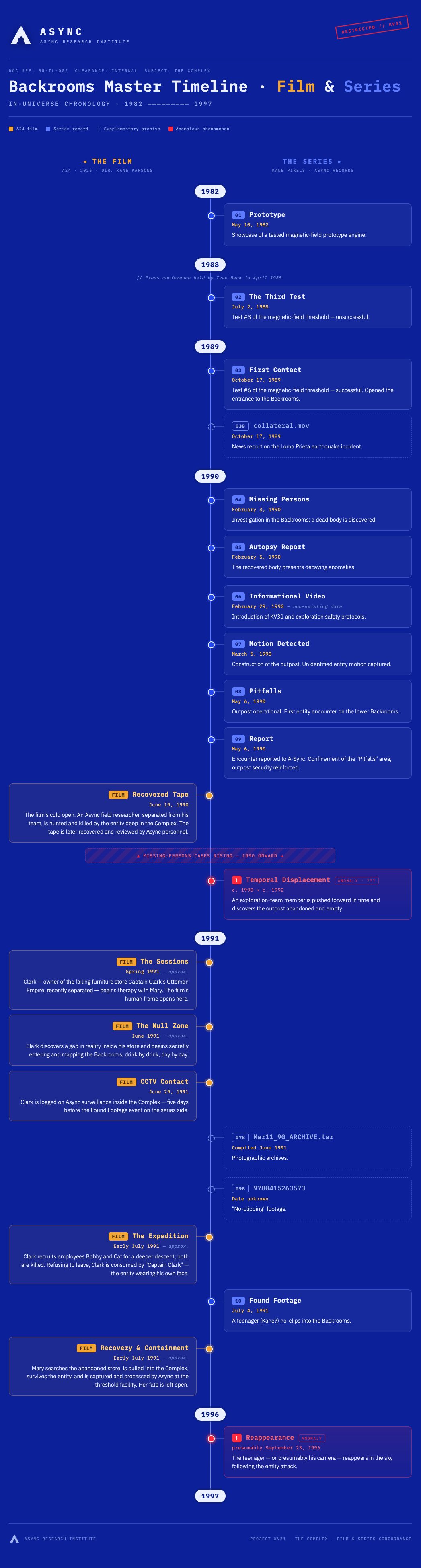
I’ve updated my full concordance timeline to include both new entries — the June 18 Preliminary Layout Survey and the June 19 Wall Breach — nested against the existing Recovered Tape event. It also carries a small “EMG Edition” marker on the new entries so you can see, at a glance, where the theatrical additions sit against the original series and film chronology.
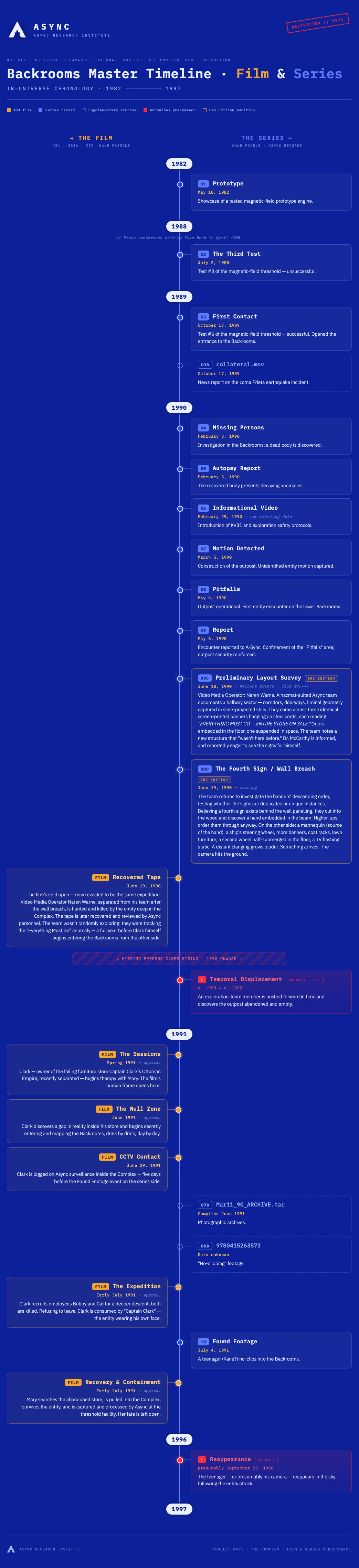
(This replaces the earlier timeline graphic I published with my walkthrough post — same design, now updated with everything from the Everything Must Go +15 minute segment.)
Sit with it for a minute. Because seeing it laid out visually is different than reading about it. The gold film events on the left now begin earlier than we thought. And the June 19 attack on Naren Warne is no longer the beginning of anything — it’s the conclusion of a 48-hour investigation into an anomaly that shouldn’t have existed yet.
The Big Reveal, Stated Plainly
Alright. Let’s just say it, without hedging. The Backrooms had Clark’s stuff a year before Clark did. That is the entire lore-shifting weight of these 15 minutes. Everything else follows from it.
The banners. The steering wheels. The lawn furniture. The captain motif. The Backrooms was already producing the material artifacts of Clark’s future breakdown while Clark was still, presumably, running his furniture store the boring way — before he ever hallucinated Captain Clark, before he ever thought of the “Everything Must Go” fire-sale, before he ever noclipped through the wall in the back of his shop.
This forces us to completely reconsider all five of the most popular – specifically the three impacted fan theories about what the Backrooms is. Let’s do it. Let’s take each one, lay out the case, then see what the new 15 minutes do to it.
The Three Competing Theories, Explained
Before we get into the impact analysis, let me walk through each of the three main reads of the Async universe that I laid out in my original theories post. Because we can’t judge whether new evidence confirms or destroys a theory unless we understand what each theory is actually claiming.
Theory 1: The Literal Lore Read
The claim. The Backrooms is a real, physically existing extradimensional space. Async, through their magnetic-field threshold experiments across the 1980s, cracked open a doorway to it in October 1989. Everything we see — the yellow rooms, the entity, the strange geometry, the time-displacement anomalies — is objectively happening in a real place with real physical rules. The rules are just deeply, deeply weird.
Why people love it. It respects the show’s world-building. It takes Kane’s series at face value. It explains the memos, the outposts, the containment protocols, the timeline entries — all of it as documentary evidence of a real event. And critically, it accommodates the temporal displacement anomaly we’ve already seen on the timeline (the researcher pushed forward from 1990 to 1992). Time doesn’t run straight inside the Complex. That’s a given.
The core commitment. The Backrooms exists whether or not humans are looking at it.
Theory 2: Async Is the Villain
The claim. The horror isn’t the Backrooms. The horror is Async. Under this reading, the “Backrooms” is either something the corporation itself manufactured — perhaps as a controlled experimental environment, a memetic weapon, or a containment site for something they created — or something they discovered and are now deliberately curating for reasons the series has never fully explained.
The strongest version of this theory says Async isn’t a research organization stumbling out of its depth. Async is a black-project weapons contractor. The disappearances aren’t accidents. The recovered tapes aren’t recovered — they’re produced. The entire aesthetic of institutional bumbling (“Motion Detected,” “Autopsy Report,” “Confinement of the pitfalls area”) is a bureaucratic mask over something much darker.
Why people love it. It fits the ’80s-corporate-conspiracy vibe of Kane’s aesthetic. It makes Async’s presence in the movie — the containment facility, Phil’s ambiguous role, the seamless capture of Mary — read as sinister rather than accidental. It also fits a very 2020s cultural anxiety about faceless institutions manufacturing horror for profit.
The core commitment. Human beings, and specifically Async, are the ultimate cause of the horror.
Theory 3: The Backrooms Is Shaped By Minds
The claim. This is the theory I landed on personally in my original longread, and it’s the one I think this new footage finally proves. The Backrooms is a real place — Async didn’t invent it or manufacture it — but the contents of the Backrooms, its rooms, its objects, its shapes, are materialized from human consciousness. Specifically from the consciousness of the people who enter it, engage with it, or become obsessed with it. The place is real and it’s made of us.
Under Theory 3, the yellow wallpaper isn’t an accident of the extradimensional physics. It’s the platonic-form yellow wallpaper of every liminal nightmare humanity has collectively dreamed about — the office park at 3am, the mall in the last hour before closing, the dentist’s waiting room in 1987. The Backrooms curates itself out of the human unconscious, and then that curation shapes what specific individuals encounter when they arrive.
Why people love it. It explains the eerie familiarity of the space. It explains why different Async researchers report subtly different geometries. It explains why the entity’s behavior shifts depending on who’s being hunted. And — crucially — it accommodates the possibility that the Backrooms can be anticipating people.
The core commitment. The Backrooms is real, but its content is a mirror.
What the 15 Minutes Do to Each Theory
Now the fun part.
Impact on Theory 1 (Literal Lore): Complicated but survivable.
Theory 1’s biggest challenge from the new footage is the specificity problem. It’s one thing to say the Backrooms is a real place with weird time. It’s another to explain why a real place with weird time contains exact reproductions of Clark’s future signage.
The strongest Theory 1 defense: time doesn’t run straight inside the Complex. We already knew this from the temporal displacement anomaly. If the Backrooms exists outside conventional causality, then Clark’s 1991 signage can absolutely exist there in June 1990 — because “before” and “after” don’t mean what they mean out here. The Backrooms is, in this reading, a place where all of its own history exists simultaneously, and Async happened to walk past the “1991 Clark signage” section a year before Clark walked past the “1990 Async attack” section. Same location. Different subjective timelines.
It’s coherent. It’s Lovecraft-adjacent. It works.
But it’s also getting cosmologically expensive. Theory 1 has to keep adding rules — time is nonlinear, geometry is unstable, consciousness may be relevant — until it starts to look like Theory 3 in a trench coat. Every accommodation the literal read makes to survive the new footage moves it closer to the mind-shaped read.
Verdict: Wounded, not killed. Fighting for its life.
Impact on Theory 2 (Async Is the Villain): Badly damaged.
This is the theory the new 15 minutes hurt most.
If Async manufactured or controls the Backrooms, then the June 18/19 expedition should show a team executing a plan. Instead, it shows a team encountering something that surprises and terrifies them. They didn’t know the Everything Must Go banners were going to be there. They had to spend a night analyzing them. They had to call in Dr. McCarthy from up the chain. Their higher-ups made dangerous decisions — the order to breach the wall despite finding a hand in the beam is not the behavior of an organization in control of the environment. It’s the behavior of an organization that thinks it’s in control and is about to be proven wrong.
Naren Warne dies. He wasn’t sacrificed to the Backrooms as part of some Async grand plan. He was killed while investigating an anomaly his employers didn’t anticipate and couldn’t explain.
Now — you can still salvage a softer version of Theory 2. Async is clearly negligent. Their higher-ups clearly value data over researcher safety. They send people into containment they know is failing. The corporate villainy is real. But the strong version — that Async created or fully controls the Backrooms — collapses under the weight of researcher terror in the new footage.
Verdict: Strong version dead. Weak version survives.
Impact on Theory 3 (Shaped By Minds): Massively strengthened.
Theory 3 is made for what we just watched.
Under this reading, everything the new 15 minutes shows us makes elegant sense. The Backrooms is real. Async did open the doorway in 1989. But once opened, the space began materializing content pulled from — and here’s the key — the human minds most obsessively engaged with it.
Clark is going to become the human being most obsessively, most desperately, most totally fixated on the Backrooms of anyone in the entire series. His entire second-act arc in the film is a man losing himself into the space, day by day, drink by drink. He’s going to project his entire failing life — the captain persona, the store, the “everything must go” fire-sale mentality of a man losing his wife and business and identity — into the geometry of the Complex.
Theory 3 says the Backrooms responded to that intense future fixation by materializing Clark’s stuff before he arrived. Because the Backrooms doesn’t experience time linearly, and doesn’t distinguish between the Clark who is currently entering it and the Clark who will enter it. From the Backrooms’ perspective, Clark is always about to arrive. His obsession is always about to happen. His captain hat and his sale banners and his ship’s wheel are always already there.
The line one of the Async researchers says — “This is a new structure. This wasn’t here before” — is the killer piece of evidence. The Backrooms is actively growing new structures in response to what’s coming. Async is watching, in real-time, the space building itself out of the raw material of a mind that hasn’t found it yet.
Verdict: Confirmed. Aggressively.
What This Changes for the Movie
Once you accept Theory 3 as the working read, the movie’s ending rearranges itself around you.
Mary’s fate at the end of the film — the doubled version of her already existing inside the Complex — stops being ambiguous. Under Theory 3, of course there’s already a Mary in the Backrooms. She was going to spend the film chasing Clark into the space. Her fixation on him was going to become her own obsession. The Backrooms was materializing her arrival while she was still sitting in her office listening to him complain about his marriage.
Phil’s line to Mary in the interview room — “That’s not up to me” — takes on new weight too. Because in a Theory 3 world, it isn’t up to Phil. It isn’t up to Async. Once you fixate on the Backrooms, you belong to it. The place has already made a version of you. The version of Mary sitting across from Phil is the biological one. The one already inside is the psychic one. And under the Backrooms’ non-linear physics, they’re equally real, equally her, and equally captured.
Clark, in this read, isn’t the tragedy of a broken man consumed by a place. He’s the tragedy of a broken man who was always going to be there. The Backrooms had his sea captain costume in June 1990 because Clark, on some level Async doesn’t understand, had already begun. His breakdown didn’t cause his obsession with the Backrooms. His future obsession with the Backrooms retroactively caused his breakdown. The place doesn’t just consume its victims. It authors them.
What Kane Did, and Why It Matters
Here’s the thing about the Everything Must Go cut that I think a lot of the “he’s pushing his luck” commentary is missing.
Kane didn’t add 15 minutes of new footage to sell more tickets. He could have released this exact 15-minute video to his YouTube channel for free — as he has done, faithfully, with every other piece of Async lore for years now. He chose to make it theatrical. He chose to attach it to the movie. He chose to force viewers to watch it in the same seat, on the same screen, immediately after Mary’s final ambiguous shot.
Because in that context — in the theater, in the dark, in the wake of the credits, the 15 minutes doesn’t play as bonus content. It plays as a reveal. The film’s ending is Mary being captured. And then Kane, after the credits, shows you that Async has been watching this same architecture spawn people’s obsessions for a decade. That Naren Warne, whose death opens the movie, was killed investigating Clark’s future belongings. That the whole structure of Async’s containment failure has been running on a logic none of the researchers understand and none of the victims can see.
You can’t get that punch by watching this on YouTube in your kitchen. Kane knows what he’s doing.
Still worth the extra ticket price? That, honestly, is your call. But knowing what the 15 minutes are — knowing that this is the single biggest continuity revelation in the entire Async universe, and that it reshapes both the movie and the YouTube series retroactively — probably tilts the math.
I paid twice. And have enjoyed it all so much, I plan to go a third time as well. Why not?
Related reading, in the order I’d recommend it:
- The Backrooms (2026) — Full Plot Walkthrough and Ending Explained
- The Backrooms Theories, All Five, Ranked and Debated
- The Complete Kane Pixels YouTube Series Companion (Episodes 1–10)
- Backrooms Series Companion Part 2 (Episodes 11–18)
- Backrooms Series Companion Part 3 (Episodes 19–22)
- The Original (Now-Superseded) Backrooms Film + Series Timeline
Tags: Backrooms, Backrooms Everything Must Go, Backrooms EMG, Kane Parsons, Kane Pixels, A24, Async, Naren Warne, analog horror, liminal spaces, 2026 horror, ending explained