Look, I’m going to be upfront with you: We Bury the Dead is not the zombie movie you’re expecting. If you walk into this thinking you’re getting 28 Days Later‘s frenetic energy or The Walking Dead‘s shambling hordes, you’re going to be confused. We Bury the Dead is something quieter, slower, and infinitely sadder—a film that uses the post-apocalyptic zombie framework to ask a much more devastating question: What do we do when the people we love are gone, but we never got to finish the conversation?
Directed by Zak Hilditch and starring Daisy Ridley in one of her best performances to date, We Bury the Dead is a film about unfinished business. About marriages that fracture under the weight of unspoken resentments. About grief that refuses to let go. And about how the living can be far more monstrous than any shambling corpse could ever be.
This is my review of a film that understands something fundamental: the real chaos isn’t the apocalypse. It’s the relational wreckage we carry with us when everything else falls apart. And we will also be explaining that ending, because I’m sure there are a lot of you that didn’t get it.

The Setup: An Electromagnetic Apocalypse
The United States accidentally detonates an experimental electromagnetic pulse weapon off the eastern coast of Tasmania. In an instant, 500,000 people drop dead—their brains simply stop. Hobart is destroyed. The island becomes a smoking, burning wasteland. And can we just take a moment to comment on the fact that it was the United States that “accidentally” killed a half a million people with our over emphasis on weapons and destruction? That has to be a political commentary of something… no?
But the half a million dead comes with a caveat… not all of those dead, stay dead. Wait, what? They start waking up. Not all of them… just a percentage. But enough to be totally freakazoid and weird. Enough to even drive hope to the survivors that their loved ones might not actually be dead. But these zombies are different – they’re docile, confused, wandering. The military insists they’re harmless and can be “humanely” disposed of.
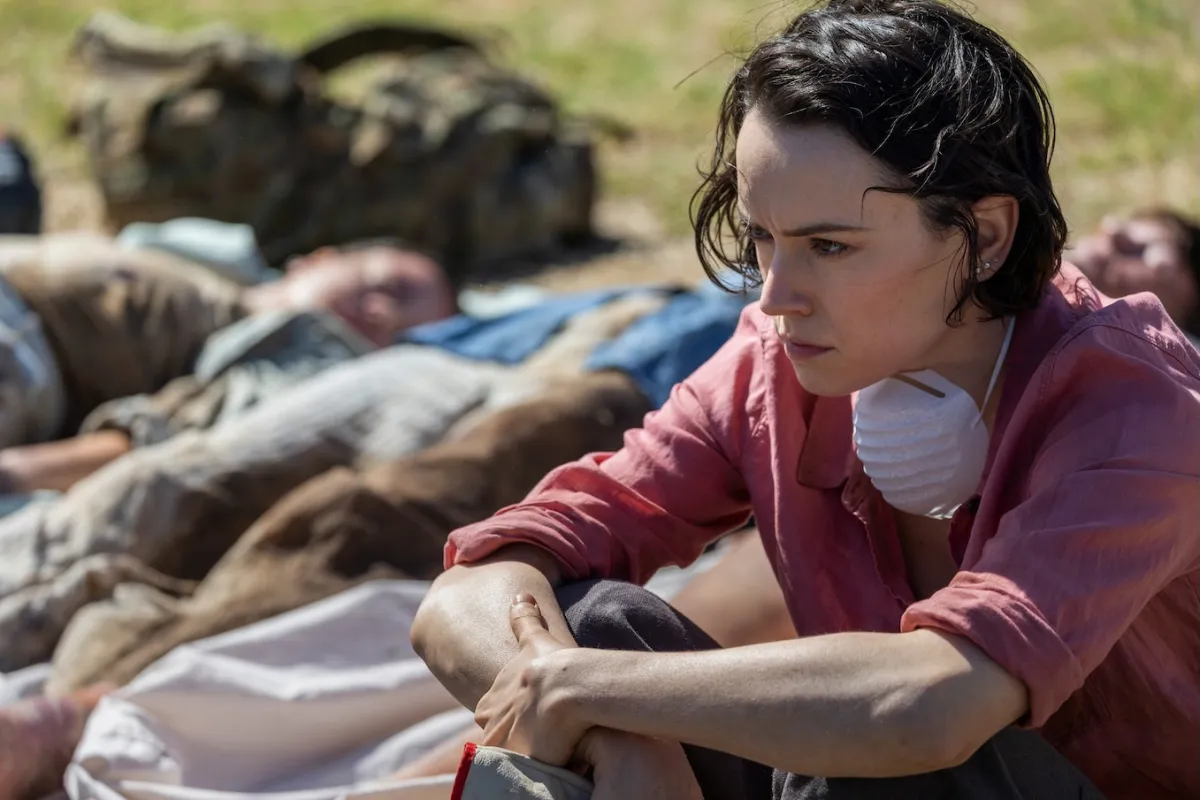
The Australian government, with international support, organizes body retrieval units—volunteers who will enter the quarantine zone to locate corpses, tag them, and help give families closure. It’s grim, procedural work. But thousands volunteer anyway, driven by altruism, or guilt, or something more personal. Ava Newman (Daisy Ridley – of The Force Awakens fame) is one of those volunteers. She’s an American physiotherapist with an ulterior motive: her husband Mitch was attending a business conference in Woodbridge, on the southern part of Tasmania, when the bomb went off. The authorities say no one could have survived. But Ava needs to know for sure. She needs closure. Or maybe she just needs to delay the moment when she has to accept the truth.
The Journey: Two People Running from Different Ghosts
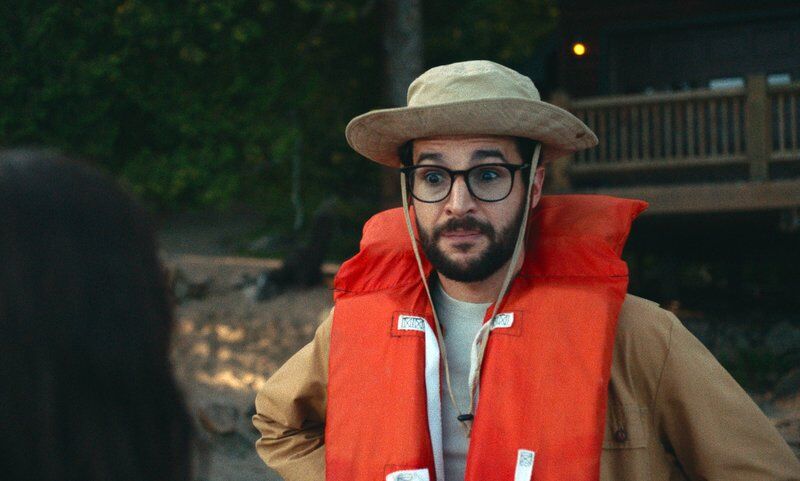
Ava is assigned to the northern part of the island, over 200 miles away from where Mitch was when the bomb went off. She’s teamed with Clay (Brenton Thwaites from The Signal fame), another volunteer with his own demons. When they find a motorcycle in an abandoned garage, they make a choice: abandon their unit and drive across Tasmania to find Mitch.
This is where the film settles into its true nature—not as a zombie survival thriller, but as a melancholic road trip through emotional devastation. The landscape is gorgeous and terrible: burned-out towns, abandoned petrol stations, empty highways cutting through countryside that should be peaceful but feels haunted. Through flashbacks scattered throughout the film, we learn the truth about Ava and Mitch’s marriage. They had been struggling with infertility. The failure to conceive created a rift between them. Ava had an affair. Mitch discovered it shortly before his business trip. Their last conversation was awful—filled with accusations and hurt and all the things you say when you don’t think it might be the last time you ever speak.
So Ava’s journey isn’t really about finding Mitch alive. Deep down, she knows he’s dead. This is about finding him so she can apologize, explain, make things right somehow. It’s about refusing to accept that some conversations just end badly and you never get to fix them. Clay understands this in his own way. He’s running from his family’s judgment, from their belief that he’s selfish. This mission is his chance to prove otherwise. He and Ava bond over their shared need to be better than who they were before the world ended.
Riley: The Real Monster of the Story
Here’s where We Bury the Dead reveals its true hand, and here’s where it earns the comparison to 28 Days Later. Remember how 28 Days Later wasn’t really about the infected? The zombies were just the backdrop. The real horror was the military compound in the third act—human men who saw the apocalypse as an opportunity to create their own kingdom, who brutalized women because there was no longer a functioning society to stop them. The infected were dangerous, sure. But they were mindless. The humans? The humans chose to be monsters.
We Bury the Dead does something similar with Riley. Ava and Clay are attacked by a zombie at an abandoned petrol station and they are saved by Riley (Mark Coles Smith), a lone Australian soldier. He seems like a lifeline—someone with training, resources, a vehicle. He offers to take Ava to Woodbridge.
But he doesn’t take her to Woodbridge. He takes her to his house.
Riley’s family—his wife Katie, his children—died in the blast. He was on the mainland at the time, unable to protect them. The guilt has hollowed him out. When Katie’s corpse reanimated, Riley kept her. She’s pregnant, preserved in his bed like a shrine. In his shed, he’s captured other zombies, chaining them up, studying them, taking notes on their behavior.
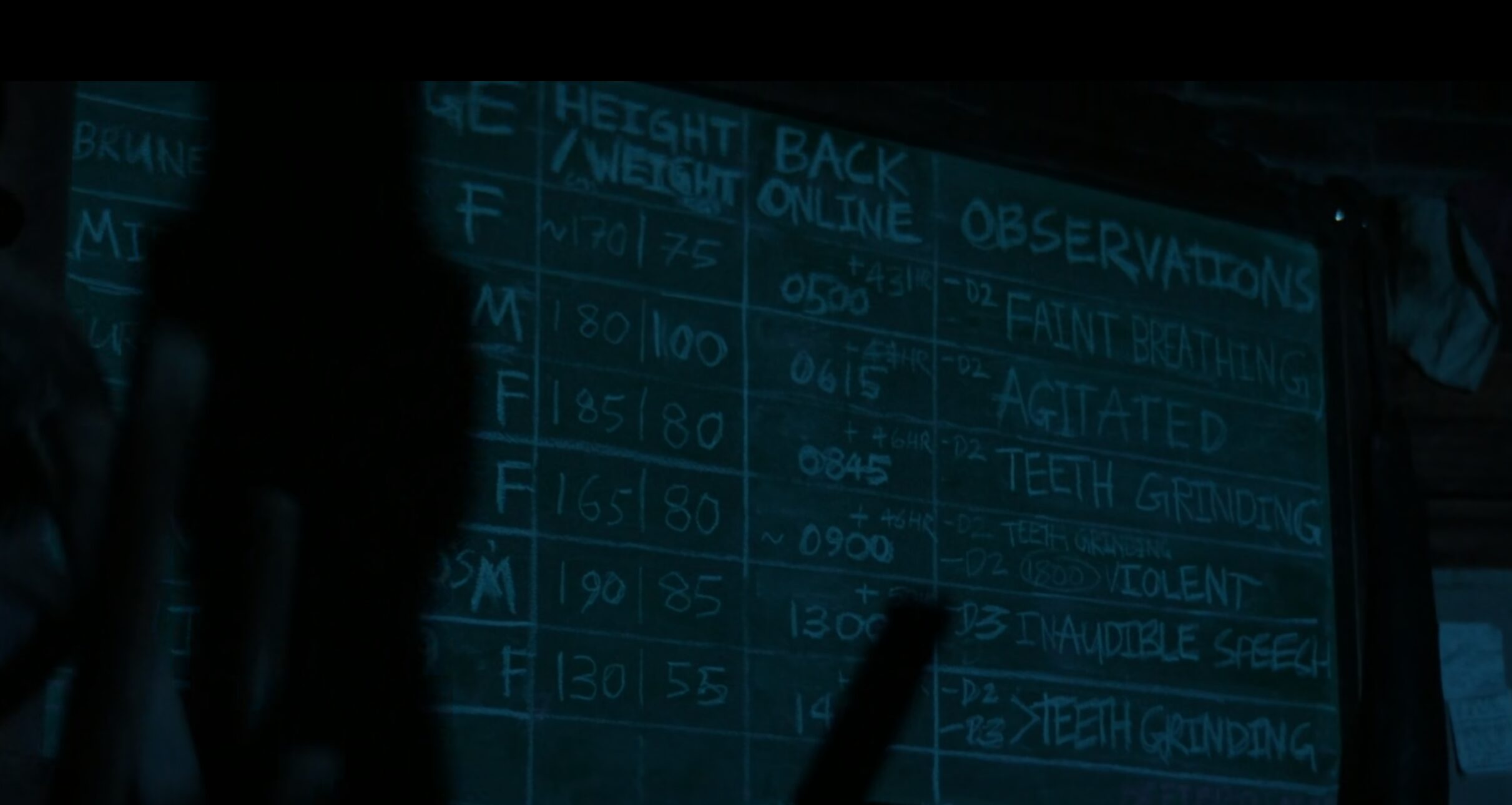
Riley has developed a theory: the dead who come back are the ones with unfinished business. They wake up because there’s something they need to complete. And if that’s true, then Katie came back for him. She came back because they weren’t finished. Because their story wasn’t over. Riley forces Ava to wear Katie’s clothes. He makes her put on Katie’s perfume. He insists she dance with him, pretending to be his wife, so he can have one more moment of normalcy, one more moment where his family isn’t dead and the world isn’t ended and everything is how it should be.
When Ava refuses to remove her wedding ring—when she won’t fully commit to the fantasy—Riley becomes violent.
This is the film’s most disturbing sequence, and Mark Coles Smith plays it with devastating precision. Riley isn’t a cackling villain. He’s a man drowning in grief who has convinced himself that if he can just hold on tight enough, he can pull his loved ones back from death through sheer force of will. He’s terrifying because his pain is genuine, his loss is real, and his logic almost makes sense until you realize it’s leading him to imprison and terrorize a woman who reminds him of what he lost.
Ava escapes, but not before discovering the full extent of Riley’s experiments. The chained zombies in his shed. The notes documenting their behavior. The twisted logic of a man who can’t let go. When she kills Riley and flees in his car, she sees Katie beginning to wake up more fully.
The Real Zombies: The Ones with Something Left to Do
Here’s what makes We Bury the Dead genuinely thoughtful instead of just bleak: the zombies aren’t the antagonists. They’re not even really a threat for most of the film.
After escaping Riley, Ava stops to rest in a camper van. Outside are the corpses of a family—father, mother, two children. That night, the father wakes up. And instead of attacking Ava, he picks up a shovel and starts digging.
He’s digging graves for his family.
The father zombie doesn’t speak. He barely seems aware. But he knows, on some deep level, what he needs to do. He needs to bury his loved ones properly. He needs to complete that final act of care.
Ava helps him. They dig together in silence. When the graves are ready and the family is laid to rest, the father steps into the grave, and looks at Ava and waits. She understands. She takes the shovel and kills him—a mercy, allowing him to be buried with his family.
This scene is the emotional heart of the film. It reframes everything we’ve seen. The zombies aren’t monsters. They’re people who came back because they had one last thing to do. They’re us, in our most reduced form—driven by love, duty, the need to complete the rituals that give meaning to loss.
Riley’s theory was right. But his application of it was monstrous. He thought Katie came back for him, to continue their relationship. The truth is simpler and sadder: she came back to finish giving birth. To bring their child into the world, even if she couldn’t stay to raise it.
The Truth About Mitch: Some Conversations Just End
Ava finally makes it to the resort where Mitch was staying. Clay finds her there, having caught up after escaping Riley. Mitch is dead. He didn’t reanimate. There’s no closure, no final conversation, no chance to apologize or explain or make things right.
And there’s more: in Mitch’s hotel room, Ava finds evidence that he wasn’t alone. Two wine glasses. A woman’s corporate ID. A “do not disturb” sign on the door. Mitch’s wedding ring, removed. He was having an affair too. While Ava was consumed with guilt about her betrayal, Mitch was doing the exact same thing.
It’s such a perfect, cruel detail. Ava traveled across a zombie-infested hellscape hoping for a chance to make amends, to explain that she still loved him despite everything. And the truth is that their marriage was already dead before the bomb went off. They were both looking elsewhere. They were both done.
Some relationships don’t get grand closure. Some conversations just end badly, and you live with that, or you don’t. Clay finds Ava sitting with Mitch’s corpse. She’s not crying. She’s not raging. She’s just… there. Processing. Finally understanding that the answer she needed wasn’t the one she was going to get. Together, they give Mitch a Viking funeral—burning his body at sea. It’s not the closure Ava wanted. But it’s the closure that exists. Sometimes that has to be enough.
The Ending Explained: New Life from Dead Ends
On the journey back, Ava and Clay encounter Katie again. Riley’s pregnant zombie wife, now fully reanimated, is walking through the wilderness. She had gone into labor and given birth. And somehow, impossibly, the baby is born alive. A living child from a dead mother. Katie walks away from the infant without a second glance. Her unfinished business is complete. She brought the child into the world. That was all she came back to do.
Ava picks up the baby. And in that moment, there’s something like hope. Not for Ava and Mitch’s relationship. Not for the marriage that failed. But for life continuing, for the possibility of new beginnings even when everything else has ended. The film ends quietly. With Ava holding a living child in a dead world. With grief acknowledged. With guilt named. With love no longer frozen in denial.
Why This Works: The Chaos Was Always Relational
Here’s why We Bury the Dead works as more than just another zombie movie: it understands that apocalypse is just an amplifier. It doesn’t create new problems—it reveals the ones that were always there. The electromagnetic pulse didn’t destroy Ava and Mitch’s marriage. Infertility and resentment did. Betrayal on both sides did. The apocalypse just made it permanent by killing Mitch before they could repair it (or decide not to).
The chaos of this world—the undead wandering, the bodies piling up, the infrastructure collapsing—is nothing compared to the relational chaos that Ava carries with her. The unfinished conversations. The things left unsaid. The apologies that never got delivered. That’s the real horror.
Riley’s grief is real. His pain is genuine. But his response—capturing zombies, imprisoning Ava, trying to force his dead wife to come back through sheer insistence—is the living embodiment of refusing closure. He’s more dangerous than any zombie because he’s conscious, he’s intelligent, and he’s convinced he’s doing the right thing.
That’s the lesson 28 Days Later taught us: the infected are predictable. They see you, they run at you, you shoot them or you run. Simple. The humans are the ones who will kidnap you, torture you, create new hierarchies of abuse in the ruins of civilization. The humans are the ones who make choices about who suffers and why.
In We Bury the Dead, Riley is the human monster. He’s the one who saw the apocalypse as permission to take what he wanted. The zombies just want to finish their business and rest. Riley wants to remake reality to fit his fantasy, and he’ll hurt anyone who gets in the way.
The Criticism: It Drags, and Maybe That’s Intentional
I’m not going to pretend We Bury the Dead is perfect. It’s slow. Really slow. Long stretches pass where nothing happens except Ava and Clay riding the motorcycle through beautiful countryside. The 94-minute runtime feels longer than it is.
Some viewers will find this insufferable. They’ll complain that it’s boring, that the zombies barely appear, that the whole thing feels like a bait-and-switch where they were promised a zombie movie and got a relationship drama instead.
And you know what? Those criticisms are valid. If you want action, scares, tension—all the things zombie movies typically deliver—you’ll be disappointed.
But I think the slow pace is intentional. Grief doesn’t move at an action-movie tempo. The process of accepting loss, of working through unfinished business, of finally letting go—it’s slow and tedious and often boring. It’s long drives through empty landscapes. It’s sitting with uncomfortable truths. It’s waiting for answers that never come.
We Bury the Dead makes you feel that. It makes you sit with Ava in her discomfort, her uncertainty, her desperate need for closure that might not exist. That’s not entertaining in the traditional sense. But it’s honest.
Final Thoughts: A Zombie Movie for People Who Don’t Care About Zombies
We Bury the Dead is a film that uses genre trappings to tell a story about something completely different. The zombies are set dressing. The apocalypse is context. The real story is about a woman trying to make peace with a relationship that died before her husband did.
It’s about realizing that some of the chaos in our lives—the fights, the betrayals, the things left unsaid—can’t be fixed just because we want them to be. Some conversations end badly and that’s all you get. Some people die with things unresolved, and you have to find a way to live with that ambiguity.
And it’s about understanding that the real monsters are never the mindless undead. The real monsters are the living people who refuse to let go, who trap others in their grief, who see other humans as tools to reconstruct the past they lost.
Riley is the monster because he’s us at our worst—unable to accept that what we love is gone, willing to hurt others to maintain the illusion that we can bring it back.
The zombies? The zombies just want to bury their families and rest. They want to finish what they started and be done. They’re more human than Riley ever manages to be.
If you approach We Bury the Dead as a traditional zombie film, you’ll be frustrated. But if you approach it as a meditation on grief, on unfinished relational chaos, on the impossible task of finding closure in a world that doesn’t guarantee it—then it’s something special. Flawed, yes. Slow, absolutely. But thoughtful in ways that most films in this genre never attempt.
Daisy Ridley is phenomenal. The cinematography is gorgeous. The teeth-grinding sound design is genuinely unsettling. And that scene of the father zombie digging graves for his family will stick with you long after the credits roll.
This is a zombie movie for people who don’t really care about zombies. It’s a relationship drama that happens to have undead people wandering through the background. And if you’re in the right headspace for it—if you’re willing to sit with its slowness and its sadness and its refusal to give easy answers—it’ll hit you right in the heart.
The real chaos was never the apocalypse. It was always us, stumbling through our broken relationships, hoping for one more chance to get it right.
Sometimes we get that chance. Sometimes we don’t. We Bury the Dead understands that sometimes the hardest thing to bury isn’t the dead.
It’s the hope that things could have ended differently.