This is film two of the IMDB Top 250 Challenge, where I let a cryptographically secure random number generator dictate my watch order through all 250 films on the IMDB Top 250 Films list and write up each one as they come. If you missed film one, we opened with Andrei Rublev, so believe me when I say the tonal whiplash of going from a three hour Soviet meditation on faith to Stanley Kubrick’s Vietnam is not lost on me. If you’re joining midstream, you can find ALL 2 of my movies so far in this particular location. But hey, if you are joining late… who knows what you’ll find there.
Alright, drum roll please… the randomizer’s second pick is Full Metal Jacket (1987), currently sitting at IMDB rank #71 out of 250. Unlike Rublev, this one is not a blind spot for me. I’ve seen this film more times than I can count, and I still wasn’t fully ready to sit with it again.

Where to watch: Full Metal Jacket is currently streaming on both Netflix and HBO Max, and as of a few months ago it also landed on Tubi if you want it free with ads. It’s also available to rent or buy on Amazon, Apple TV, and Fandango at Home. This is about as easy as it gets to track down on this list.
Full Metal Jacket – The film itself
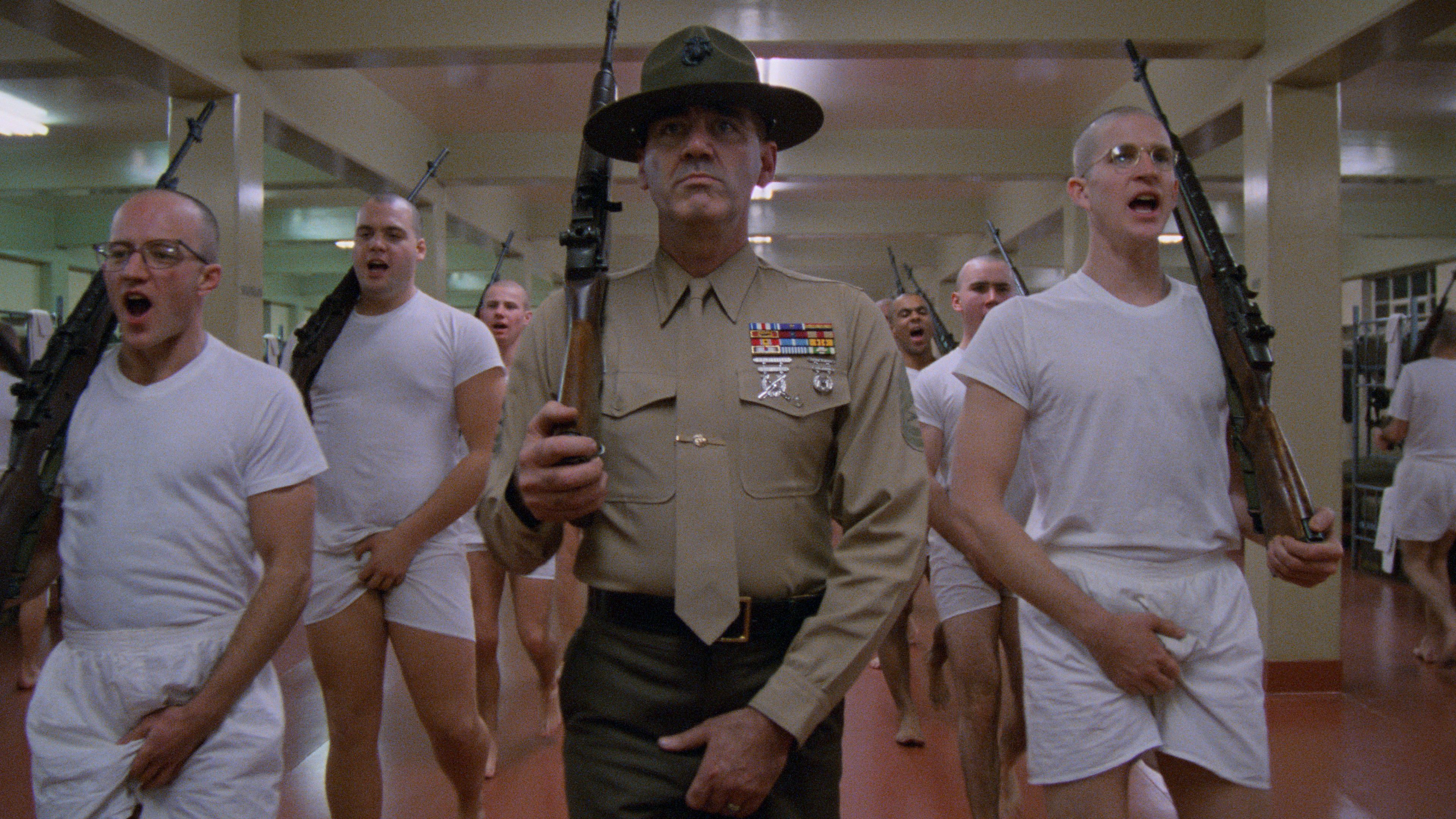
Full Metal Jacket is Stanley Kubrick’s 1987 war film, adapted from Gustav Hasford’s 1979 novel The Short-Timers, with a screenplay credited to Kubrick, Hasford, and Michael Herr (the same Michael Herr who wrote Dispatches, the war reporting book that shaped how a generation thought and wrote about Vietnam). The film splits cleanly into two halves that barely acknowledge each other exist. The first is set at Parris Island, following a platoon of Marine recruits through basic training under the direct, unrelenting abuse of Gunnery Sergeant Hartman. The second follows one of those recruits, nicknamed Joker and played by Matthew Modine, into the Tet Offensive and the battle for Hue City in 1968, now working as a military journalist for Stars and Stripes.
The casting of Hartman is one of those production stories that’s become legend in its own right. R. Lee Ermey was originally brought on as a technical advisor, a real former Marine drill instructor who had actually served in Vietnam. Kubrick liked what he saw enough to cast him in the role outright, and Ermey ended up improvising a huge amount of his own dialogue, drawing directly on his own training experience. It’s one of the rare cases where “technical advisor becomes the performance everyone remembers” actually happened.
The other performance the film hinges on is Vincent D’Onofrio as Private Leonard “Gomer Pyle” Lawrence, the recruit who becomes the specific target of Hartman’s abuse and the platoon’s collective punishment for his failures. Kubrick reportedly called the role the hardest to cast in the entire film. D’Onofrio gained something like 70 pounds for the part, an early and extreme example of the kind of physical transformation that’s become its own subgenre of awards-bait acting since. Except this one received zero major award nominations, a fact that still baffles me. Like, how? He should have at least been nominated a half dozen awards… even if he wasn’t selected. But no, nothing. This is just shocking to me.
Production itself is its own strange footnote. Kubrick, notoriously unwilling to fly, shot the entire film in England rather than traveling to Southeast Asia or even the US. Parris Island was recreated using British Army barracks at Bassingbourn, and Hue City was built out of the derelict Beckton Gas Works in East London, with palm trees imported from Spain and buildings dynamited to match photographs of the real aftermath of the Tet Offensive. The film was released in the summer of 1987, going up against Oliver Stone’s Platoon, released the year prior, in the ongoing conversation about how American film was finally starting to reckon with Vietnam a decade after the war ended. Kubrick received the film’s only Oscar nomination, shared with Herr and Hasford, for Best Adapted Screenplay.
My Reaction to The Full Metal Jacket
My own feelings on this film are complicated, though maybe not in the way that phrase usually implies. Full Metal Jacket says an enormous amount in a very short amount of time, and the opening stretch at Parris Island, the tragedy of Gomer Pyle and the sheer force of Gunnery Sergeant Hartman, never fails to pole axe me. I’ve watched this movie enough times that I should theoretically be immune to it by now. I am not.
I watched it again a couple months ago with someone who’d never seen it before, and honestly I spent half the runtime watching their face instead of the screen. Watching someone experience that opening cold, watching the chaos unspool in real time and then watching it continue unspooling once the film moves into Vietnam, is its own kind of experience. It’s just one tragedy stacked on top of the next, and there’s something almost cruel about how efficiently the film delivers that.
I should say, this fascination isn’t new for me. As a kid in high school I used to head into town, hit the local Blockbuster and the library, and come home with stacks, literal stacks, of Vietnam material. Movies, sure, but also autobiographical accounts of the war, books on the illegal incursions into Laos and Cambodia, anything I could find on the Vietnamese perspective of the conflict. I found the whole period mesmerizing in a way I never fully outgrew, and I think that’s part of why this film hits the way it does for me specifically.
Here’s my real hangup with it though. The tragedy that opens the film, everything with Private Leonard Lawrence, is so devastating that it makes the entire rest of the movie top heavy. How do you compete with that? The Vietnam half still surprises, still lands blows, but if you walk away from this film for a day or two and think about what’s actually still sitting with you, it’s Vincent D’Onofrio’s face. That performance is so unbelievably iconic it belongs in the same conversation as Heath Ledger’s Joker in The Dark Knight, and the fact that D’Onofrio walked away with zero nominations from any major award body is genuinely baffling to me.
Politically, I think Kubrick did something important here, shining a hard light on a part of American history that deserves exactly that kind of scrutiny. If you walk away from this film thinking we were doing God’s work in Vietnam and across Southeast Asia, I’d push back on that pretty hard. We were, plainly, invading and devastating a part of the world we had no legitimate claim to being in. Full Metal Jacket makes it about as clear as a film can that this was never a holy war, and I think that clarity is a big part of why it’s held up as long as it has.
Should you watch The Full Metal Jacket?
Yes, obviously, and if you somehow haven’t seen it yet, do not read anything else about it first. Go in cold for the Parris Island section specifically. If you’ve already seen it, it rewards a rewatch in a way a lot of war films don’t, mostly because Ermey and D’Onofrio are doing work you notice more the second and third time through, once you’re not just white-knuckling your way through what happens to Pyle. The one caveat is structural rather than a criticism of quality: know going in that the film’s emotional peak arrives early, and the back half is working with a different kind of tension. That’s not a flaw so much as just how the thing is built.
IMDB Challenge status
That’s two down, two hundred forty eight to go. From a Soviet icon painter to a Marine boot camp in under a week, this randomizer has no interest in easing anyone into anything. Come back in a couple days to see what it pulls next.